
Complaint Management Software Features: A Buyer's Evaluation Checklist
Use a buyer's checklist to test complaint management software features across intake, investigation, decisions, response, and improvement.

Key Takeaways
- 1Evaluate a complete complaint journey, not a list of feature labels.
- 2Require evidence for ownership, investigation, approval, deadline, and integration controls.
- 3Test incorrect AI suggestions and exceptions while preserving human accountability.
- 4Map regional requirements only when they apply to your organization and activity.
- 5Confirm migration, configuration, support, and exit costs before accepting commercial scope.
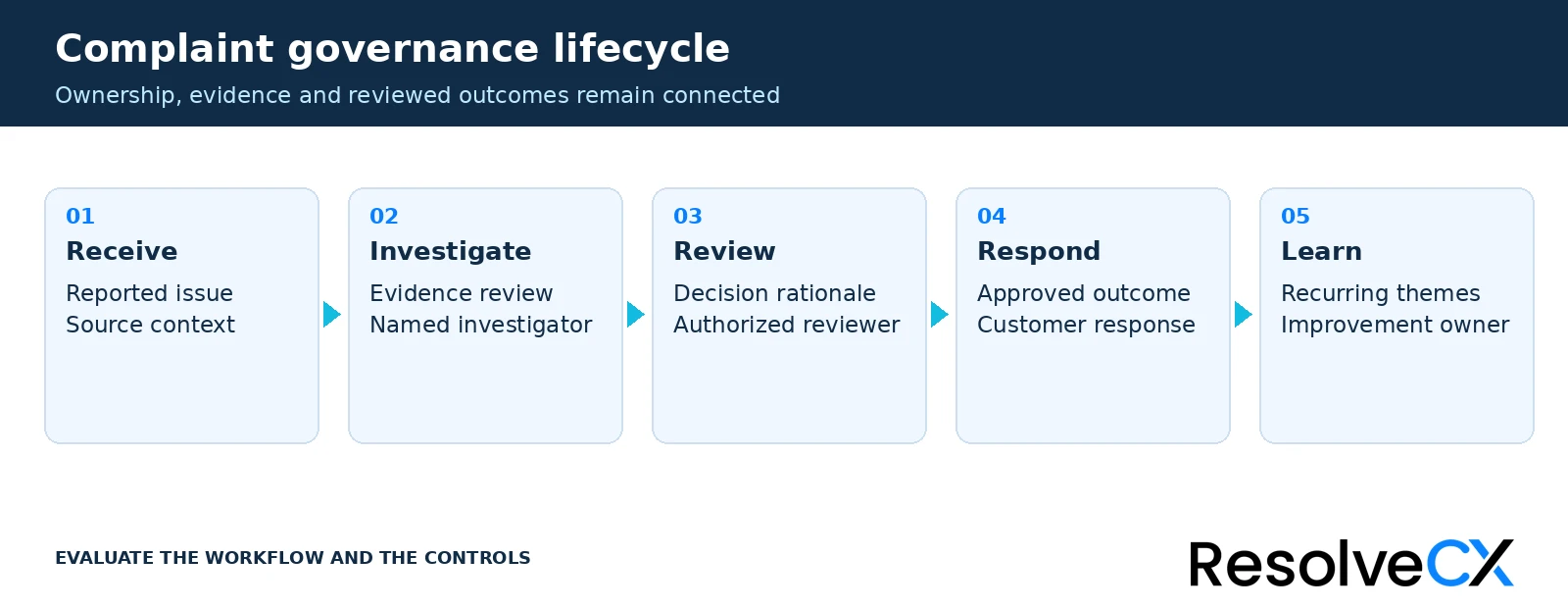
The most useful complaint management software features keep ownership, evidence, deadlines and decisions connected throughout a complaint. Buyers should evaluate those capabilities against their actual operating process, then require vendors to demonstrate how the controls work when something goes wrong.
A polished dashboard cannot prove that a sensitive complaint will reach an authorized reviewer or that an investigator can reconstruct a disputed decision. Your checklist should identify required controls, acceptable evidence and purchasing blockers before the first demo.
For a practical product context, explore ResolveCX's approach to AI complaint governance.
What Are Complaint Management Software Features?
These capabilities help teams capture dissatisfaction, investigate the issue, coordinate responsibility, communicate an outcome and learn from recurring problems. Depending on the platform, these capabilities may involve structured records, workflow configuration, reporting and AI assistance.
A feature is only one part of the operating model. A deadline timer needs an applicable policy; an approval step needs an authorized person; a report needs consistent definitions. Software supports these arrangements, while the organization remains responsible for its process and decisions.
Do You Need Dedicated Software or an Existing Helpdesk?
Start with investigation complexity, customer impact and required controls. Low complaint volume does not necessarily mean low risk. Conversely, straightforward complaints may be handled adequately through a properly configured existing system.
| Option | Potential fit | Verify before choosing |
|---|---|---|
| Existing helpdesk | Routine complaints within service operations | Evidence history, approval rules and sensitive access |
| CRM service workflow | Complaints requiring customer and account context | Investigation depth and cross-team ownership |
| Dedicated complaint platform | Formal investigations and governed outcomes | Workflow fit, control evidence and delivery scope |
These categories overlap. Evaluate the actual configuration rather than assuming every helpdesk lacks governance or every specialist platform provides it. Adding a separate platform should solve a demonstrated operational problem without creating another disconnected record.
Which Features Should Buyers Evaluate?
Evaluate complaint management software features against a complete journey: intake, investigation, decision, response and improvement. Prioritize requirements that protect the record and customer outcome before convenience features.
Structured Intake and Complaint Records
The record should preserve the reported issue, receipt date, customer context, source and relevant product or service. Test required fields and duplicate handling. Ask the vendor to demonstrate your actual channels: a label such as omnichannel does not establish which sources are supported or how records are linked.
Classification and Priority Controls
Check whether categories reflect your products and complaint types. Priority should consider impact, urgency and applicable policy. Customer sentiment can inform review, but calm wording may still describe serious harm. Test ambiguous and multi-issue complaints, and confirm who can correct categories without silently changing historical reporting.
Named Ownership and Accountable Handoffs
Every complaint needs an accountable owner even when several teams contribute. Ask the vendor to transfer work while the investigator is absent. The receiving team should see the next action, unresolved questions and relevant history. Confirm whether reassignment preserves accountability and whether an unaccepted handoff becomes visible.
Deadline Tracking and Escalation
Verify the trigger date, applicable calendar, service commitment and escalation destination. Ask what happens when a complaint changes category or receives additional evidence. Internal service targets and regulatory response requirements are different. Pause rules must follow approved policy; users should not reset a deadline simply by changing status.
Investigation and Evidence Chronology
Investigators need to distinguish the customer's allegation, supporting material, proposed finding and confirmed decision. Test attachments, communication history and source references. A readable chronology should establish what was known at each stage. Request evidence of how corrections and missing documents are handled, rather than assuming an attachment folder creates an adequate record.
Decision Review and Approval
Check who can propose a remedy, approve material findings and authorize closure. Approval should retain the rationale and any conditions. Test a rejected proposal and an attempt by an unauthorized user to approve it. Separate duties where the risk justifies independent review, without forcing every routine complaint through unnecessary gates.
Customer Communication and Reopening
Check how acknowledgments, progress updates and final responses remain connected to the complaint. Templates should support consistency while allowing accurate individual explanations. Reopen a resolved complaint using new evidence and inspect the history. Closing a record should not erase previous findings or imply that the customer accepted the outcome.
Audit History and Data Controls
Request current documentation covering access, retention, hosting, security and export. Test restricted records using different roles. Inspect who changed a decision, when and why. Do not equate a visible activity feed with tamper resistance. Establish how records are retained, corrected or deleted under your organization's obligations.
Reporting and Root-Cause Follow-Up
Reports should help teams identify aging complaints, overdue actions, outcomes and recurring themes. Agree denominators and definitions before comparing performance. A repeated symptom is not a verified cause. Improvement work needs an owner, supporting investigation and a later effectiveness check. Closure counts alone cannot show whether recurrence has decreased.
Integrations and Workflow Configuration
Ask which data moves between systems, in which direction and how frequently. Identify the authoritative record and responsibility for failed synchronization. Separate standard capabilities from configuration, paid services and roadmap proposals. Test who can change routing, categories or approval rules and whether those changes remain reviewable.
To connect these requirements with a product discussion, review ResolveCX's complaint management workflow.
A Practical Evidence Checklist
| Requirement | Ask the vendor to demonstrate | Failure signal |
|---|---|---|
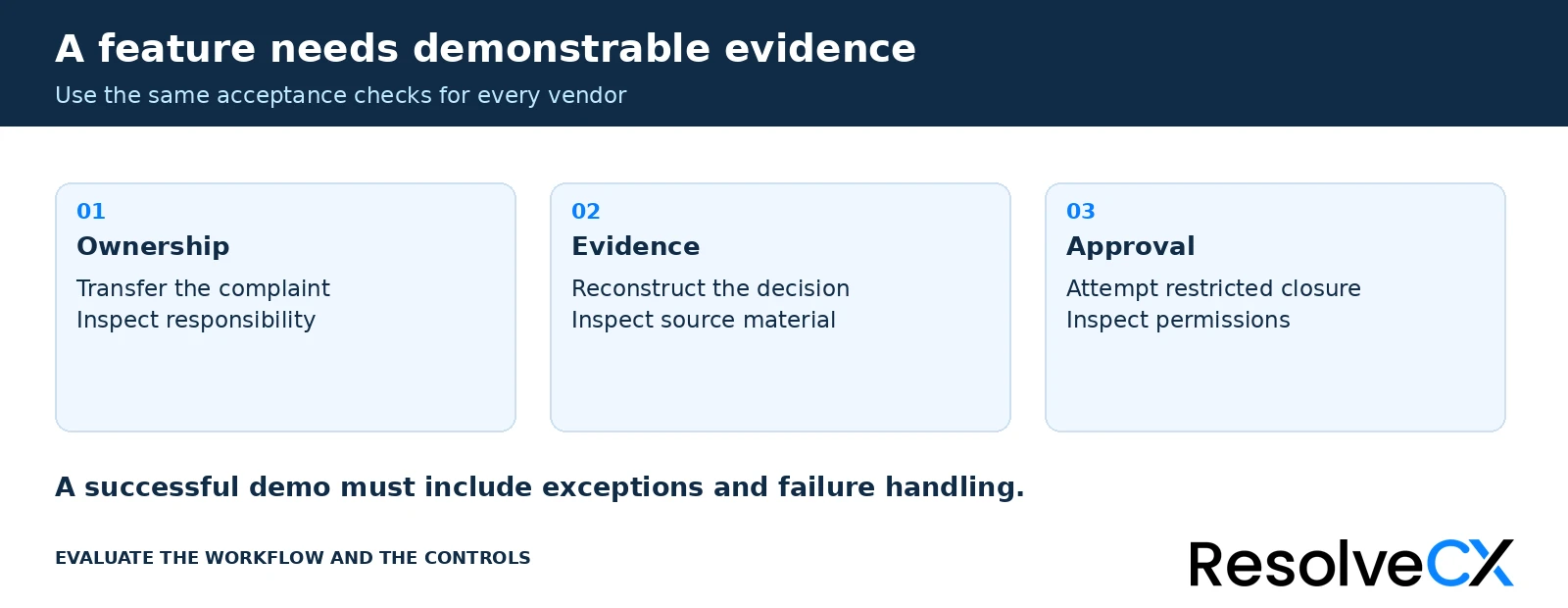
| Ownership | Transfer responsibility and inspect history | Nobody owns the next action |
| Evidence | Reconstruct a disputed decision | Findings lack supporting material |
| Approval | Reject an unauthorized closure | Restricted action succeeds |
| Deadlines | Apply the correct policy and calendar | Status changes erase the due date |
| Integration | Show a failed update and recovery | Missing data goes unnoticed |
Record the evidence, responsible reviewer and unresolved limitation for each requirement. A verbal assurance is not equivalent to a successful demonstration.
What Controls Should AI-Assisted Features Have?
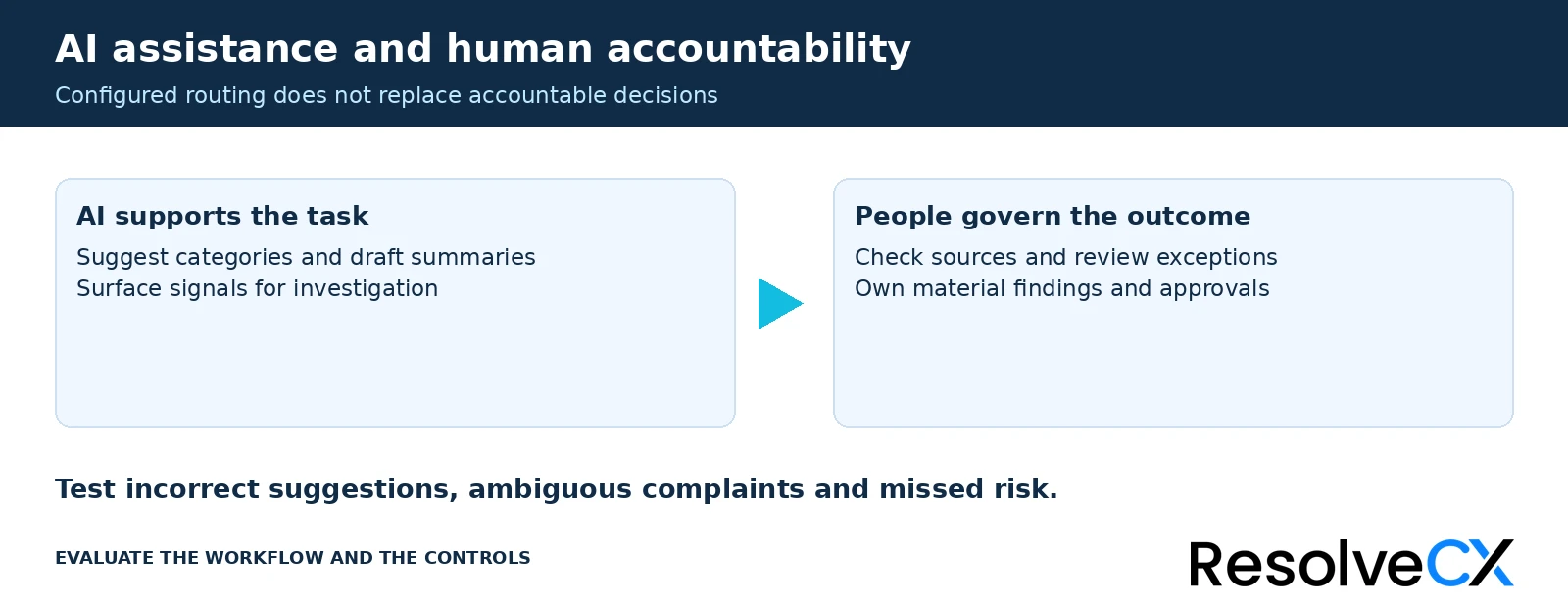
AI-related complaint management software features should assist defined tasks while preserving accountable decisions. Classification, summaries and sentiment signals need different tests because their errors affect different parts of the workflow.
Ask vendors to show:
-
The source material behind a suggestion.
-
How staff correct an incorrect classification.
-
How uncertain or exceptional cases reach review.
-
Which actions follow rules and which require approval.
-
How AI processing, data use and limitations are documented.
Test examples containing mixed issues, incomplete context and indirect descriptions of harm. Check results across relevant languages and complaint categories. Accuracy measured on easy examples may conceal errors in high-risk cases.
NIST's voluntary AI Risk Management Framework identifies human-AI roles and oversight as governance concerns. Its guidance supports evaluation; it is not a certification that a complaint platform is compliant. 1
For the relevant product context, explore ResolveCX AI classification with team oversight.
How Should You Test Vendors During a Demo?
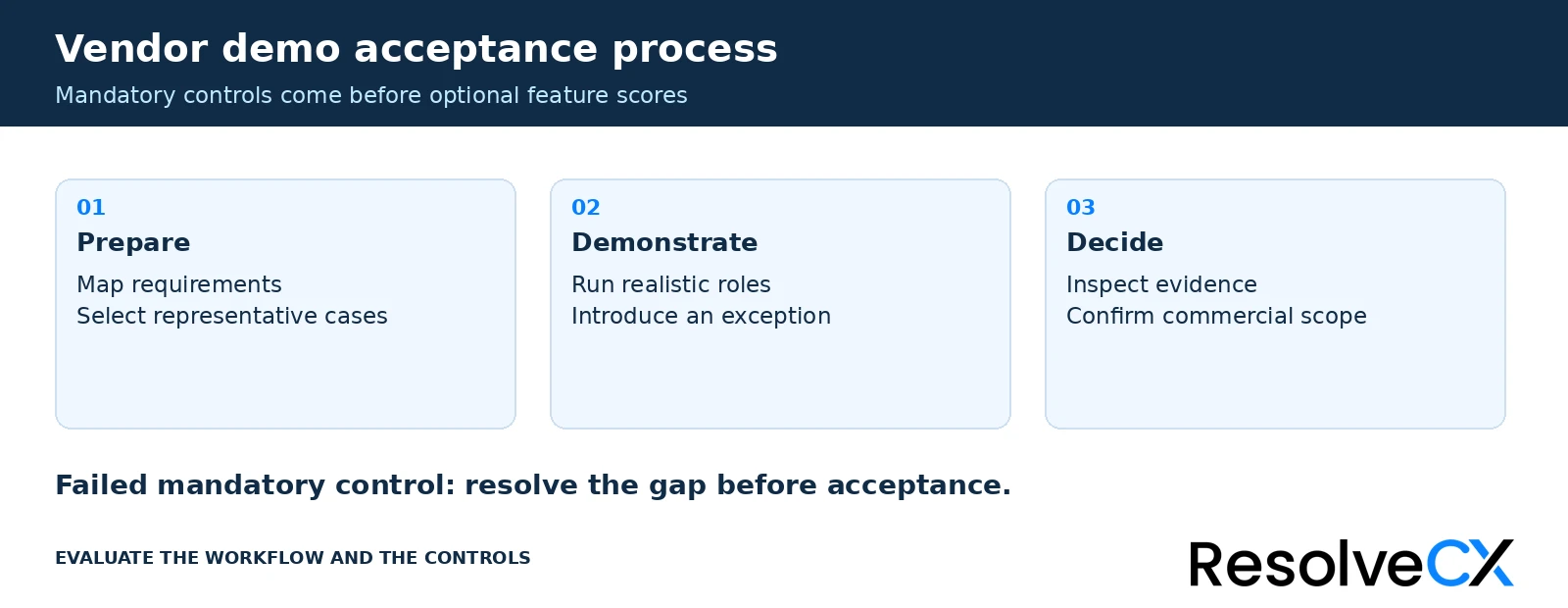
Use the same anonymized scenarios to compare complaint management software features. Include realistic exceptions rather than accepting a prepared happy path.
-
Map a representative complaint, its owner, required evidence and approval points.
-
Agree mandatory controls with operations, compliance, security and privacy stakeholders.
-
Run the complaint from intake to customer response using different roles.
-
Introduce an absent owner, incorrect category, missing document or failed integration.
-
Inspect the resulting record, permissions and exception handling.
-
Confirm commercial scope and capture outstanding gaps in writing.
Recommended scoring is simple: unverified, demonstrated with limitations, or demonstrated against the requirement. Add optional-feature scores only after mandatory controls pass. A strong dashboard score should not compensate for an unacceptable access failure.
Treat a roadmap promise as a delivery dependency. Record its committed scope, acceptance test and contractual treatment before relying on it.
Who Should Approve the Evaluation?
Complaint handlers should assess investigation usability; operations should examine workload and handoffs; compliance should review policy mapping; security should evaluate technical evidence. Procurement should reconcile the demonstrated configuration with the contract. Assign one coordinator to consolidate findings so unresolved issues do not disappear between separate reviews.
Record each requirement's business reason and acceptance evidence. For example, a sensitive complaint may require restricted investigator access and an independent reviewer. Test both permissions using realistic roles, then retain the resulting evidence. If a workaround is proposed, identify its owner, ongoing effort and failure consequences before accepting it.
What Happens When a Mandatory Control Fails?
A failed mandatory control should pause selection until the limitation is resolved or the requirement is formally reconsidered by the responsible stakeholders. Do not quietly lower its priority because another feature looks attractive. Record the decision and any conditions attached to acceptance.
Distinguish a product gap from an operating-process gap. Software cannot supply approval authority when the organization has never defined it. Conversely, a documented policy cannot compensate for a configuration that permits unauthorized approval. Test the combined arrangement, and require a repeat demonstration after remediation.
How Do USA, UK and UAE Requirements Affect Evaluation?
Regional requirements should shape workflow evaluation only when they apply to the organization, product and complaint. Avoid using one country's financial-services process as a universal rule.
For CFPB-routed US financial complaints, the company process specifies a response within 15 calendar days and allows up to 60 calendar days for a final response when the initial response is not final. Evaluate the relevant workflow against that process. 2
In UK financial services, the FCA's complaint review emphasizes management information, root-cause analysis, governance and measuring the effect of improvement actions. Its thematic review covered 40 firms, with guidance updated in July 2026. 3
For applicable UAE licensed financial institutions, CBUAE Consumer Protection Standards address complaint management and resolution. Confirm current requirements and organizational applicability with compliance stakeholders before configuring controls. 4
Industry context also changes the test. A telecom complaint may require incident context; a retail dispute needs order evidence; a healthcare service complaint may contain sensitive information. Financial-service investigations may require a documented decision review. Demonstrate these distinctions using representative records.
What Costs and Implementation Requirements Should Buyers Check?
The cost of complaint management software features includes more than licensing. Request a written scope covering users, workflows, migration, integrations, training, support and administration. Where AI usage is chargeable, establish the billing unit and expected demand.
Check whether configuration changes require specialist services. Ask about historical attachments, inactive records, storage limits and data export. An exit plan should establish what you receive, in which format and whether associated evidence remains usable.
Before launch, verify:
-
Approved categories, policy rules and responsible roles.
-
Access permissions and sensitive-record restrictions.
-
Migrated records, attachments and chronology.
-
Integration failure handling and recovery ownership.
-
User acceptance, training and support arrangements.
Measure progress against a baseline: overdue actions, investigation aging, reopened complaints and verified improvement outcomes. Include quality checks so shorter handling time does not reward incomplete investigations.
Run a limited pilot with agreed acceptance criteria before expanding access. Review sampled complaints with frontline users and authorized reviewers. Capture missing evidence, confusing responsibilities and excessive workarounds. Resolve material defects, repeat affected tests and obtain operational acceptance before treating the workflow as ready.
How ResolveCX Supports Governed Complaint Operations
ResolveCX presents complaint management as a connected workflow for capturing dissatisfaction, investigating evidence and recording reviewed outcomes. Its product page emphasizes visible ownership, service commitments, chronology and accountable follow-up. 5
The AI classification page describes categorizing inbound work and applying configured handling rules while teams retain oversight and responsibility for decisions. 6
Use a product discussion to confirm supported channels, record relationships, integrations and approval scope. Request current access, retention, hosting and security documentation separately. These requirements depend on the agreed product configuration and operating practices; software does not guarantee regulatory compliance.
Conclusion
Choose complaint management software features that your team can demonstrate, govern and maintain. Start with the complaint record, ownership, evidence and decision controls. Then assess convenience, AI assistance and reporting against the same operating requirements.
Before selecting a platform, test one representative journey and its exceptions. Book a ResolveCX demo around your complaint workflow to discuss requirements, limitations and delivery scope.
Frequently Asked Questions
A system should support structured capture, ownership, investigation, response and review. Deadline controls, permissions, audit history and reporting depend on operational needs. Buyers should verify how these capabilities work together rather than count feature labels.
A helpdesk handles service requests broadly. Complaint workflows often require deeper investigation, documented rationale and controlled outcomes. Some helpdesks can support these requirements through configuration; evaluate the actual workflow before introducing another platform.
Consider dedicated software when existing tools cannot reliably support required investigation, cross-team accountability or review. Volume is only one factor. A small number of sensitive complaints can justify stronger controls, while simple workflows may fit existing systems.
It should explain the record's history: relevant actions, responsible people, timestamps and decision changes. Evidence references and approval rationale help reviewers understand outcomes. Ask vendors to demonstrate integrity and export capabilities rather than assume every activity feed is sufficient.
Configured rules may route work automatically, but organizations should define review and exception controls according to risk. Test incorrect categories and missed high-risk signals. AI classification should not establish a complaint's merits or replace accountable decisions.
No. Software can support records, workflows and review, but compliance depends on applicable requirements, configuration, policies and operating practices. Legal, compliance, security and privacy stakeholders should assess the proposed implementation and ongoing responsibilities.
Ask who owns the next action, what evidence supports the finding and who can approve the outcome. Then introduce an exception. Inspect the resulting record and confirm whether the demonstrated functionality is included in the proposed commercial scope.
Check migration, integration work, configuration, training, support, storage and ongoing administration. Clarify AI charges where applicable. Confirm export and termination arrangements so the organization understands the cost of maintaining or leaving the platform.
Priorities typically include reviewable evidence, accountable ownership, applicable deadline rules, permissions and authorized decisions. Requirements vary by jurisdiction and activity. Map each obligation to a control and require evidence that the proposed configuration supports it.
Track overdue actions, investigation aging, reopened complaints and recurrence after corrective action. Review customer outcomes alongside speed. Keep definitions consistent and inspect sampled records, because a high closure rate can coexist with weak investigation quality.
Sources
-
1. NIST AI Risk Management Framework Core - voluntary governance and human oversight guidance.
-
2. CFPB Your Company's Role in the Complaint Process - company response process for CFPB-routed complaints.
-
3. FCA Complaints and Root Cause Analysis - thematic review, updated July 2026.
-
4. CBUAE Consumer Protection Standards - applicable financial-sector standards.
-
5. ResolveCX Complaint Management - published product scope and discovery considerations.
-
6. ResolveCX AI Classification - published classification and oversight positioning.
About ResolveCX Team
ResolveCX Team are practitioners and product specialists in complaint governance, escalation management, and regulated CX operations. Our articles draw on real implementation experience across financial services, healthcare, and telecommunications.
Contact the TeamRelated articles

ResolveCX: The Future of AI-Powered Case Management
How AI-first platforms are transforming customer complaint resolution and escalation management in regulated industries, and what governance guardrails make it safe.
How Case-First Architecture Reduces Repeat Complaints
How case-first architecture retains resolution memory and reduces reopens, cost-to-serve, and compliance risk through governed case continuity.

Complaint to Audit: Defensible Grievance Lifecycles
Why complaint records fail during audits and how to build defensible grievance lifecycles with structured governance, from first contact to final resolution.