Operations
How Case-First Architecture Reduces Repeat Complaints
How case-first architecture retains resolution memory and reduces reopens, cost-to-serve, and compliance risk through governed case continuity.
ResolveCX Team
12 min read
90

Choose ticket, case or combined workflows by testing how your customer work handles ownership, evidence, decisions and verified outcomes.

Key Takeaways
Ticket management organizes service requests and the actions needed to resolve them. Case management coordinates an underlying issue when related activities, evidence, contributors and decisions need to remain connected. Your business may need either model or a platform that supports both.
The practical question in case management vs ticket management is whether your existing workflow can keep responsibility and customer outcomes clear. A routine request needs efficient handling; a disputed or complex issue may need coordinated investigation. Explore ResolveCX's approach to governed customer resolution when assessing how ownership, evidence and human decisions should connect across your operation.
Ticket management is the process of receiving, prioritizing, assigning, responding to and resolving service requests through identifiable records. Tickets help teams organize queues, retain communications, monitor commitments and identify work needing attention.
A ticket can contain several interactions and involve multiple contributors. It does not have to represent one message or one reply. Salesforce's ticketing guide uses ticket and case terminology together, illustrating that vendors do not apply universal naming boundaries. 1
Ticket workflows generally suit work where:
The requested outcome is understood.
A documented handling path exists.
The assigned team has suitable authority.
Exceptions can be referred without losing ownership.
Completion criteria are clear and reviewable.
A customer asking for an order update may need a handler to check fulfillment records and explain the current position. A coordinated investigation adds little if the information is reliable and no wider issue emerges.
Customer service case management coordinates the work required to resolve an issue through a connected record. The case can bring together communications, related requests, supporting material, tasks, contributors, findings and approved actions.
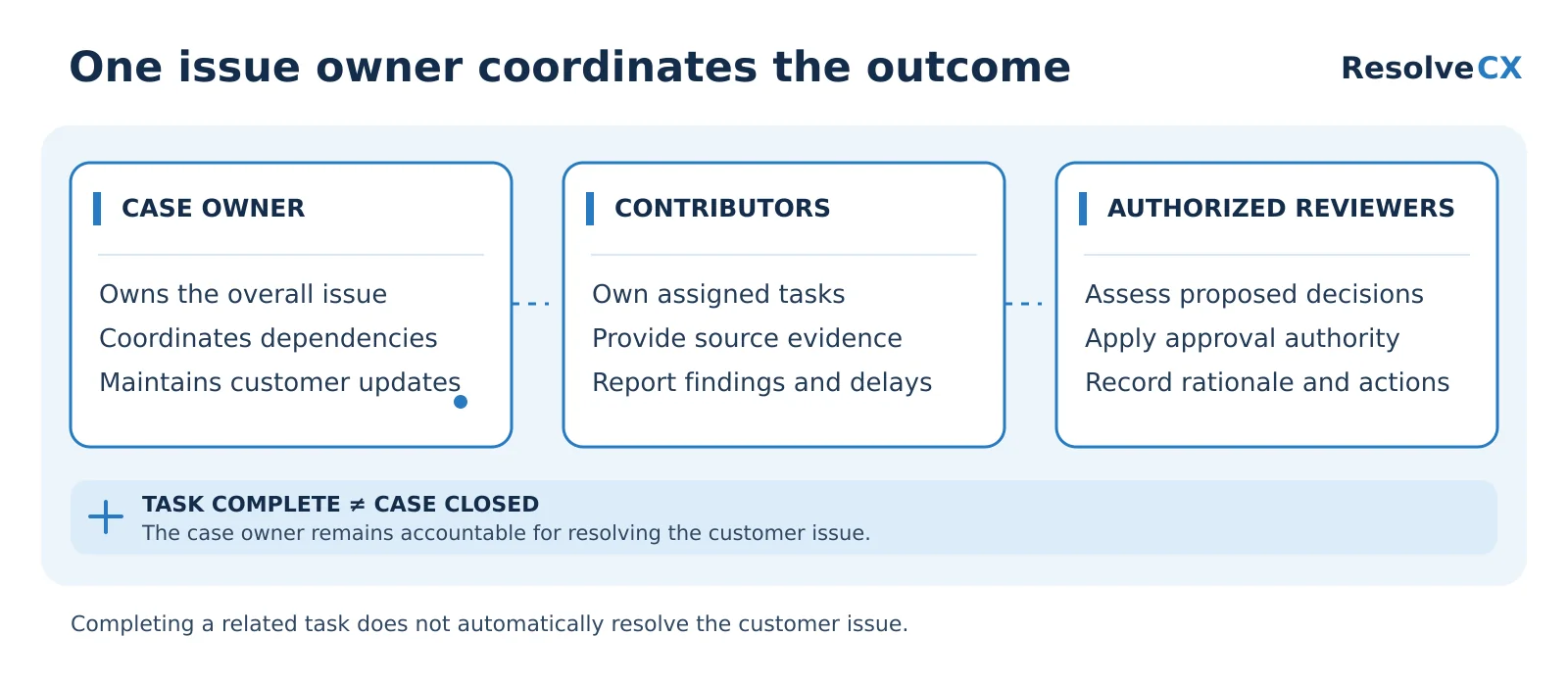
The case owner remains accountable for the overall issue while other people perform specific work. This arrangement becomes useful when the next step depends on investigation, another team's findings or authority beyond the original handler.
Customer service cases are distinct from legal or social-work case files, although those disciplines also coordinate complex matters. Here, the focus is customer operations: complaints, unresolved service issues and cross-team resolution.
A complaint may require case coordination. An escalation brings additional authority or expertise into the work. An incident concerns an operational failure, while problem management investigates recurring causes. Connecting these records should preserve their different purposes.
Review ResolveCX's case management workflow to assess how an accountable record could connect the reported concern, supporting material, reviewer finding and final action. Confirm the agreed configuration during evaluation. 4
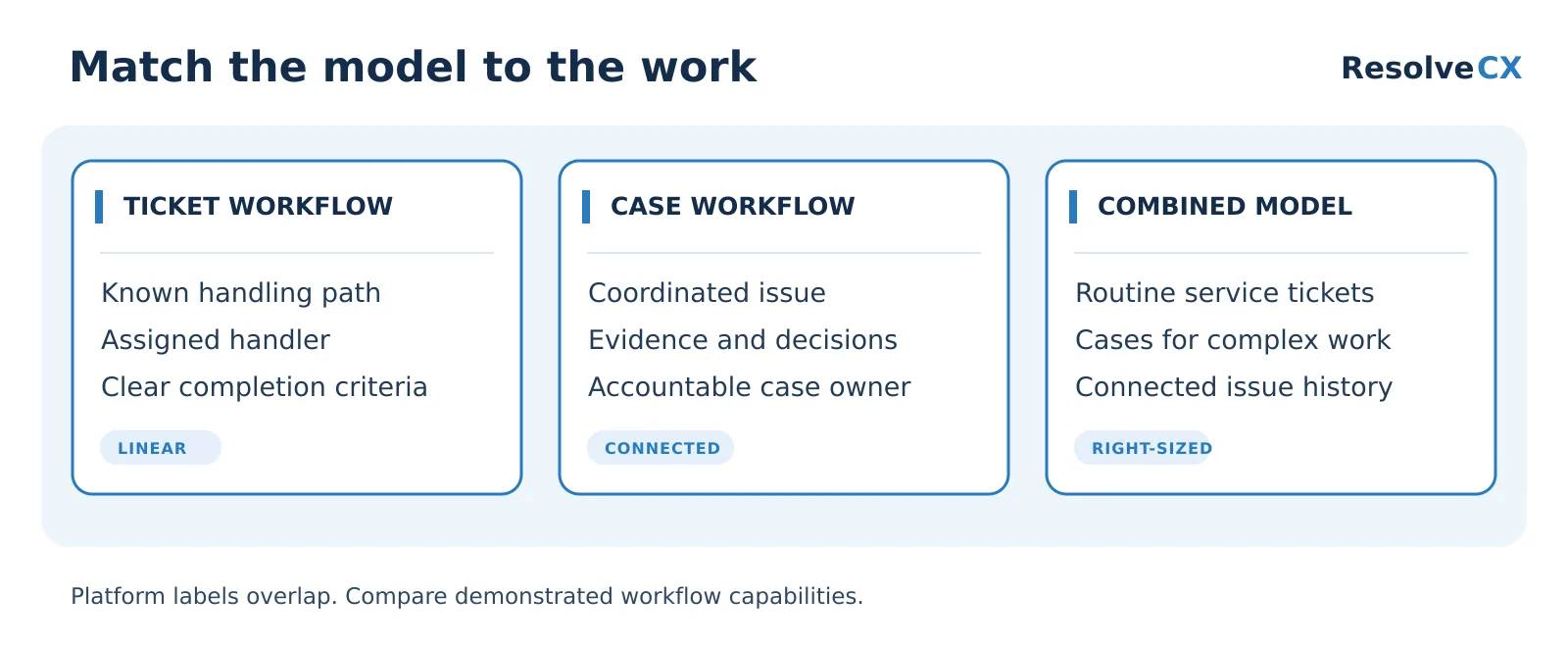
Compare operating capabilities rather than names. Ticketing platforms can support sophisticated workflows, and case management products still need configuration, trained users and clear responsibilities.
| Dimension | Ticket-management emphasis | Case-management emphasis |
|---|---|---|
| Unit of work | Service request or support issue | Coordinated issue and related work |
| Workflow | Established response and resolution path | Activities, dependencies and decision points |
| Ownership | Assigned handler or team | Accountable issue owner plus contributors |
| Context | Request history and communications | Related records, evidence and chronology |
| Decisions | Actions within assigned authority | Review and approval where required |
| Dependencies | Work needed to complete the request | Findings affecting the overall outcome |
| Closure | Request meets completion criteria | Overall issue meets defined criteria |
| Measurement | Response, backlog and ticket resolution | Coordination, decisions and case outcomes |
These are functional emphases, not guaranteed feature differences. Zendesk, for example, documents ticket SLA policies covering response and resolution measurements. Buyers should not assume that deadline controls are exclusive to case software. 2
The distinction becomes operational when completing an activity leaves the customer's underlying issue unresolved. A technical task can finish while a related complaint still needs a reviewed response or an authorized remedy.
Choose a ticket workflow when it reliably supports the required information, authority, commitments and completion checks. Assess actual handling rather than assuming that high volume requires cases or low volume excludes them.
A long-running replacement request can remain suitable for ticketing if the process is known and responsibility stays clear. Duration alone does not define complexity. Improve categories, routing or training before buying another system when those changes address the real gap.
Case management capabilities help when contributors must coordinate evidence, dependent activities and decisions that the existing workflow cannot govern reliably. Look for disputed facts, repeated failed responses, sensitive material or decisions beyond the handler's authority.
Consider an illustrative SaaS provisioning failure. Support confirms that the customer paid, engineering investigates activation logs and an authorized reviewer assesses the appropriate customer remedy. Completing engineering's task does not automatically settle the customer's concern. One owner should coordinate the evidence, commitments and final response.
A brief allegation of inappropriate data access may also require immediate specialist assessment. Speed and seriousness are separate dimensions; a short interaction can lead to consequential work.
A combined model keeps routine service work efficient while providing coordinated handling for complex exceptions. This can operate within one platform or across connected tools, depending on demonstrated capabilities and architecture.
Use case management vs ticket management to identify the work pattern first:
| Work pattern | Suitable starting model | What to verify |
|---|---|---|
| Known request with authorized action | Ticket workflow | Ownership, commitments and completion |
| Disputed issue requiring coordinated judgment | Case workflow | Evidence, contributors and decision authority |
| Routine intake with complex exceptions | Combined model | Transition rules and connected history |
Avoid imposing lengthy approval stages on every routine request. Equally, do not compress an investigation into a generic resolved status simply to clear the queue.
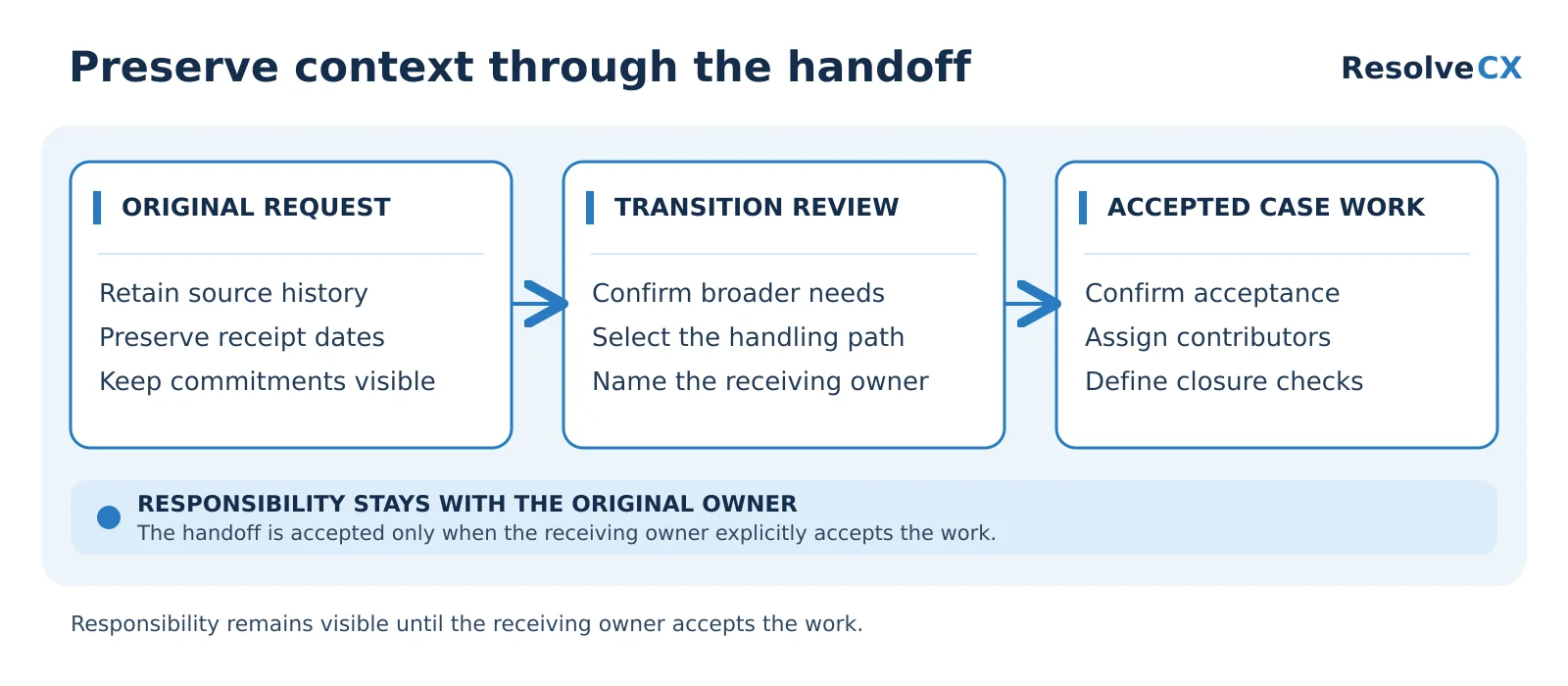
A ticket should move into a broader case workflow when the issue requires coordination or judgment that its current handling path cannot support. Define transition criteria before staff encounter the exception.
Possible triggers include contradictory evidence, unresolved complaints, specialist review, multiple dependent activities or an action requiring higher authority. Treat these as process-design recommendations, not universal legal requirements.
Use this transition sequence:
Preserve original receipt timestamps and applicable commitments. Creating a case should not silently restart a deadline or remove prior handling from view. Decide which information is linked, copied or retained elsewhere, and record the relationship.
Keep the current owner responsible until the receiving owner accepts the work. If acceptance fails, alert the designated lead and maintain customer communication. Forwarding an email or changing a queue is not sufficient evidence of an accepted handoff.
Explore governed escalation for issues needing higher authority when evaluating how urgent or unresolved customer work could retain context, an accepting owner and attributable decisions. 5
Tickets and cases can work together when the authoritative issue record and responsibilities for related work are defined. The customer-facing owner coordinates the overall outcome; task assignees complete their own agreed contributions.
Microsoft Dynamics 365 documentation describes parent and child cases for work involving different departments or an issue affecting multiple customers. This is one documented implementation approach, not a requirement that every platform use identical relationships. 3
For an illustrative telecommunications fault, technical teams may restore service through incident work while the customer case records impact, commitments and the response. Several requests can relate to the event, but each customer's circumstances still need appropriate handling.
Do not expose sensitive evidence merely because records are linked. Contributors should receive the information needed for their role. Separate restricted material from approved customer updates and test permissions across related records.
Agree which system owns each update if tools are connected. Test failed synchronization, duplicate records, missing attachments and conflicting statuses. A connection described in a proposal should be validated against the actual workflow before teams rely on it.
Define closure dependencies explicitly. Some tasks must finish before the issue closes; other improvement work can remain open with its own owner. Reopening should preserve previous findings and explain what new information requires attention.
Make case management vs ticket management concrete through representative demonstrations. Test a routine request, a complex issue and a failed handoff using the same requirements for each shortlisted product.
Ask the vendor to demonstrate:
Capture of the original request and subsequent contact.
Coordination with another team without losing the issue owner.
An unaccepted transfer and its intervention path.
Restricted evidence visible only to appropriate reviewers.
A proposed action requiring authorized approval.
An attempt to close before mandatory work is complete.
Reopening with previous history still understandable.
Record what was demonstrated, what needs configuration and what depends on additional licenses, services or manual work. Mandatory controls should be evaluated separately from optional conveniences. A polished dashboard cannot compensate for missing approval authority.
Include workflow design, data cleaning, migration, integrations, training, review capacity and continuing administration. Preserve historical identifiers, receipt dates and decision context during migration, then reconcile sample records and reports.
A broader workflow can create additional review demand. Estimate who will investigate, approve and monitor exceptions, including peak periods and staff absence. Software cannot create meaningful oversight if authorized reviewers lack time or usable evidence.
Financial services may require careful assessment of disputed outcomes and remedy authority. Telecommunications teams need to distinguish restoration of service from resolution of the customer's complaint. SaaS teams should separate technical completion from outstanding customer commitments.
For BPO and contact-center operations, specify which decisions the provider can make and which remain with the client. Name the owner while client approval is pending, and test what happens when that approver is unavailable.
Across the USA, UK and UAE, assess applicable sector requirements, privacy arrangements, retention and service commitments with legal, compliance and security stakeholders. A configured workflow supports these processes; it does not guarantee compliance or make one jurisdiction's rules universal.
Measure case management vs ticket management using the appropriate unit of work. Ticket response time and case outcome time answer different questions. Several closed tickets can belong to one unresolved case.
Track ticket backlog and resolution time alongside case age, time awaiting decisions, unaccepted handoffs, reopened issues and incomplete outcome records. Monitor repeat contacts to identify customers still seeking help after an apparently successful task.
Define when each clock starts, pauses and stops. Zendesk's documentation shows that different resolution metrics use different status rules. Compare configured measurements carefully rather than assuming all reported resolution times mean the same thing. 2
Sample closed records for evidence quality and appropriate approvals. Review recurring themes separately from verified causes, then assign investigation or corrective action where warranted. Case closure should not automatically erase outstanding prevention work.
AI can support classification, summaries and identification of patterns in either model. AI functionality alone does not establish whether the workflow can coordinate evidence, authority and customer outcomes.
Keep suggestions separate from verified findings. Review summaries against original records, and assess significant customer impact independently of model confidence. A confident suggestion can still concern an issue needing specialist judgment.
In case management vs ticket management, evaluate AI against evidence, permissions and approval requirements before authorizing customer-facing actions within any workflow.
People should retain authority to correct routes, reject proposed actions and request further investigation. Monitor missed risks and reviewer workload as well as speed. The purpose is better supported decisions, not unreviewed automation of consequential outcomes.
ResolveCX positions case management around a connected record for cross-team customer work. Its published material describes accountable ownership, supporting evidence, reviewer findings and final actions, with controls configured to the agreed operating model. 4
Its escalation material describes human-reviewed routes, accepted responsibility and attributable decisions for urgent or unresolved customer issues. AI can prepare context where configured; people remain responsible for material decisions. 5
Evaluate ResolveCX alongside existing CRM, contact-center and service tools. Confirm sources, permissions, record relationships, integration behavior and exception handling during discovery. Named connectors, automatic synchronization and fixed implementation times should not be assumed from a general workflow description.
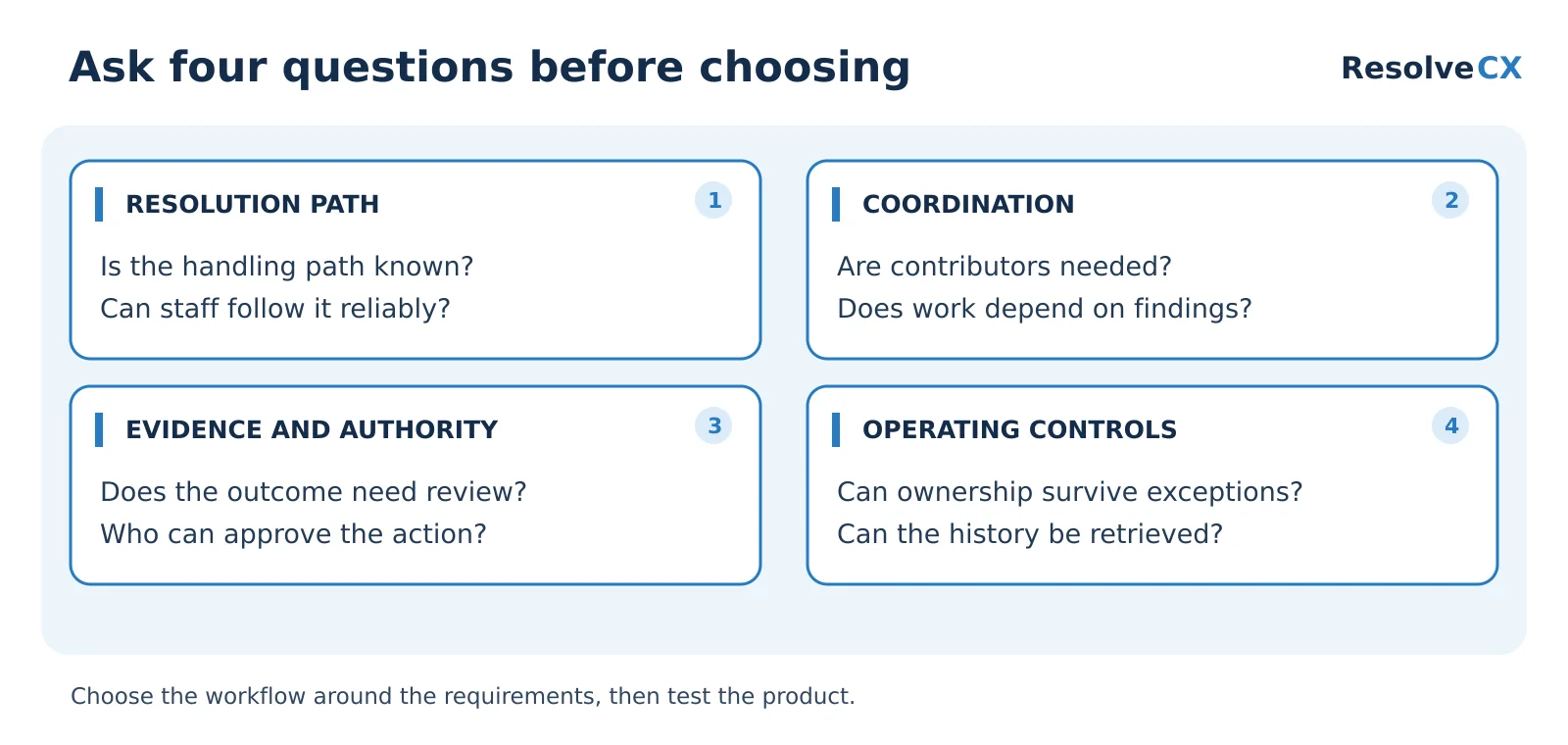
Use case management vs ticket management to choose capabilities around your actual customer work. Start by testing one routine request and one issue needing investigation or coordinated decisions. Improve existing tools where they meet the requirements; extend or replace them where material controls remain unsupported.
Book a ResolveCX demo around your customer issue workflow to examine ownership, evidence and decision requirements using a representative case.
Ticket management organizes service requests. Case management coordinates an issue's related work and decisions. Product terminology overlaps, so evaluate actual capabilities and configuration.
No. Some platforms use the terms interchangeably or support both workflows within one record model. Separate records are useful only when their relationships and responsibilities are clear.
Yes, if its workflows, permissions, evidence handling and decision controls meet your requirements. Demonstrate the complete process rather than relying on the product label.
When required coordination, investigation or authority exceeds the current handling path. Preserve the originating history and confirm an accepting owner before transferring responsibility.
Yes. Consequences and complexity matter alongside volume. A small team handling sensitive or disputed issues may need coordinated review, while routine requests can remain simple.
No. CRM provides relationship context, while case management coordinates issue resolution. A CRM platform may include case-management functions, so assess the available modules and controls.
Yes. Verify that routine requests remain efficient and complex work receives appropriate review. Test permissions, related records and reporting rather than assuming one workspace solves every requirement.
Assign one accountable owner for the overall issue. Contributors own their specific tasks, and authorized reviewers own decisions within their authority. Document accepted transfers and escalation paths.
No. Applicable requirements, configuration, trained people and operating practices determine effectiveness. Review relevant controls with legal, compliance, privacy and security stakeholders.
AI can suggest categories and prepare briefings. People verify sources, assess consequences and control decisions. Keep a manual handling path for exceptions and unreliable suggestions.
About ResolveCX Team
ResolveCX Team are practitioners and product specialists in complaint governance, escalation management, and regulated CX operations. Our articles draw on real implementation experience across financial services, healthcare, and telecommunications.
Contact the TeamHow case-first architecture retains resolution memory and reduces reopens, cost-to-serve, and compliance risk through governed case continuity.

How AI-first platforms are transforming customer complaint resolution and escalation management in regulated industries, and what governance guardrails make it safe.

An eight-stage operating guide connecting customer intake, accountable ownership, evidence, decisions and verified resolution, with exception and closure controls.