Customer Service Case Management Workflow: From Intake to Resolution
An eight-stage operating guide connecting customer intake, accountable ownership, evidence, decisions and verified resolution, with exception and closure controls.
ResolveCX Team28 October 202614 min read9 views
Key Takeaways
1Give each stage an owner, required record and clear advance condition.
2Adapt review to the case type; escalation can occur at any stage.
3Retain accountable ownership through waiting and until a handoff is accepted.
4Verify authorized action before closure, and preserve history when reopening.
5Keep AI drafts separate from source evidence and assign continuing improvement work.
A customer service case management workflow connects the original customer concern with ownership, investigation, decisions, actions and a reviewable outcome. Each stage needs a responsible person, a usable record and a clear condition for moving forward.
For service leaders, the goal is consistent handling through routine work and exceptions. Receipt confirmation, an answered message and a closed status are different events. Explore ResolveCX's approach to governed customer resolution when assessing how your team should keep evidence and human decisions connected from first contact to resolution.
What Is a Customer Service Case Workflow?
A case workflow defines how a customer issue progresses, who coordinates the work and what evidence supports the outcome. It also specifies what happens when information is incomplete, an approval is delayed or the customer disputes the proposed resolution.
Keep the case distinct from its interactions. Microsoft's case-management overview describes multiple activities, such as customer calls, associated with one case. A customer can also have several separate cases. This distinction helps teams preserve context without combining unrelated concerns. 1
Salesforce describes service workflows as defining how requests arrive, responsibilities and when a case is resolved. The stages below extend that foundation with explicit evidence and review controls. 2 This vendor-authored explanation is background, not independent validation of the proposed controls or ResolveCX capabilities.
Straightforward requests can follow a simpler path. Use additional investigation and review when the issue requires them, rather than imposing identical stages on every interaction.
What Should Every Case Record Contain?
Capture enough information to identify the concern, assess impact and establish the next action. Gather additional detail during investigation instead of requiring every possible field before someone can report an urgent issue.
A practical record includes:
Case identifier, original receipt time and source interaction.
Reported concern and relevant customer or account reference.
Reviewed category, customer impact and priority.
Accountable owner, contributors and next action.
Applicable commitments, due actions and waiting reasons.
Supporting evidence, communications and investigation findings.
Decisions, required approvals and completed actions.
Outcome, closure reason and reopening history.
Apply access and retention arrangements appropriate to the information. Preserve the original customer account, label derived summaries and record corrections. Check for related open work before creating another case, but do not merge concerns merely because they involve the same customer.
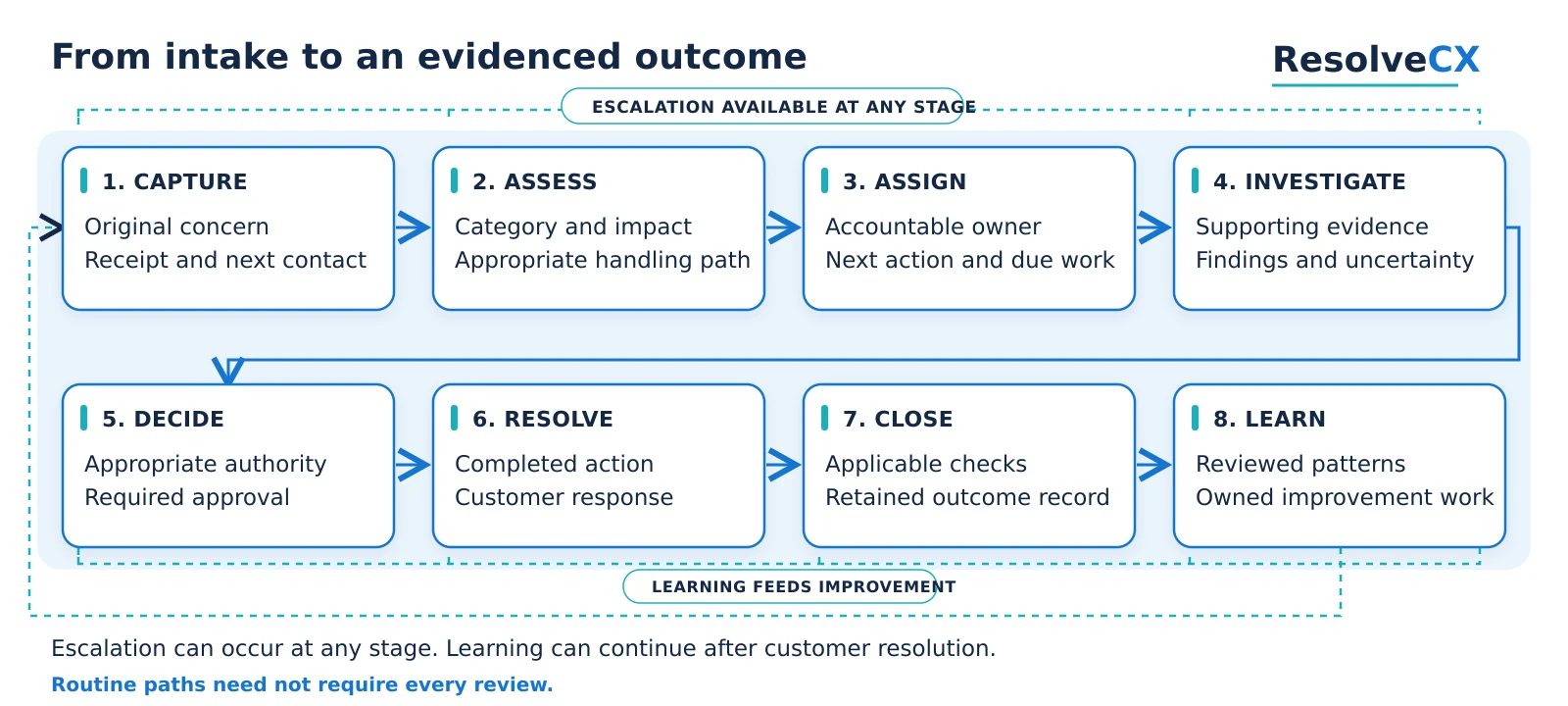
Figure 1. Eight stages connect customer intake with resolution and learning.
The Eight Stages from Intake to Resolution
The following customer service case management workflow is a practical operating model. Adapt responsibilities and advance conditions to each case type. Escalation may occur at any stage, and learning can continue after customer resolution.
1. Capture and acknowledge the case
Retain the concern as received, its source and the original receipt details. Identify immediate customer impact and record missing information. Necessary urgent review should not wait for administrative completeness.
Confirm receipt using an appropriate message and explain the next contact. An acknowledgement confirms that the concern arrived; it does not establish that the evidence has been assessed. Give incomplete records an owner and a specific follow-up action.
2. Assess, classify and prioritize
Review the category, impact, urgency and handling requirements. Confirm the relevant customer context before choosing a route. Distinguish an ordinary service request from a complaint or an issue needing specialist attention.
If AI suggests a category, check it against the original concern. Confidence and consequence are different dimensions: a confident suggestion can still concern significant harm. Reassess classification when new evidence changes the issue.
3. Assign an accountable owner and plan the next action
Name the person responsible for the overall case, then assign contributors to specific tasks. Record the next action and applicable commitment. A queue location or copied email is insufficient if nobody accepts responsibility.
Define fallback ownership for absence or unavailable specialists. Keep commitments visible while work moves between teams. Contributors can own their tasks without becoming the owner of the entire customer outcome.
Review ResolveCX's case management workflow to assess how ownership, supporting material, reviewer findings and final actions could remain connected in your configured process. 4
4. Investigate and coordinate evidence
Gather records relevant to the concern and document unresolved questions. Keep allegations, source evidence, AI suggestions and reviewer findings distinguishable. A summary should guide investigation without replacing the underlying material.
Ask contributors for specific findings and due actions. Record contradictions rather than choosing the most convenient version. Customer updates should explain progress accurately without revealing restricted information or presenting an unapproved finding as final.
5. Escalate and obtain required decisions
Escalate when the issue needs higher authority, specialist expertise or an intervention under policy. Explain the trigger, customer impact, requested decision and relevant history. Confirm who accepts the next responsibility.
Present proposed actions with supporting evidence, uncertainty and applicable policy. Authorized reviewers should be able to approve, amend, reject or request further investigation. Keep the decision and rationale attributable. Approval requirements depend on the action and operating rules; not every routine step needs a separate approver.
6. Complete the action and explain the outcome
Confirm that the authorized action actually occurred. Record completion evidence and the response given to the customer. Sending a correction request to another department is not the same as verifying that the correction was applied.
Explain the finding and next steps clearly. Label an interim workaround as such, with an owner for remaining work. Decide whether unresolved dependencies prevent customer resolution or belong in separately owned improvement work.
7. Verify closure and preserve the record
Check the case-type closure criteria, required decisions, customer communication and outstanding mandatory work. Retain an understandable outcome and closure reason. Avoid treating a status change as evidence that these conditions were met.
Microsoft documents configurable resolution behavior, including handling of open activities and related cases. Test those settings carefully: software behavior may complete or cancel related work differently from your intended policy. A successful button click does not prove an appropriate outcome. 3 In the documented interface, confirming the open-activities warning automatically cancels those activities when resolving the case. Parent and child resolution depends on configured settings. These are Dynamics 365 behaviors, not evidence that work was substantively completed or that ResolveCX behaves identically. The controls in this guide are recommendations to test, not vendor guarantees.
8. Review patterns and assign improvement work
Review recurring themes alongside operational evidence. A group of similar complaints suggests a problem worth investigating; it does not establish the cause. Assign investigation and corrective action where justified, with an owner and review date.
Keep prevention work distinct from the individual customer outcome. A customer can receive an appropriate remedy before a wider process change is complete. Assess whether corrective action improves recurrence and impact rather than assuming that completion equals effectiveness.
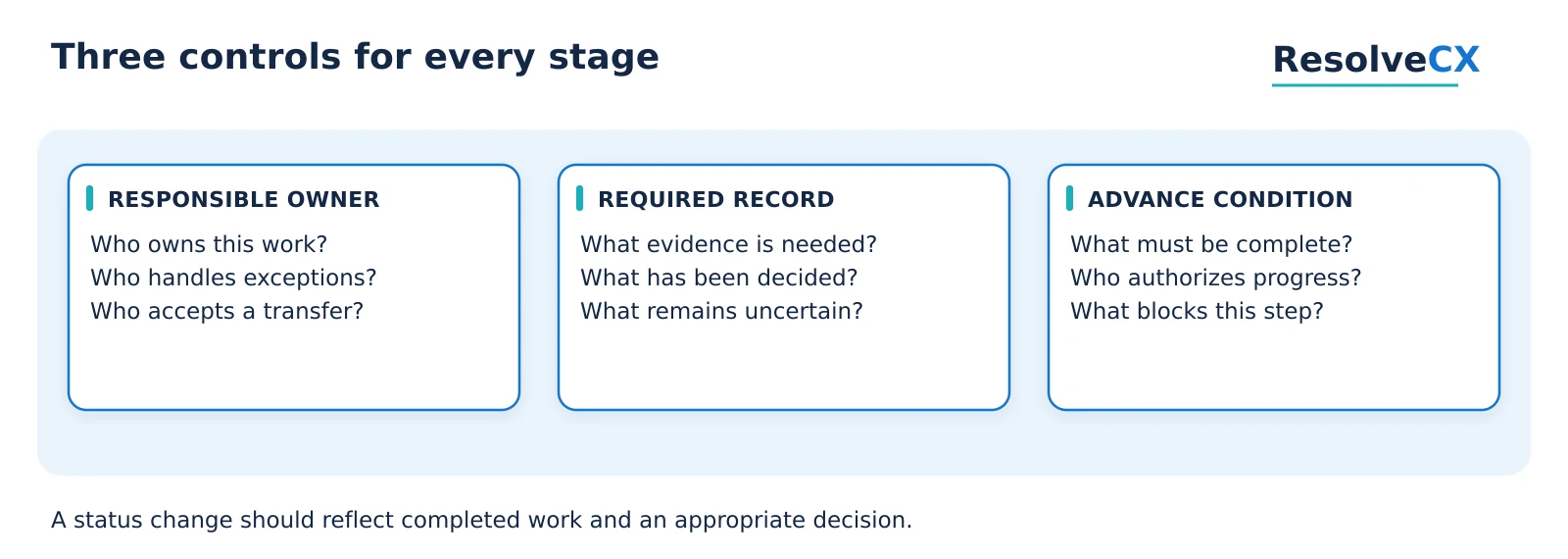
Figure 2. Define the owner, required record and advance condition.
Which Controls Should Each Stage Produce?
Use this matrix to check responsibilities and progression. These are recommended controls, not a universal vendor template or regulatory standard.
Stage
Responsible role
Required record
Advance condition
Intake
Intake handler
Concern and receipt details
Case identifiable; urgent impact assessed
Assessment
Handler or triage lead
Category, impact and constraints
Appropriate path selected
Ownership
Case owner
Accepted responsibility and next action
Work and commitments assigned
Investigation
Owner and contributors
Evidence, findings and uncertainty
Decision supported or uncertainty referred
Decision
Authorized reviewer
Rationale and required approval
Action authorized
Resolution
Action owner
Completion evidence and response
Outcome checked
Closure
Owner or designated reviewer
Closure reason and retained history
Applicable criteria met
Learning
Improvement owner
Reviewed pattern and follow-up
Action assigned and reviewed
A stage should remain visible when its advance condition is unmet. Record why it is blocked, who will intervene and what happens next. Do not add more statuses unless they change a handling decision or reveal a meaningful dependency.
How Should Handoffs, Waiting States and Reopening Work?
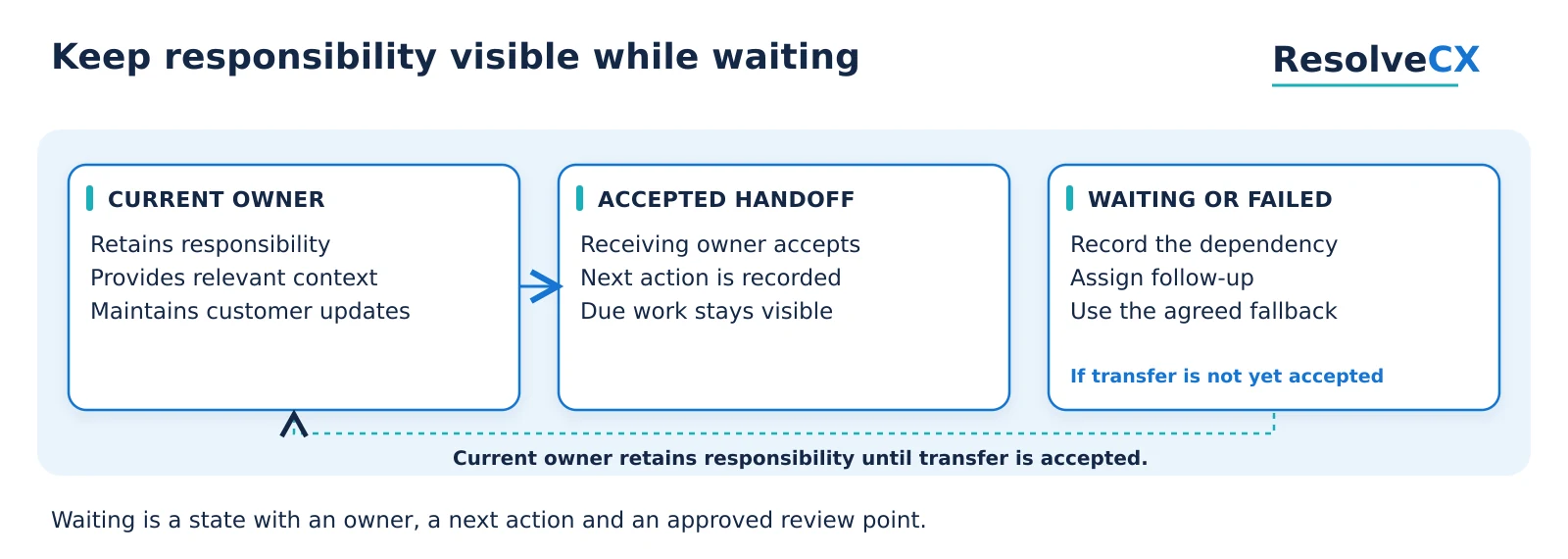
A customer service case management workflow needs explicit exception rules. Keep an accountable owner while awaiting information, approval or a receiving team. Record the dependency, follow-up responsibility and next review date.
Accepted handoffs
Send the receiving owner the concern, relevant evidence, decisions already made, outstanding work and requested next action. Keep the current owner accountable until acceptance is recorded. If acceptance fails, alert the designated lead and continue appropriate customer communication.
Waiting states
Specify what is awaited and who follows up. Separate waiting on the customer from waiting on an internal contributor. An internal status should not silently pause an external commitment; assess clock behavior against applicable policy and obligations.
If the customer does not respond, use an approved process for follow-up and disposition. Silence does not automatically prove acceptance. Record the handling reason and preserve an appropriate route for renewed contact.
Reopening
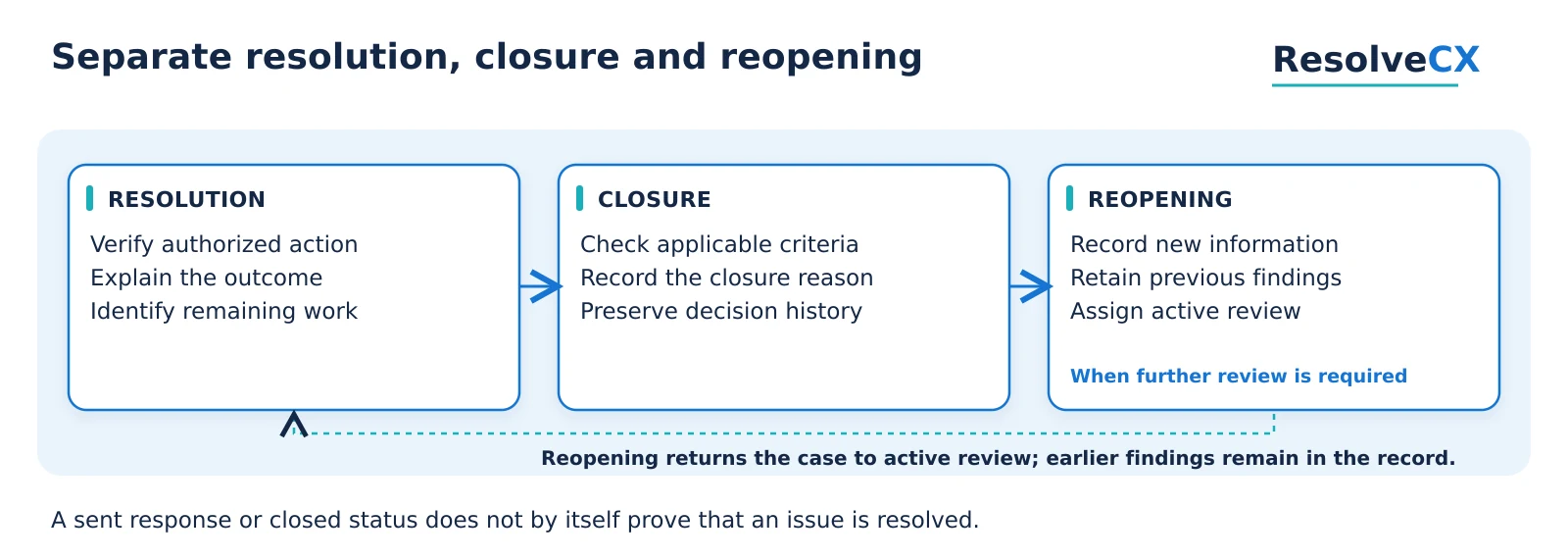
Reopen when new information, failed action or an unresolved concern requires further review under policy. Preserve the previous finding and explain what changed. Distinguish new concerns from continuation of the same issue.
Closing an escalation also does not necessarily close the case. Additional authority may have resolved the immediate blockage while an approved action or customer response remains outstanding.
Figure 3. Waiting and transfers retain accountable ownership.
Where Can AI Assist Without Taking Decision Authority?
AI can support a customer service case management workflow through suggested categories, draft briefings and relevant context. People should verify sources, assess consequences and control significant findings, approvals and actions.
Use only authorized context and keep generated material labelled as a draft. Check missing events, incorrect summaries and statements that convert an allegation into a fact. The receiving handler needs access to the original record and authority to correct the briefing.
Explore AI case summarization for reviewable handoffs when assessing how draft orientation could support your team. ResolveCX's published description keeps source records authoritative and makes availability dependent on configuration. 5
When suggestions are unreliable or a connection fails, continue through a documented manual path. A failed automation should create visible work for a responsible person, not leave a case silently unowned.
What Does the Workflow Look Like in Practice?
Travel: a cancelled booking and refund review
In an illustrative booking complaint, intake preserves the customer's account and booking reference. The case owner gathers cancellation records, asks the appropriate team to review refund eligibility and obtains any required approval.
Resolution includes checking that the authorized refund occurred and explaining the outcome. Closure requires the applicable evidence and response record. Recurring cancellation problems can receive separately owned investigation without leaving the customer's case indefinitely open.
Telecommunications: restoration with an unresolved complaint
Technical teams may restore service while the customer still disputes charges or the earlier handling. Keep the incident's technical outcome connected to the case without assuming that restoration settles every concern.
The case owner coordinates impact evidence, appropriate review and the response. In BPO operations, specify which decisions remain with the client and who owns the case while approval is pending. Financial-services disputes similarly require attention to evidence and remedy authority.
How Should You Implement and Measure the Workflow?
Implement a customer service case management workflow around representative case types and actual failure points. Start with a limited scope that the team can operate and review reliably.
Examine recent cases, including reopened and stalled work.
Define roles, required records and closure criteria.
Configure commitments, permissions and exception paths.
Test routine handling and failed transitions.
Train handlers, contributors and reviewers on responsibilities.
Pilot, review outcomes and correct gaps before expansion.
Test incomplete intake, unrelated follow-up messages, unaccepted transfers, unavailable approvers, contradictory evidence, connection failures, waiting states and premature closure. Inspect the history after reopening and verify that restricted material remains protected.
Budget for configuration, connections, data quality, training, review capacity and ongoing administration. A workflow with mandatory review needs enough qualified people to perform it meaningfully.
Measure substantive review time separately from acknowledgement time. Track ownerless cases, acceptance delays, time awaiting decisions, overdue actions, reopened cases and incomplete closure records. Monitor repeat contacts and recurring issues alongside corrective actions.
Define the population, start point and waiting treatment for each measure. Pair speed with record quality and customer outcomes. A lower closure time is not an improvement if required investigation has simply disappeared.
Document metric definitions, owners and review cadence. When results worsen, inspect the underlying records before changing targets; apparent delay may reveal unavailable reviewers, failed handoffs or missing evidence that needs correction.
Figure 4. Verify outcomes, preserve closure records and govern reopening.
How ResolveCX Supports This Workflow
ResolveCX positions case management around coordinated customer work with accountable ownership, supporting material, reviewer findings and final actions. Its published workflow emphasizes evidence and responsibility through handoffs, with controls agreed for the operating model. 4
AI summaries may provide orientation from authorized context where configured. People check facts and remain responsible for next steps. Confirm sources, permissions, record relationships, retention, exception handling and delivery scope during evaluation. 5
Across USA, UK, UAE and global operations, assess applicable requirements with legal, compliance, security and privacy stakeholders. ResolveCX supports governance processes; configuration and operating practices determine effectiveness, and the platform does not guarantee legal or regulatory compliance.
Conclusion
Start by documenting one customer service case management workflow with clear owners, required evidence and advance conditions. Test the exceptions before expanding automation. The practical result should be a case whose next action is visible and whose outcome can be explained.
It defines how a customer issue moves through intake, assessment, coordinated action and resolution. It includes owners, required records, decision points and exception handling.
A practical lifecycle covers capture, assessment, assignment, investigation, decisions, action, closure and learning. Adapt the sequence to the case type; urgent escalation can occur immediately.
Capture the original concern, receipt details, source, relevant customer reference and known impact. Record missing information and assign follow-up without delaying necessary urgent review.
Name one accountable owner for the overall issue. Contributors own specific tasks, and authorized reviewers own their decisions. Confirm acceptance before transferring overall responsibility.
Escalate when impact, uncertainty, deadlines or authority require intervention under policy. Provide the context, requested decision and next action, then confirm receiving responsibility.
Record the outstanding information, follow-up owner and review date. Apply approved communication and clock rules; do not assume every commitment pauses while the customer responds.
Resolution addresses the issue or agreed outcome. Closure confirms that applicable completion checks and records are satisfied. A sent response alone does not establish either.
Reopen when new evidence, failed action or a continuing concern requires review under policy. Retain earlier decisions and record the reason for returning to active handling.
AI can suggest categories and prepare summaries. People verify source information, correct errors and control decisions. Keep sensitive context protected and manual handling available.
Measure substantive review, ownership gaps, handoff delay, decision waiting, reopened work and record completeness. Define each measure clearly and assess speed alongside customer outcomes.
ResolveCX Team are practitioners and product specialists in complaint governance, escalation management, and regulated CX operations. Our articles draw on real implementation experience across financial services, healthcare, and telecommunications.