
Complaint Tracking vs Complaint Management Software: Key Differences
Understand when complaint tracking is enough and when investigation, decision authority, and cross-team ownership need broader management controls.

Key Takeaways
- 1Tracking is part of management; product labels do not establish capability limits.
- 2Test both a straightforward complaint and a disputed complaint crossing teams.
- 3Prioritize accountable ownership, connected evidence, and authorized decisions.
- 4Compare Capture, Own, Investigate, Decide, Close, and Learn through realistic demonstrations.
- 5Preserve record meaning during migration and map only applicable governance requirements.
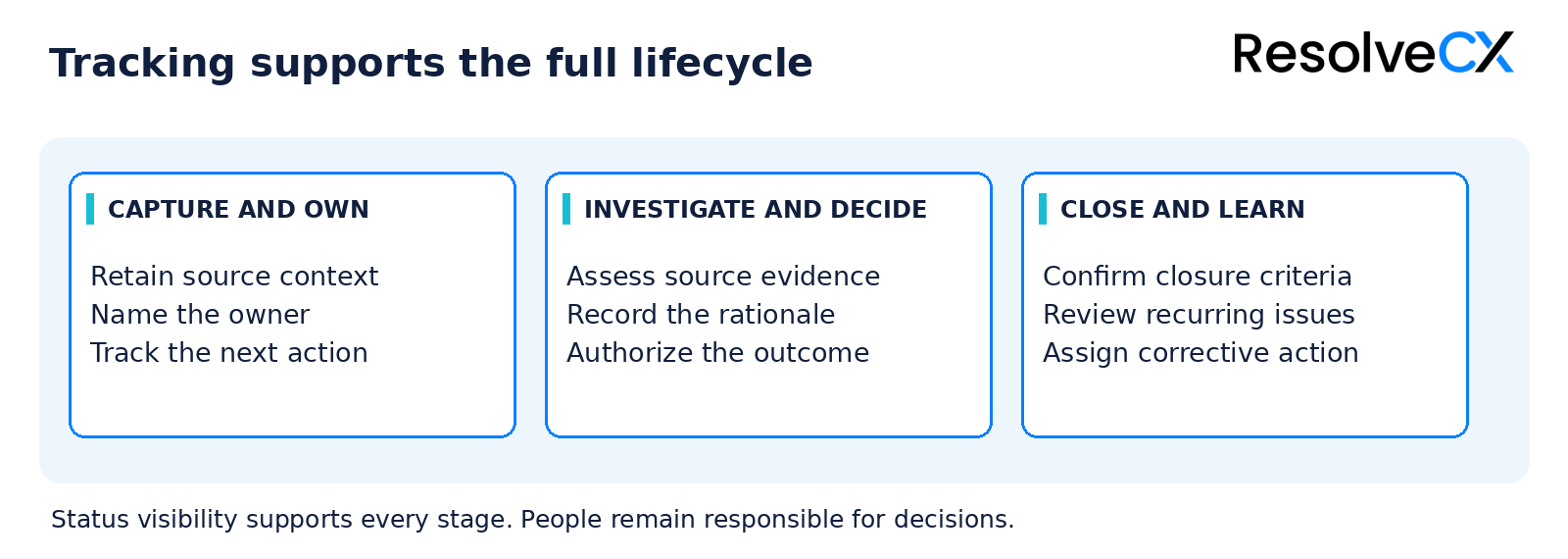
Complaint tracking shows where a complaint stands. Complaint management coordinates the work needed to investigate it, reach an authorized decision, communicate the outcome and learn from recurring issues. Tracking is part of management, and the software categories overlap.
For enterprise buyers, complaint tracking vs complaint management is therefore a capability question. Can your team explain who owns the complaint, what evidence supports the finding and why it was closed? Explore ResolveCX's approach to complaint governance when assessing how ownership, evidence and human decisions should connect across your operation.
What Is Complaint Tracking Software?
Complaint tracking software records complaints and makes their progress visible. A typical tracker contains an identifier, customer details, category, owner, received date, current status and follow-up dates. It helps teams find open complaints and see which actions are overdue.
The label does not establish a capability ceiling. Case IQ describes complaint tracking and complaint management software as alternative terms, with investigation records and trend analysis among its described functions. Evaluate the product itself rather than assuming that every tracker only stores rows. 1
A useful tracking record should answer:
-
What did the customer report, and when?
-
Who is responsible for the next action?
-
What has happened since receipt?
-
Which commitment or deadline applies?
-
What outcome was recorded?
A dashboard makes these fields visible. Reliable handling still depends on accurate entries, available handlers and a clear process for exceptions.
What Is Complaint Management Software?
Complaint management software supports a coordinated complaint lifecycle: capture, assessment, ownership, investigation, decision, response, closure and learning. The depth required depends on the complaint. A straightforward service error may need a short investigation; disputed evidence or significant customer impact can require specialist input and additional review.
The important distinction is whether the system supports the work behind the status. Evidence should remain connected to findings, decision authority should be clear, and the response should reflect the approved outcome.
A complaint may require a case when several teams must coordinate investigation. Escalation brings higher authority, expertise or urgency into that work. An incident records an operational failure; problem management investigates recurring causes. These records serve different purposes, even when related.
Complaint Tracking vs Complaint Management: Key Differences
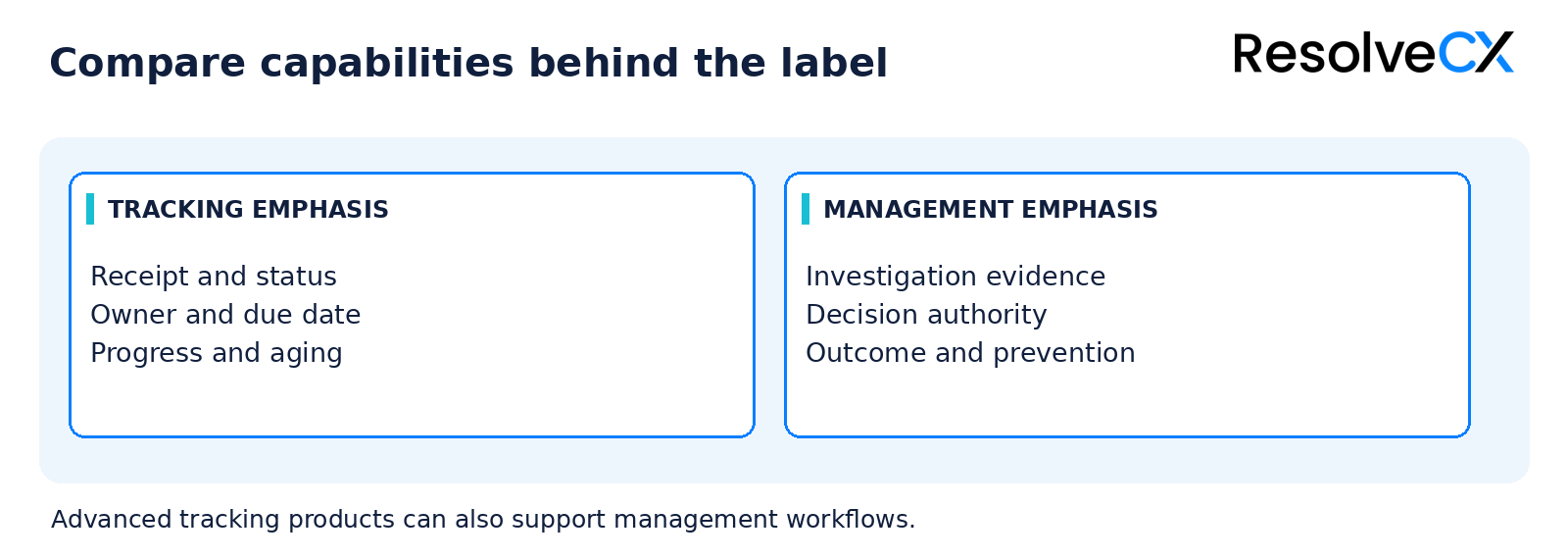
Compare functional emphasis rather than rigid product categories. An advanced tracker can support management controls, while a product marketed as complaint management may still require configuration or additional modules.
| Dimension | Tracking emphasis | Management emphasis |
|---|---|---|
| Core question | Where does the complaint stand? | What must happen and who decides? |
| Ownership | Assigned person or team visible | Accountable owner and controlled handoffs |
| Investigation | Notes and progress recorded | Evidence assessed against the reported concern |
| Decision | Outcome or status captured | Rationale and required approvals retained |
| Deadlines | Due dates and aging visible | Applicable commitments and interventions governed |
| Closure | Status changed to closed | Defined closure criteria assessed |
| Reporting | Volume, status and aging | Handling quality, outcomes and recurrence |
| Improvement | Patterns identified | Investigation and corrective action owned |
The distinction matters most when a complaint becomes contested. A closed status answers an administrative question. It does not, by itself, explain whether the customer's concern was investigated or whether the remedy was authorized.
Ask what the history records. Timestamps and edits are useful, but reviewable decision history also needs the relevant evidence, rationale and responsible person. Confirm which information survives corrections, reopening and export.
In complaint tracking vs complaint management, reporting should distinguish a recurring theme from a verified cause. Several complaints labeled billing error identify a pattern worth investigating; they do not establish which process failed. A responsible investigator should examine supporting records, document the finding and recommend action. The improvement owner then checks whether the change worked. Keep the complaint outcome separate from the corrective action status: the customer may receive an appropriate remedy before a wider process change is complete.
How Does the Same Complaint Look in Each Approach?
A straightforward delivery complaint
Consider an illustrative retail complaint about a late delivery. The handler checks the order record, confirms the delay, applies an authorized refund policy and informs the customer. A governed complaint tracker may support this process adequately.
The record still needs the source complaint, responsible handler, action taken and closure reason. A complex approval chain would add little value if the remedy already falls within the handler's authority and no additional risk is identified.
A disputed complaint crossing teams
Now consider a billing complaint in which the customer disputes a charge and says an earlier agent promised a correction. Support, billing and a specialist reviewer need to examine different records.
A tracker can show that the complaint is awaiting review. Management capabilities should help the teams assemble evidence, distinguish the customer's allegation from verified facts, record contradictions and approve the response under policy.
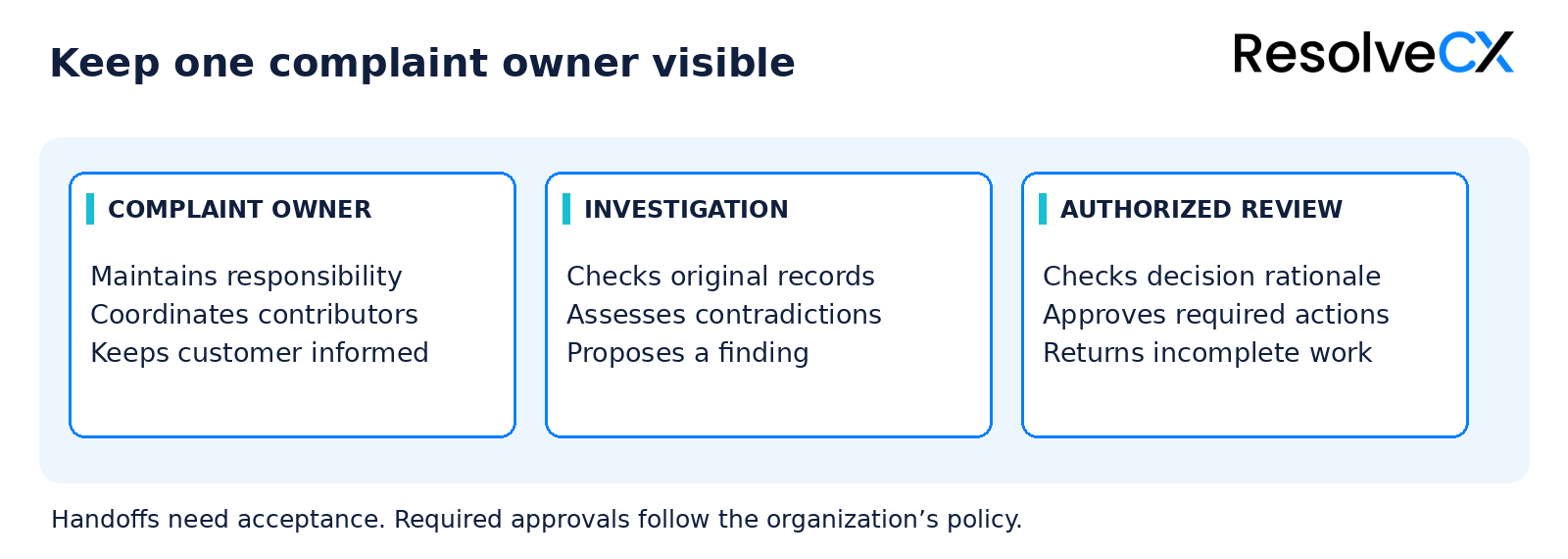
Keep one accountable owner while contributors investigate. A transfer should become effective only when the receiving owner accepts responsibility; failed acceptance needs an intervention path. The customer should not have to reconstruct the handoff.
Explore case management for complaints that cross teams to assess how a coordinated record could support ownership, evidence and decisions in your workflow. Confirm the configured controls during evaluation. 4
When Is Complaint Tracking Enough?
Complaint tracking can be sufficient when the process is straightforward, responsibilities are clear and the existing tool preserves the information your organization needs. The relevant test is operational reliability, rather than a universal complaint-volume threshold.
Use complaint tracking vs complaint management to assess whether your current setup supports:
-
A named owner and a clear next action.
-
Accessible source records and customer communications.
-
Applicable response commitments and monitored exceptions.
-
Authorized remedies and understandable closure reasons.
-
Retrieval of previous handling and outcomes.
A small team may meet these needs through a configured help desk or CRM workflow. Conversely, a single complaint involving serious harm or disputed evidence may require stronger controls despite low overall volume.
Review actual closed and overdue complaints before buying. If the process works and the records are complete, improving configuration or training may be the appropriate next step.
When Do You Need Broader Management Capabilities?
Broader complaint management becomes necessary when required investigation, review or coordination cannot be performed reliably in the current setup. Complexity can come from consequences, contributors, obligations or repeated failures.
Warning signs include complaints repeatedly losing ownership, evidence stored in disconnected folders, handlers closing cases without required review and customer updates contradicting investigation findings.
Other triggers include:
-
Different teams holding conflicting versions of the complaint.
-
Decisions requiring authority beyond the assigned handler.
-
Sensitive records needing restricted access.
-
Recurring complaints with no owner for corrective action.
-
Managers reconstructing the rationale after closure.
Identify the missing control before choosing a new platform. A requirement for documented approval differs from a desire for a prettier dashboard. The first changes the operating process; the second may be solved through reporting improvements.
Can Your Existing Help Desk or CRM Do the Job?
Possibly. Help desks and CRM service modules can support complaint intake, assignment, deadlines and configured workflows. Zoho Desk, for example, describes collaboration, automation, SLAs and process blueprints on its complaint management page. These functions demonstrate category overlap, not suitability for every complaint process. 2
Evaluate the edition, configuration and implementation needed for your requirements. Check whether evidence, permissions, approvals, exception handling and retained history work together during realistic tests.
The practical options are to improve the existing system, extend it with a governed complaint workflow or replace it where the required capabilities cannot be supported reasonably.
If systems work together, define which record owns the complaint and which system owns each update. Agree how evidence references, status changes and failed connections are reconciled. A proposed integration does not establish reliable synchronization until tested.
How Should Buyers Evaluate the Difference?
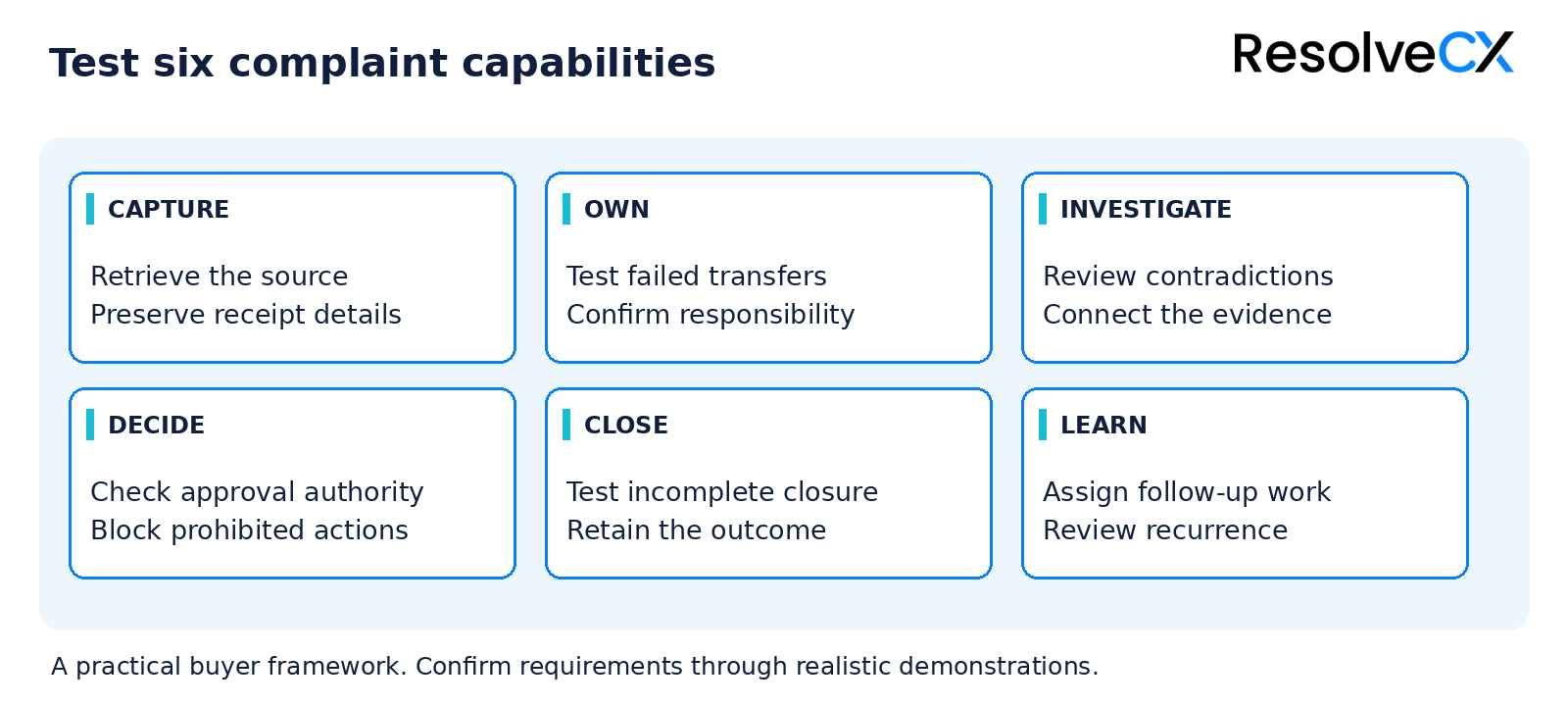
Make complaint tracking vs complaint management concrete by testing six capabilities: Capture, Own, Investigate, Decide, Close and Learn. This is a practical evaluation framework, not a regulatory standard.
| Capability | Demonstration question | Evidence to inspect |
|---|---|---|
| Capture | Can we retrieve the original complaint? | Source, identifier and receipt timestamp |
| Own | What happens when a transfer fails? | Current owner and intervention record |
| Investigate | How are contradictions handled? | Source material and investigation rationale |
| Decide | Can an unauthorized action be blocked? | Permission rules and approval history |
| Close | What prevents incomplete closure? | Required checks and recorded outcome |
| Learn | Who acts on recurring complaints? | Investigation owner and corrective action |
Run the same sequence with every shortlisted product:
-
Capture a realistic complaint with its original message and supporting material.
-
Assign an owner, request a transfer and leave it unaccepted.
-
Add contradictory evidence and ask a contributor to investigate.
-
Submit a proposed outcome to the appropriate authorized reviewer.
-
Attempt closure before a required step is complete, then reopen the complaint.
-
Retrieve the history and show how recurring issues receive accountable follow-up.
Include accessibility needs when testing forms and customer updates.
Separate demonstrated capability from promised configuration. Document any dependencies, additional licenses, services or manual workarounds. A feature marked available may still need substantial design work before your team can use it reliably.
Set mandatory requirements before comparing optional features. If your policy requires independent approval for a particular remedy, failure to demonstrate that approval control is a material gap even when the product scores well elsewhere. Avoid averaging mandatory controls into a total score that lets attractive dashboards compensate for missing authority checks. For other capabilities, compare the effort needed to configure and operate them. Record who will maintain rules, train reviewers and investigate exceptions after launch. This gives procurement and operations a shared basis for deciding whether the proposed solution is practical and proportionate to the complaint process.
What Should You Check Before Migrating?
Migration should preserve the meaning of complaint records, not just move their text. Map identifiers, original receipt dates, categories, source material, current owners, open commitments and decision history before importing.
Keep a record of what moved, what remained archived and how users retrieve archived evidence. Avoid resetting historical receipt dates to the migration date or treating an imported closed status as proof of a reviewed outcome.
Test permissions using sensitive and ordinary complaints. Confirm retention, deletion and export arrangements with privacy and security stakeholders. Reconcile sample records and reports against the original data before relying on new dashboards.
Budget for workflow configuration, connections, data cleaning, training, review capacity and continuing administration. Comparing subscription prices alone can hide the cost of reconstructing incomplete records or maintaining manual exceptions.
Measure improvement after rollout through more than closure speed. Monitor complaints without an owner, unaccepted handoffs, approval queue age, reopened complaints and incomplete decision records. Review recurrence alongside corrective actions; a declining complaint count can also reflect reporting friction.
How Do Industry and Governance Requirements Change the Decision?
Industry context changes the evidence, authority and follow-up required. Apply complaint tracking vs complaint management to the actual complaint rather than assuming every case in an industry needs identical controls.
In financial services, disputed charges or service decisions may require documented evidence review and remedy authority. In telecommunications, recurring faults may need coordination with operational incidents while the complaint owner maintains customer communication.
In retail, a routine return can follow a simpler process than an allegation of product safety harm. In BPO operations, clarify which decisions the provider can make and which remain with the client, including responsibility while approval is pending.
For teams operating across the USA, UK and UAE, map applicable sector requirements, privacy arrangements and service commitments before configuring the workflow. Do not assume one country's deadlines or reporting rules apply globally. Legal and compliance stakeholders should assess relevant obligations.
ISO 10002:2018 provides complaints-handling guidance covering process operation, resources, improvement and effectiveness review. It is a useful process reference; it does not establish that buying a particular software product guarantees compliance. 3
How ResolveCX Supports Governed Complaint Handling
ResolveCX is an AI complaint governance platform focused on connected ownership, evidence and decisions. Its complaint management material describes a shared chronology linking the complaint, investigation and response, with service commitments and review steps configured to the agreed process. 5
Review ResolveCX's complaint management workflow when assessing how your team could retain an evidenced response and accountable next action.
AI can support classification and summaries where configured. People check source context and remain responsible for findings, responses and closure. Confirm supported sources, permissions, retention, exception handling and delivery scope during discovery. Software capability and operating responsibility must remain clear. 5
Conclusion
Use complaint tracking vs complaint management to identify the controls your operation actually needs. Test a straightforward complaint and a disputed complaint before deciding whether to improve, extend or replace your current system.
Prioritize clear ownership, connected evidence, appropriate decision authority and understandable closure. Book a ResolveCX demo around your complaint process to review those requirements against a representative workflow.
Frequently Asked Questions
Tracking makes receipt, status and progress visible. Management coordinates investigation, decisions, responses and learning. Product labels overlap, so evaluate the controls a system can demonstrate.
Yes. Tracking provides visibility throughout the lifecycle. Management adds the responsibilities and actions needed to turn that visibility into an appropriate customer outcome.
Yes. Some tracking products offer extensive workflows and evidence handling. Confirm approval permissions, decision history and configuration requirements rather than relying on the category name.
When it reliably supports your ownership, evidence, commitments and authorized actions. Low volume helps administration, but serious consequences can require stronger controls regardless of volume.
Often, with suitable configuration. Test the complete complaint process, including exceptions and retrieval. Additional workflows may be needed for evidence review or specialist approvals.
Retain the original concern, receipt details, responsible owner, communications, supporting evidence, findings, decisions and outcome. Include approvals and relevant correction history under your retention policy.
No. Compliance depends on applicable requirements, configuration and operating practices. Review software controls with legal, compliance, privacy and security stakeholders.
Yes, if record ownership and data movement are defined. Test duplicate handling, permissions, failed updates and reconciliation so connected systems do not create competing histories.
Test a complaint from capture to closure, including an unaccepted transfer, contradictory evidence and a blocked action. Inspect retained history after reopening and export.
AI can suggest categories, prepare summaries and surface patterns. People should verify source material and retain responsibility for decisions. AI suggestions are not evidence of causation.
Sources
About ResolveCX Team
ResolveCX Team are practitioners and product specialists in complaint governance, escalation management, and regulated CX operations. Our articles draw on real implementation experience across financial services, healthcare, and telecommunications.
Contact the TeamRelated articles
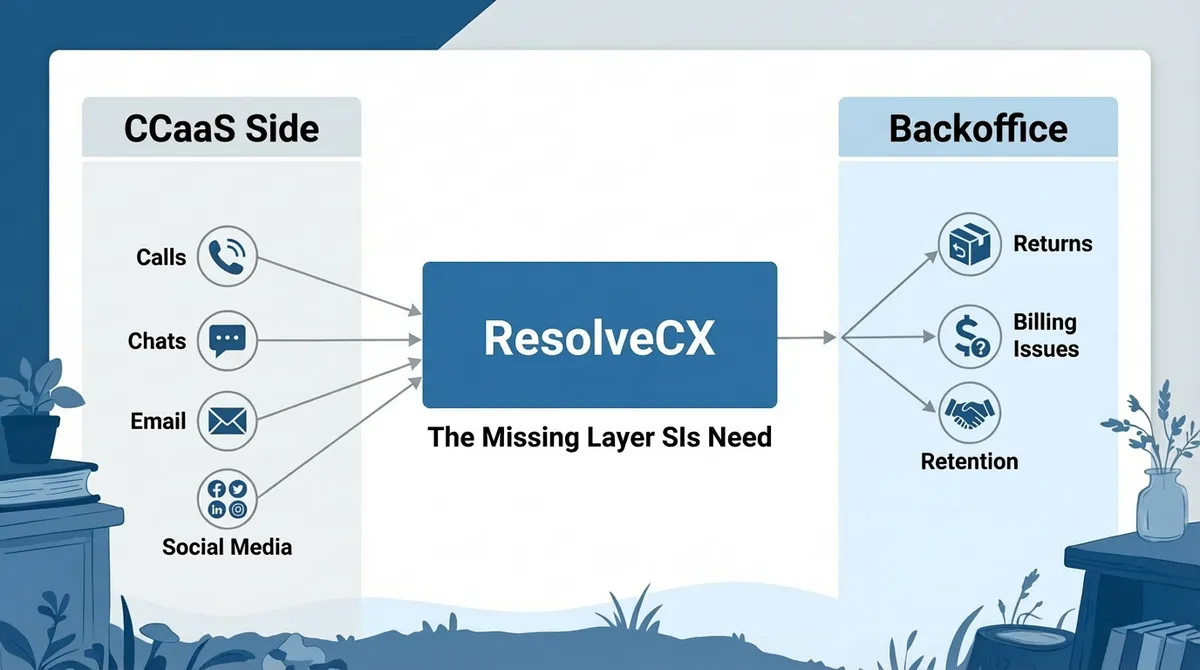
Why System Integrators Need a Case-First Layer
How ResolveCX helps SIs attach higher-margin services by making complaint and escalation handling auditable, consistent, and defensible across every CCaaS deployment.

Patient Grievance Handling in Multi-Hospital Networks
Why inconsistent processes in growing hospital networks create governance risk and how structured standardisation transforms complaint management across sites.

How AI Complaint Resolution Software Prevents Escalations and Customer Churn
Learn how AI-powered resolution governance helps teams detect escalation risk, preserve case context, connect recurring complaints to root causes, and intervene before customers leave.