Customer Complaint Escalation Process: Levels, Triggers and Ownership
A practical operating guide to complaint escalation levels, triggers, ownership, handoffs and remedy verification, with eight steps and an adaptable matrix.
ResolveCX Team27 October 202614 min read
Key Takeaways
1Use observable triggers to select the expertise, authority or urgency needed.
2Treat four escalation levels as an adaptable model, not a mandatory sequence.
3Keep one complaint owner accountable until a receiving owner accepts responsibility.
4Transfer evidence, requested decisions, deadlines and customer-update commitments together.
5People own consequential decisions; verify the remedy before closing the complaint.
A customer complaint escalation process moves a complaint to the expertise, authority or urgency required for a responsible outcome. It should tell employees what activates escalation, who coordinates the complaint, which decision is needed, when the customer receives an update and what evidence proves completion.
The goal is controlled intervention rather than automatic transfer to a senior person. A clear process preserves the customer account, investigation history and accountable decisions. Explore ResolveCX's approach to governed complaint resolution when considering how those controls can remain connected.
What Is a Customer Complaint Escalation Process?
The customer complaint escalation process is the documented route used when normal handling cannot safely, fairly or promptly deliver the next action. Escalation may add specialist expertise, increase decision authority, accelerate work, require independent review or initiate an external referral.
Escalation does not always move upward. A handler may refer technical work sideways while retaining customer communication. Priority determines speed; escalation changes who must act, decide or oversee. Internal escalation also differs from referral to an ombudsman, regulator or alternative dispute-resolution scheme operating under separate rules.
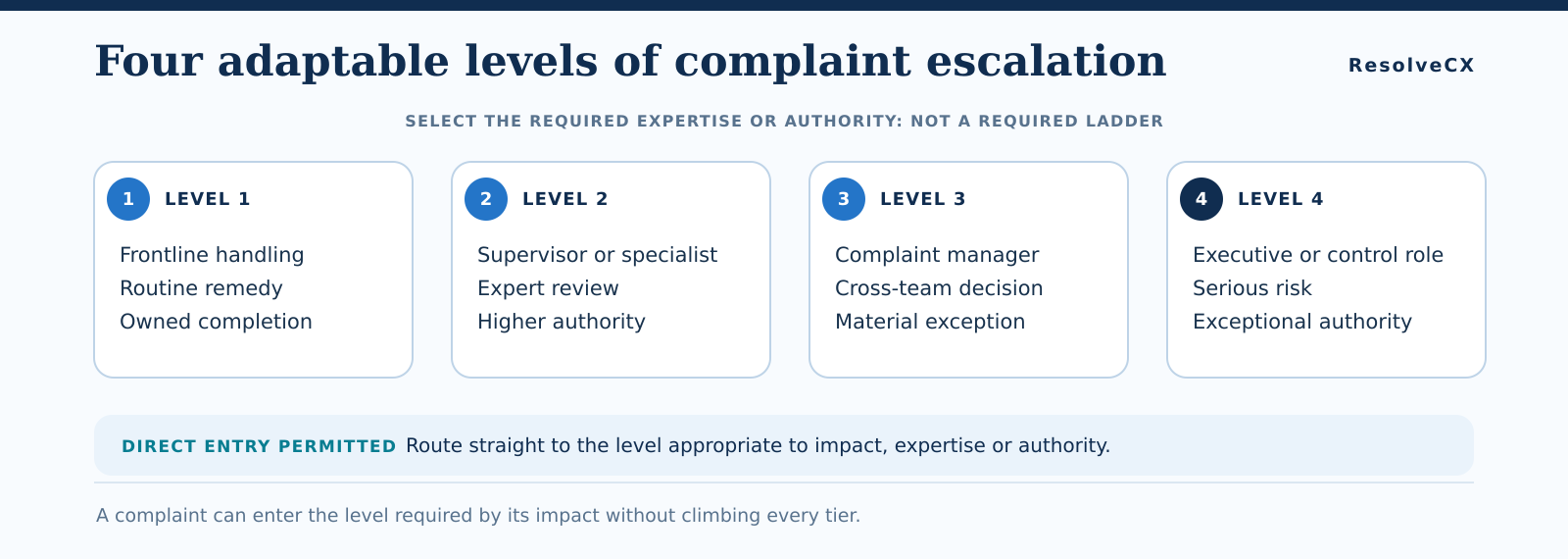
These four levels are an adaptable operating model, not a legal standard. A complaint can enter at the level appropriate to its impact without climbing each step.
Level 1: Frontline resolution
Frontline teams handle complaints covered by known procedures and remedies. They capture the concern, acknowledge receipt, correct straightforward errors and retain responsibility until completion or accepted escalation.
Level 2: Supervisor or specialist review
Use Level 2 for additional expertise, policy interpretation or authority beyond frontline limits, including technical diagnosis, disputed billing evidence or supervisor-approved remedies.
Level 3: Management and cross-functional decision
Level 3 coordinates significant impact, multiple departments or a material exception. A complaint manager assembles findings and obtains the appropriate cross-functional decision.
Level 4: Executive, legal, compliance or crisis handling
Reserve Level 4 for serious potential harm, material security events, substantial regulatory exposure or widespread failure. Executive visibility supports accountable action without replacing qualified investigation.
Level
Typical owner
Example trigger
Required authority
Exit condition
Level 1
Frontline handler
Standard complaint within policy
Approved routine remedy
Action verified and explained
Level 2
Supervisor or specialist
Expertise or higher remedy required
Specialist finding or limited exception
Finding accepted and next action owned
Level 3
Complaint manager
Multi-team impact or repeated failed resolution
Cross-functional decision
Authorized decision and delivery plan
Level 4
Executive or control function
Serious harm, legal or regulatory risk
Exceptional or independent authority
Risk controlled and accountable outcome issued
Figure 1. Levels describe authority and expertise, not a mandatory sequence.
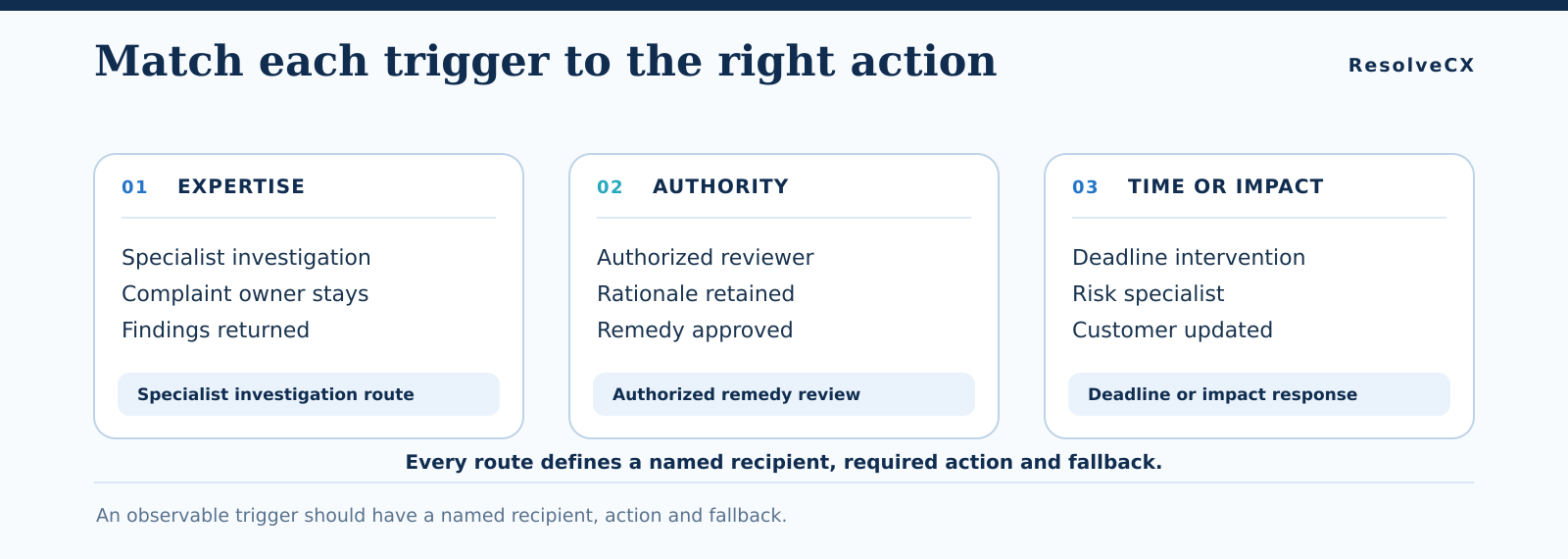
A trigger describes an observable condition and resulting action. “Customer is upset” is subjective; “customer disputes a second resolution and requests independent review” is verifiable.
Impact or potential harm
Escalate when delay or error could materially affect health, safety, finances or essential-service access. Assign urgent review before evidence is complete, recording known facts and uncertainty.
Missing expertise
Use functional escalation when the current team lacks expertise. Route the task to a qualified specialist while preserving one complaint owner; technical difficulty alone need not involve senior management.
Insufficient decision authority
Use hierarchical escalation when the proposed remedy, exception or final response exceeds the handler's authority. Record the decision requested and applicable limit so the receiving reviewer understands why involvement is necessary.
Deadline or commitment risk
Intervene before a customer or regulatory deadline expires through resources, an owner change, interim response or management review. A clock alert should not send every delay to executives.
Repeated failed resolution
Escalate when earlier actions failed, new evidence arrives or the case repeatedly reopens. Review prior reasoning instead of repeating the same remedy under a new owner.
Vulnerability, accessibility or communication needs
Provide suitable assistance when customer circumstances or communication needs affect fair handling, while limiting unnecessary disclosure of personal information.
Legal, regulatory, privacy or security concern
Send potential control issues to the designated specialist. Frontline staff should refer observable indicators without making legal conclusions, while access to restricted material remains controlled.
Customer request for review
Explain the review path. A request for “the CEO” need not reach an executive, but route it to a role with adequate independence and authority.
Figure 2. Route observable triggers to roles with an action and fallback.
Who Owns an Escalated Complaint?
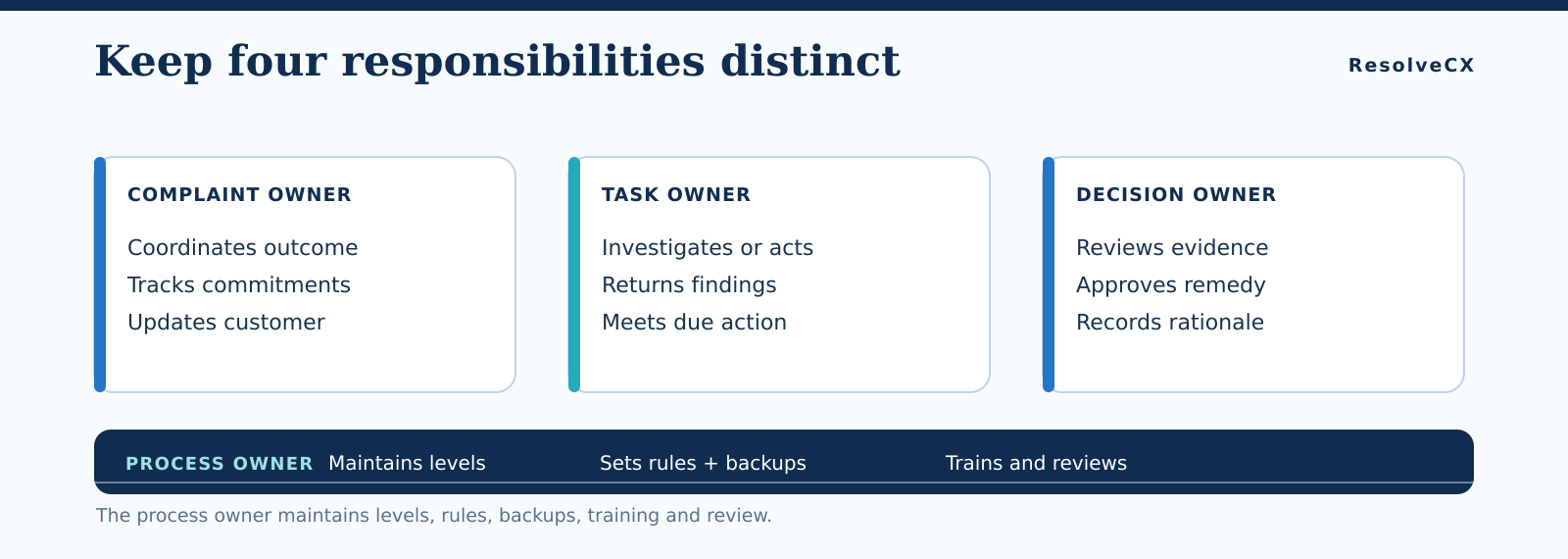
One complaint owner coordinates the outcome while others own tasks and decisions. That responsibility covers the plan, deadlines, evidence, customer updates and final verification.
Complaint owner
The complaint owner coordinates teams, follows dependencies, manages communication and verifies the authorized remedy.
Task owner
A task owner retrieves evidence, investigates a defect or completes another defined action. Task assignment does not transfer responsibility for the overall customer outcome.
Decision owner
The decision owner can approve, reject or amend a finding, remedy or exception. Record the evidence considered, rationale, conditions, date and authorized person.
Process owner
The process owner maintains definitions, levels, fallback roles, training and controls, then reviews whether triggers remain consistent and current.
Customer-communication owner
The complaint owner usually retains customer communication. If that responsibility transfers, record acceptance and tell the customer who will make the next contact.
Figure 3. One owner coordinates the complaint across tasks and decisions.
Preserve the original concern, receipt time, channel, known impact, requested outcome and supporting material. Confirm receipt and the next contact without delaying urgent review.
2. Assess impact and applicable handling
Identify immediate risk, case type, accessibility needs, deadlines and conflicts. Separate confirmed facts, allegations and summaries, applying appropriate access restrictions.
3. Confirm the escalation trigger
Record the condition, intended level and intervention. If several triggers apply, choose one coordinating route and avoid competing owners.
4. Assign or retain accountable ownership
Name the complaint owner, receiving role, due action and fallback. The current owner remains accountable until acceptance; a queue assignment alone is insufficient.
5. Transfer an evidence and decision packet
Provide the reference, concern, impact, trigger, attempted actions, relevant evidence, requested decision, deadline and customer-update commitment without distributing irrelevant personal information.
6. Investigate, decide and approve
The receiving role examines evidence, documents uncertainty and acts within its authority. Reviewers can approve, amend, reject or request further investigation, with rationale retained.
7. Communicate progress and outcome
Tell the customer what is being reviewed, who owns the next contact and when an update is expected. The final response explains the outcome and applicable review route.
8. Verify remedy, close and learn
Confirm that the authorized action occurred. Record the closure reason, preserve history and assign separate corrective work when a recurring cause needs investigation.
Complaint reference and original customer account.
Known impact, urgency and accessibility needs.
Confirmed trigger and intended escalation level.
Work already completed and remedies attempted.
Supporting evidence, contradictions and open questions.
Requested action, decision or specialist finding.
Applicable customer, service or regulatory deadline.
Current owner, receiving role and backup owner.
Next customer update and responsible communicator.
Acceptance, exit and fallback conditions.
How to Build a Complaint Escalation Matrix
Create one row for each meaningful combination of trigger and destination. Include the level, observable criteria, complaint owner, decision role, response target, required evidence, customer-update rule, backup and exit condition.
Test the matrix against recent routine, complex, reopened and failed complaints. If different reviewers choose different levels from the same facts, clarify the trigger. Recheck the matrix after product, staffing, policy, system or regulatory changes.
For example, a customer disputes a second billing correction. The trigger is repeated failed resolution, the complaint owner remains the service case manager, and a billing specialist checks the transaction history. A supervisor reviews any remedy beyond the frontline limit. The customer receives an update by the agreed time even if the specialist has not finished. The escalation exits when the authorized correction is verified and the owner can explain the outcome. If the billing error affects many accounts, create a related incident or problem investigation with separate ownership. This is an illustrative workflow, not a claim about a customer or a prescribed deadline.
How Should Waiting, Rejected Transfers and Reopening Work?
Waiting requires an owner, dependency, follow-up date and customer-update rule. Distinguish customer waiting from an internal delay that may not pause external commitments. If a handoff is rejected, retain the current owner and use a defined fallback. Reopen for new evidence, failed remedy or continuing harm, preserving earlier findings and recording what changed.
For each exception, record the reason for escalation, the person accepting responsibility, the next customer update, and the condition for returning to normal handling. Review exceptions regularly to detect unclear rules and bottlenecks in practice.
How Can Automation and AI Support Escalation?
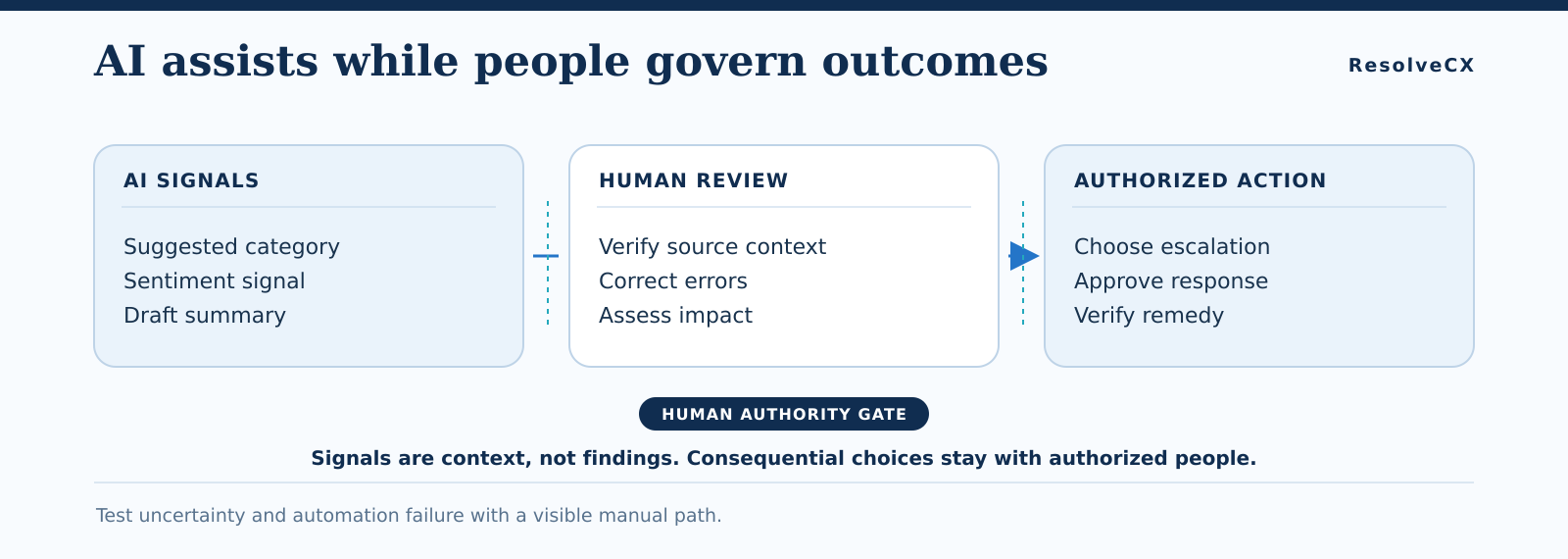
Automation can monitor deadlines, route work and expose overdue actions. AI can suggest classifications, sentiment signals, summaries and relevant knowledge. Test accurate, uncertain and incorrect outputs. People verify sources and consequences; sentiment alone should not determine compensation, vulnerability or legal status. Label generated summaries, preserve source records and provide correction and manual fallback paths.
Salesforce documents criteria-based escalation rules and actions as vendor background, not evidence of ResolveCX capabilities. 5
Figure 4. Human reviewers govern escalation and remedy decisions.
How Should Teams Communicate During Escalation?
Confirm that the complaint has moved to review without promising a specific result. State what will be examined, who owns the next contact and when the customer will hear again. Use interim updates when investigation continues beyond the expected milestone.
The final communication should address each material complaint point, summarize the evidence or reasoning that can appropriately be disclosed, state the action and explain any available review route. Avoid presenting a draft, AI suggestion or unapproved finding as final.
Regulatory and Industry Considerations
Escalation rules vary by jurisdiction, product and sector. UK financial-services firms should assess applicable FCA DISP requirements for complaint handling, resolution, time limits, records and reporting. The precise route depends on the complaint and respondent. 1
UK telecommunications providers must maintain an accessible complaints code, and unresolved disputes may proceed to an approved alternative dispute-resolution scheme under applicable Ofcom rules. Internal escalation should leave enough time to meet external obligations. 2
In US consumer finance, the Consumer Financial Protection Bureau routes eligible complaints to companies for review and response through its process. Organizations need clear ownership for external complaints as well as internal ones. 3
UAE businesses should identify the relevant federal, emirate and sector channels. Consult the Ministry of Economy and Tourism's consumer-complaint resource and the relevant competent authority to confirm intake and referral responsibilities. 4
Software can support consistent routing, access control, deadlines and records. It does not guarantee compliance. Review requirements with legal, compliance, privacy and security stakeholders and configure the workflow accordingly.
Which Escalation Metrics Should Teams Track?
Measure escalation rate by complaint type and trigger, time to accepted ownership, time awaiting decisions, missed triggers, unnecessary transfers, overdue updates, reopened complaints, remedy completion and repeat issues. Trace aggregates back to individual cases so managers can inspect causes.
Define each measure's denominator, clock and exclusions. Lower escalation or closure time is not improvement if valid risk, required review or remedy verification disappears.
Common Escalation Process Failures
Treating customer emotion as the only trigger.
Requiring every complaint to climb every level.
Transferring work without receiving-owner acceptance.
Confusing task assignment with complaint ownership.
Escalating urgency to a role without relevant authority.
Sending incomplete evidence or contradictory customer updates.
Allowing internal waiting to hide approaching deadlines.
Closing after approval but before the remedy occurs.
Using AI classification without correction or fallback controls.
Failing to reopen when an authorized action does not work.
Combining internal escalation with external regulatory referral.
Recording recurring complaints without assigning prevention work.
How ResolveCX Supports Complaint Escalation
ResolveCX supports the customer complaint escalation process through configured triggers, accountable ownership, time controls, approvals, customer updates and evidence. AI can surface context and suggestions where configured, while people retain control of significant outcomes. 67
Organizations should verify required case types, permissions, integrations, retention rules, reporting and fallback paths during implementation. Effective governance depends on configuration and operating practices; ResolveCX does not guarantee legal or regulatory compliance.
Conclusion
A dependable customer complaint escalation process uses observable triggers, the right expertise or authority, one accountable complaint owner and accepted handoffs. It preserves evidence, keeps customers informed and verifies the remedy before closure. Start with recent failed or delayed complaints, test the matrix against them and correct unclear ownership before adding automation.
Escalate when the current handler lacks required expertise, authority, independence or time, or when impact and applicable rules require specialist intervention. Use an observable trigger and named destination.
Functional escalation adds specialist expertise. Hierarchical escalation adds decision authority. Time-based escalation responds to deadline risk, while impact or risk escalation addresses potential harm or control concerns.
Use the fewest levels that reflect meaningful changes in expertise, authority or oversight. Four levels provide a practical starting model, but organizations should adapt it to actual operations.
One complaint owner coordinates the overall outcome. Specialists may own tasks, and authorized reviewers own decisions. Overall responsibility transfers only when the receiving role accepts it under the defined process.
It requires appropriate review, not necessarily executive involvement. Route the complaint to someone with adequate independence and authority, and explain the review path clearly.
Include the original concern, impact, trigger, work completed, evidence, open questions, requested decision, deadline, current owner, receiving role, customer-update commitment and fallback.
Rules can monitor time, route work and send alerts. AI can suggest categories or risk signals. People should review material context and retain authority over consequential decisions and remedies.
Priority controls speed. Escalation changes who must act, decide or oversee the work. A complaint can be urgent without requiring higher authority, or non-urgent while needing specialist approval.
Close after the authorized decision has been implemented, the outcome communicated, applicable records completed and remaining work assigned. A decision or status change alone is insufficient.
No. Software can support controls and records. Compliance depends on applicable requirements, configuration, policies, qualified decisions, supervision and consistent operating practice.
ResolveCX Team are practitioners and product specialists in complaint governance, escalation management, and regulated CX operations. Our articles draw on real implementation experience across financial services, healthcare, and telecommunications.