
Escalation Management Matrix: Roles, Rules and Examples
A practical escalation matrix guide with row fields, distinct owners, seven handoff steps, three worked examples and seven implementation tests.

Key Takeaways
- 1Map observable triggers to expertise, authority, acceptance targets and backup coverage.
- 2Separate case, task, decision and process ownership.
- 3Keep the current owner accountable until a receiving owner accepts.
- 4Track internal targets separately from customer commitments and applicable external obligations.
- 5Test coverage gaps, authority limits and remedy verification before adopting a matrix.
An escalation matrix tells customer operations which issue needs intervention, who can act, and what happens if that person is unavailable. It works when a receiving owner accepts and the customer knows who remains responsible. This guide offers a matrix, three examples, and a test method. Explore ResolveCX's complaint governance approach for visible ownership, evidence, and decisions across teams.
What is an escalation matrix?
An escalation matrix is a decision table that maps an observable trigger to the role, authority, response target, backup, and communication action required. The matrix helps a handler choose the route. A procedure explains how to make and verify the handoff. The case record preserves the trigger, acceptance, evidence, decisions, customer updates, and outcome. All three are needed for complex complaints.
An escalation is not always a climb through management levels. A billing specialist may investigate a duplicate charge while the complaint owner keeps the customer informed. A supervisor may separately approve a remedy. A widespread service failure may also activate an incident response. These routes can operate together without transferring every responsibility to a single manager. For introductory definitions, see what escalation management means. This guide focuses on matrix rows and accepted handoffs, rather than the software buyer's guide.
Functional, hierarchical, and time-based routes
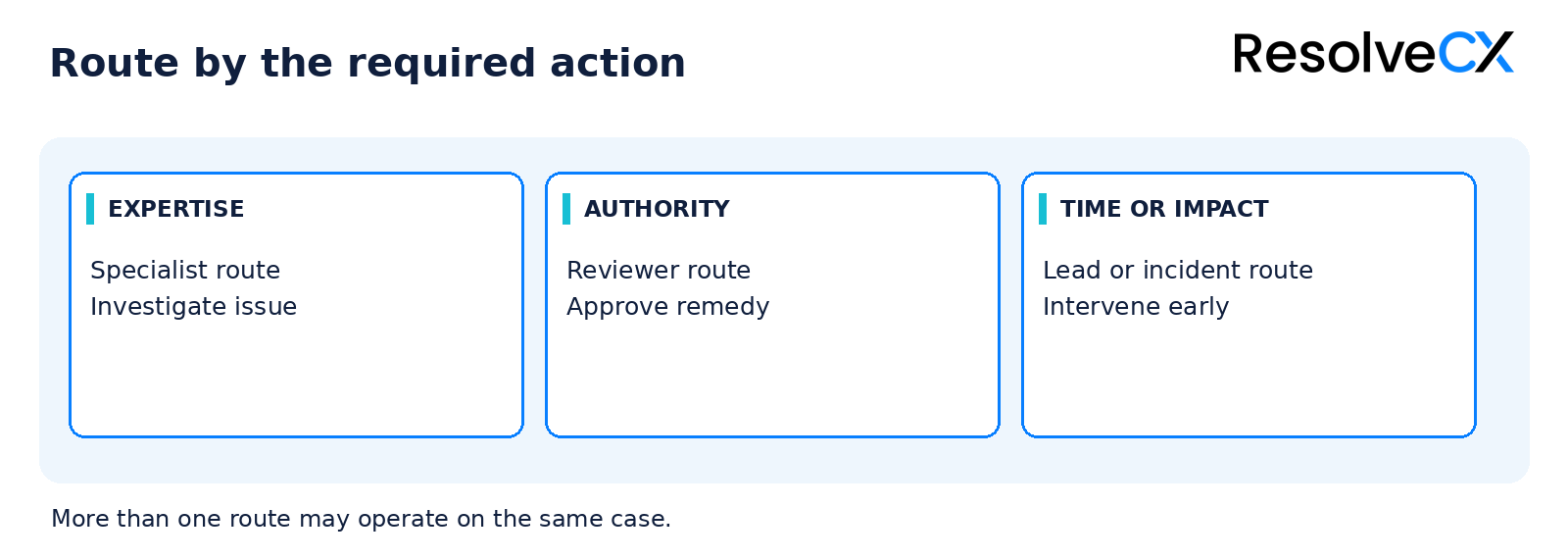
Functional escalation brings in expertise that the current handler lacks. Hierarchical escalation brings in a person with the authority to make a decision or resolve a conflict. Time-based escalation activates when an agreed progress or deadline threshold is reached. Define what each route changes: investigation ownership, approval authority, priority, or visibility. An alert that changes none of these is unlikely to help.
What belongs in each matrix row?
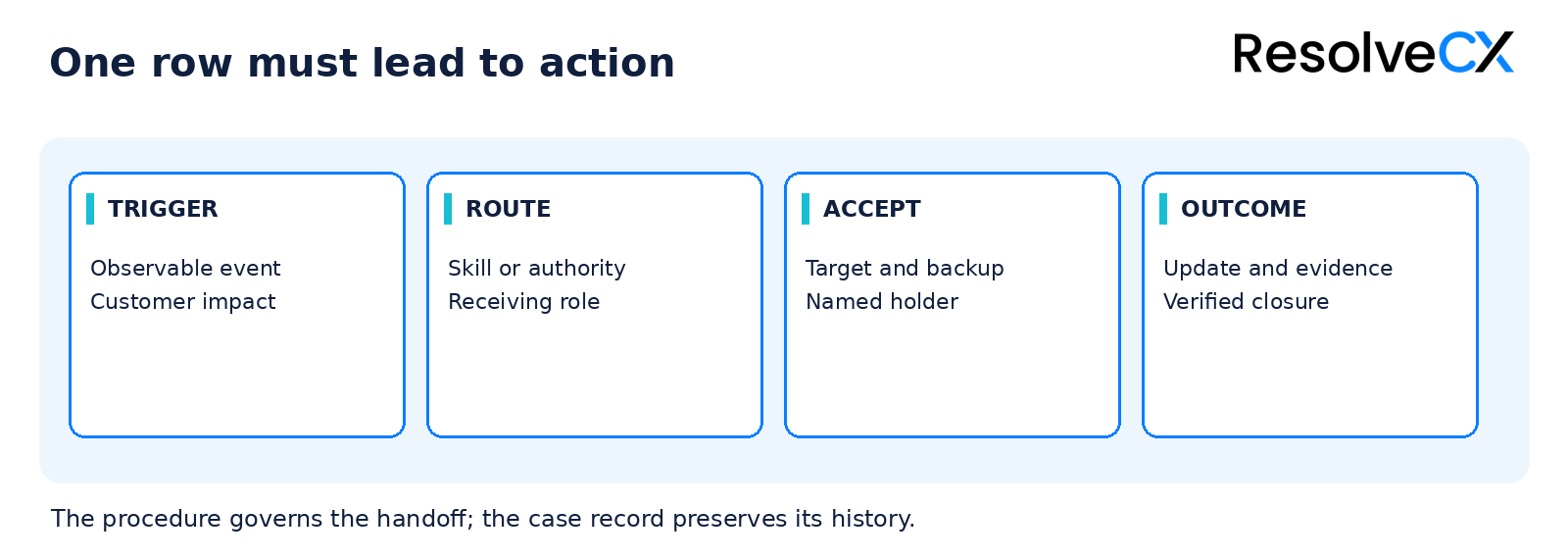
Build a row around a repeatable decision, not merely a department name. The example below shows fields that a customer service team can copy into its own policy. The roles and targets are illustrative. Validate them against staffing, customer commitments, contract terms, risk controls, and applicable obligations before use.
| Field | What to record | Test question |
|---|---|---|
| Trigger and impact | Observable event, affected customers, urgency, and uncertainty | Could two handlers identify the same trigger? |
| Route and role | Specialist, manager, control function, or parallel routes | Can this role actually investigate or decide? |
| Acceptance and backup | Receiving person, acknowledgement target, and fallback route | Who owns the case if nobody accepts? |
| Required action | Specific finding, approval, containment, or review | What should the recipient deliver? |
| Customer update | Communication owner, channel, and next promised time | Who speaks to the customer meanwhile? |
| Evidence and closure | Source record, decision rationale, remedy check, and review route | Can someone reconstruct the outcome? |
The escalation matrix should point to a maintained coverage directory rather than repeat personal contacts. Specify business or elapsed time, time zone, start event, and holidays. Keep a regulatory response date separate from an internal acceptance target. A specialist task does not erase a customer commitment.
A filled row for a billing dispute
Trigger: A customer provides evidence of a duplicate charge and the proposed remedy exceeds frontline authority. Route: Payments operations investigates the transactions; an authorized reviewer decides the remedy. Acceptance: Both recipients acknowledge within the organization's approved target, with named backups. Communication: The complaint owner gives the next update at the agreed time. Closure: Verify the correction, record approval and customer response, and retain the source evidence. No universal response time is implied by this example.
Which role owns the case, task, and decision?
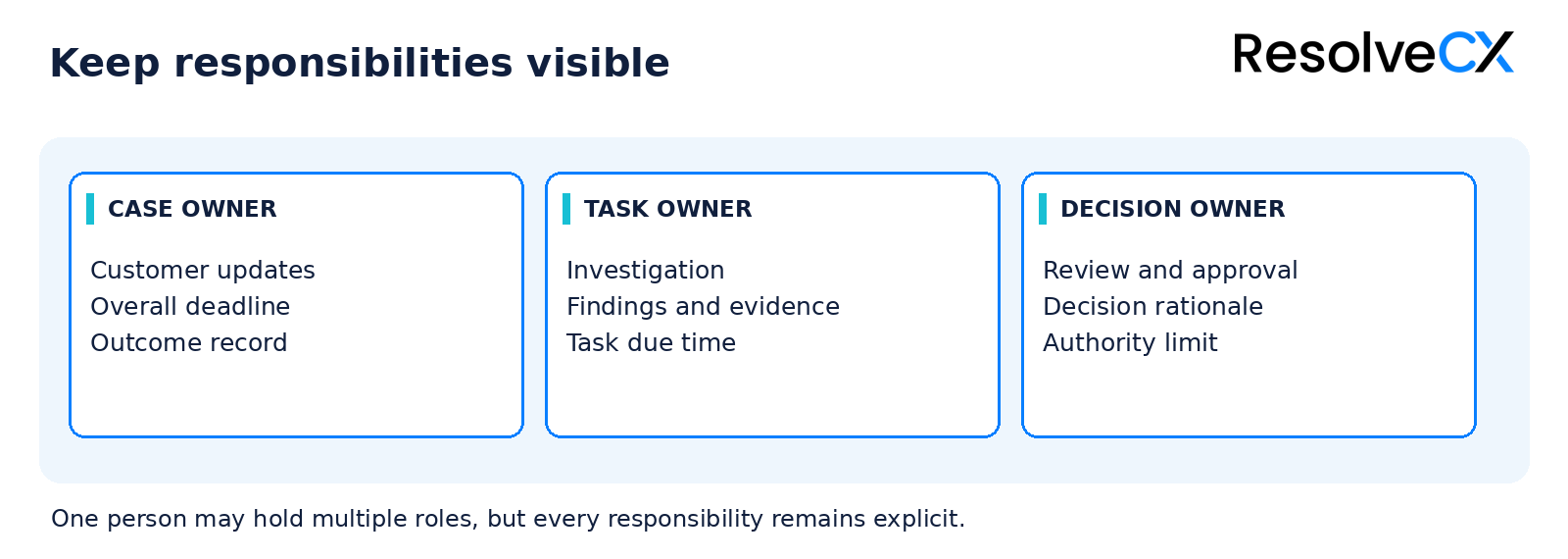
The case owner coordinates the customer outcome and remains accountable for progress, the next update, and the complete record. A task owner investigates or performs a defined action. A decision owner approves a remedy, exception, or formal response within delegated authority. The same person can hold more than one role in a small team, but the responsibilities should remain explicit.
| Role | Owns | Does not assume automatically |
|---|---|---|
| Case owner | Customer communication, overall progress, deadlines, outcome record | Specialist expertise or remedy authority |
| Task owner | Investigation, findings, evidence, task due time | Customer relationship or final approval |
| Decision owner | Review, approval or rejection, rationale | Completion of every investigative task |
| Process owner | Matrix version, coverage, training, exception review | Ownership of every live customer case |
Identify both role and current holder. A role-only entry may lead to an unmonitored queue; a person-only entry becomes stale. Define backup coverage. For outsourced operations, distinguish the BPO's case owner from the client's approval authority, and define how the client receives evidence and accepts a decision request.
Which rules should trigger escalation?
Use conditions a handler can recognize from the record. Customer impact, continuing harm, inability to use a core service, repeated failed contacts, a threatened commitment, missing expertise, or a remedy beyond authority may justify intervention. Sensitive allegations may require a separate approved route. A customer's tone can be a useful signal, but it should not alone determine the legal significance, severity, or outcome of a complaint.
Severity, priority, and authority are different
Severity describes impact. Priority describes the order of attention, considering urgency and commitments. Authority describes who can make a material decision. A low-impact error might become urgent because a promised response is due. A widespread failure can be severe even before the first customer complains. The matrix needs separate fields when these distinctions change routing.
| Situation | Route | Required action | Fallback |
|---|---|---|---|
| Specialist knowledge required | Functional route to named expert | Accept task and report finding | Backup specialist or lead |
| Remedy exceeds authority | Authorized decision maker | Review evidence and decide | Alternate approver |
| Deadline becoming unworkable | Case lead or complaint manager | Remove blocker and agree response plan | Duty manager |
| Wider service disruption | Approved incident route plus case owner | Contain impact and connect affected cases | Incident backup |
Escalation thresholds should leave enough time for useful action. If investigation, approval, and response preparation require several working days, a warning two hours before the external deadline is too late. An internal service level agreement can set a shorter acceptance target for the next team. Calculate both clocks visibly and document which, if any, pause rules are permitted.
When can a case skip a level?
A case should go directly to the skill or authority the trigger requires when the policy permits it. An apparent safety concern should not wait in a routine queue just to pass through every tier. Likewise, a specialist investigation need not imply executive approval. A bypass should record the reason, receiving role, and case owner so that speed does not remove accountability. Review ResolveCX escalation management for a product view of governed triggers, ownership, decisions, and customer context.
What does an accepted handoff look like?
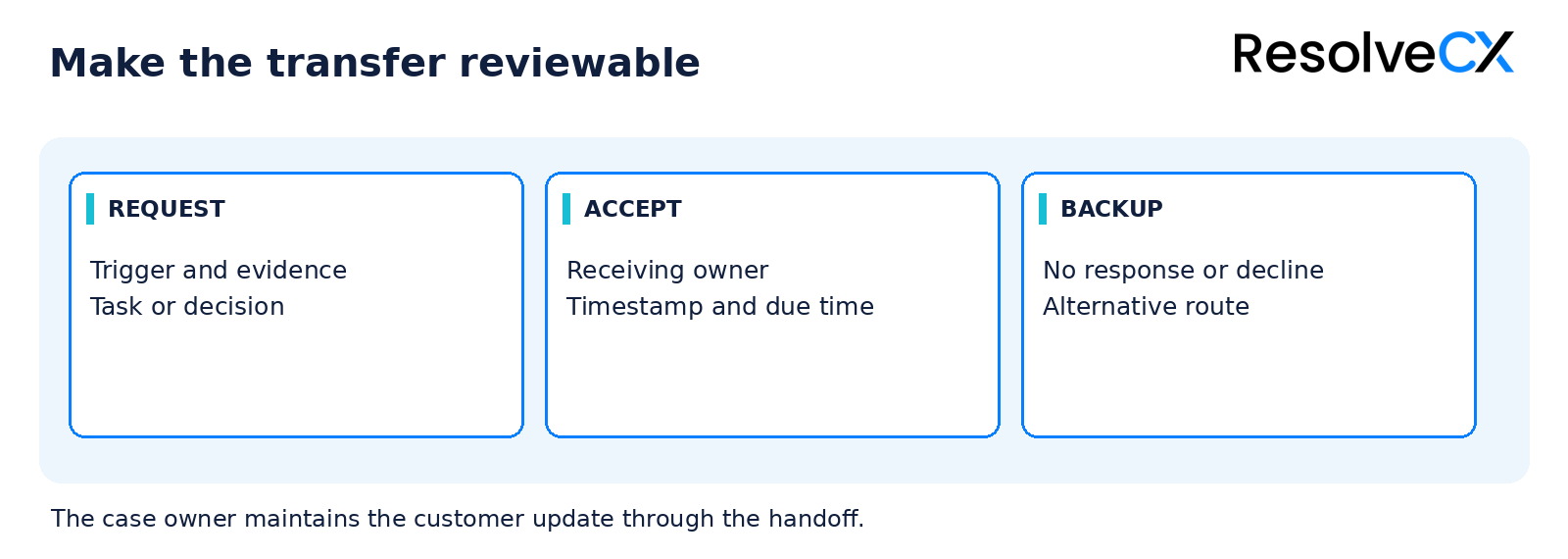
A transfer request is not an accepted transfer. Until the receiving person acknowledges responsibility, the current case owner should retain the next action and monitor the deadline. This rule prevents a case from disappearing between an inbox, specialist team, and manager. The receiving person can decline for a documented reason, but that decision must activate a backup route rather than return the issue to an unattended queue.
-
Record the trigger, customer impact, priority, deadline, and requested decision or task.
-
Attach a short evidence packet linked to the full case history; separate verified facts from assumptions.
-
Notify the receiving role through the approved channel and record the request time.
-
Require acknowledgement or a documented decline within the configured target.
-
If no acceptance arrives, contact the backup and alert the coordinating owner.
-
Confirm who will update the customer, when, and through which channel.
-
Record findings, approvals, action taken, remedy verification, and closure or further review.
An evidence packet should include the reported concern, affected service, chronology, steps already tried, supporting material, known uncertainty, customer expectation, remaining time, and the exact decision needed. Do not copy sensitive material into unnecessary messages. A summary helps the recipient act quickly, but the underlying evidence must remain accessible under approved permissions.
Three worked examples for customer operations
Retail: duplicate payment and remedy approval
A customer reports two payments for one order. The agent records references and checks whether a duplicate capture occurred. Payments operations accepts an investigation. Because correction exceeds agent authority, an authorized reviewer receives a parallel decision request. The complaint owner remains the contact, promises an update, and verifies correction before closure. If the specialist is unavailable, backup activates without making the customer restart.
BPO: client-side approval after a service failure
A contact-centre agent identifies repeated failed fulfilment and a customer request beyond the BPO's delegated remedy limit. The BPO case owner preserves the conversation and asks its delivery lead to validate facts. The client-side approver receives the evidence, authority question, and deadline through the contracted channel. The BPO retains communication responsibility unless the contract assigns it differently. The matrix names an out-of-hours recipient and records when the client accepted the decision request. Internal escalation cannot be mistaken for client approval.
Financial services: an internal clock and a complaint-response obligation
A UK financial-services firm receives an applicable complaint requiring investigation and a material remedy decision. The case owner tracks internal specialist and approval targets alongside the relevant complaint-response rule. The FCA's DISP 1.6 sets different requirements for particular complaint types; it includes an eight-week written-response framework for many complaints and shorter rules for certain payment-services and e-money complaints. Legal and compliance teams must confirm which rule applies. An internal handoff or pause must not be assumed to change that external obligation. The official FCA complaint time-limit rules govern this illustration. For applicable EMD or PSD complaints, DISP 1.6.2AR requires a final response by the end of 15 business days after the day of receipt. Only in exceptional circumstances, for reasons beyond the respondent's control, may a holding response by that point precede a final response by the end of 35 business days after the day of receipt. Under DISP 1.6.2BR, an EMD or PSD part of a mixed complaint follows the shorter rules. Confirm applicability, exceptions and any other relevant provisions with qualified advisers; this illustration is not legal advice.
These examples show decisions rather than universal tier counts. Retail may need an investigator and approver; BPO work adds an external authority boundary; regulated work requires a separately governed deadline. Explore ResolveCX case management when several contributors must work from one customer record with visible evidence, due actions, and decisions. These are illustrative scenarios, not customer case studies.
How do you implement and test the matrix?
Start with closed and near-miss cases. Note unclear ownership, insufficient specialist context, stalled approval, or repeated customer explanations. Agree impact categories, authority limits, backup coverage, and evidence with operations and control teams. Configure the smallest usable set of routes and test before launch.
-
Replay a case that should have gone directly to a specialist.
-
Test a wrong initial severity and document how a person corrects it.
-
Submit a complaint outside coverage hours and check the next available owner.
-
Make the primary approver unavailable and verify fallback acceptance.
-
Change priority near a deadline without losing the original timestamps.
-
Test an incident affecting several complaints while each customer case stays owned.
-
Reopen a case after an apparently completed remedy and check the history.
For each simulation, ask whether the recipient could act using the provided evidence, whether the customer-update owner stayed clear, and whether a reviewer could reconstruct the decision. Record the observed result for each test, assign someone to fix failed routing, and repeat the scenario before publishing the policy to frontline teams. Version the matrix, name its process owner, train handlers at the point of work, and review it when policies, products, staffing, or recurring issues change.
What should software support?
Software can present the route, track time, notify the owner, record acceptance, and retain history. It cannot repair an ambiguous trigger or confer undelegated authority. Demonstrate a case that changes priority, crosses a shift boundary, needs approval, and receives a customer update.
Ask the vendor to show linked evidence, role permissions, backups, separate clocks, exceptions, decision history, and reports on unaccepted handoffs. Check security, retention, data residency, and integration behavior with the responsible teams. AI may suggest a category, risk signal, or summary. An authorized person should verify the source context and retain control over material escalation, remedy, response, and closure decisions.
How ResolveCX supports a governed matrix
ResolveCX describes configured escalation triggers, tiers, time targets, accepted ownership, human-reviewed decisions, and a record of customer updates. Its case management approach can keep cross-team actions and evidence connected to the complaint. Evaluate the specific rules, calendars, access, integrations, and exceptions your operation needs. The platform supports governance processes but does not guarantee that a complaint will meet every service or regulatory requirement.
Conclusion
A useful escalation matrix directs a specific decision to an available person while one owner remains accountable for the customer outcome. Fill one row for a recurring difficult case, then test its trigger, acceptance, backup, evidence, update, and closure. To examine that path against your operation, book a ResolveCX demo.
Frequently Asked Questions
Use as many as are needed to distinguish expertise, authority, and coverage. A small team may need two routes; a larger operation may need several. Extra levels should change a decision or capability, not merely add a handoff.
No. The matrix identifies the trigger, route, owner, target, and fallback. The procedure explains how to notify, transfer, communicate, document, and close the work. The case record shows whether the procedure was followed.
The named case or communication owner remains responsible unless an explicit, accepted transfer changes that role. The specialist can own investigation while the original handler updates the customer and coordinates the outcome.
Route it to a manager or authorized reviewer when the needed decision exceeds current authority, a policy requires review, or material risk needs senior intervention. A technical problem may instead need a specialist first.
An internal receiving team may have a new task target, but escalation should not silently reset an existing customer commitment. Check the governing contract, policy, and applicable rules before changing any clock or pause condition.
Record the reason and activate the approved alternative while the current owner maintains the case. The process owner should review repeated declines for an unclear trigger, missing evidence, or insufficient capacity.
AI can flag signals and prepare context. Material routing, approval, remedy, and closure should follow configured decision rights and human review where required. Give handlers a route to correct uncertain or inaccurate suggestions.
Review it when roles, policies, products, service coverage, or customer commitments change, and after recurring failed handoffs. A scheduled review should test whether names, backups, targets, and evidence requirements still work.
Track time to acceptance, unowned cases, late escalations, missed customer updates, approval delay, breach causes, repeat complaints, and verified remedy outcomes. Segment results by issue and severity so an aggregate rate does not conceal material failures.
It should distinguish the BPO's internal route from the client's decision authority and communication duties. Define contract-specific acceptance channels, cover, evidence, and backup contacts so a client handoff remains owned and reviewable.
Sources
Atlassian's incident escalation and SLA documentation is background on routing and clock conditions, not evidence of ResolveCX features or permission to pause external obligations. Google's guidance informs editorial usefulness and clear attribution, not a search-ranking or rich-result guarantee.
About ResolveCX Product Management Team
ResolveCX Product Management Team. This article explains escalation matrix design and evaluation. Examples are illustrative, not customer case studies or legal advice.
Contact the TeamRelated articles
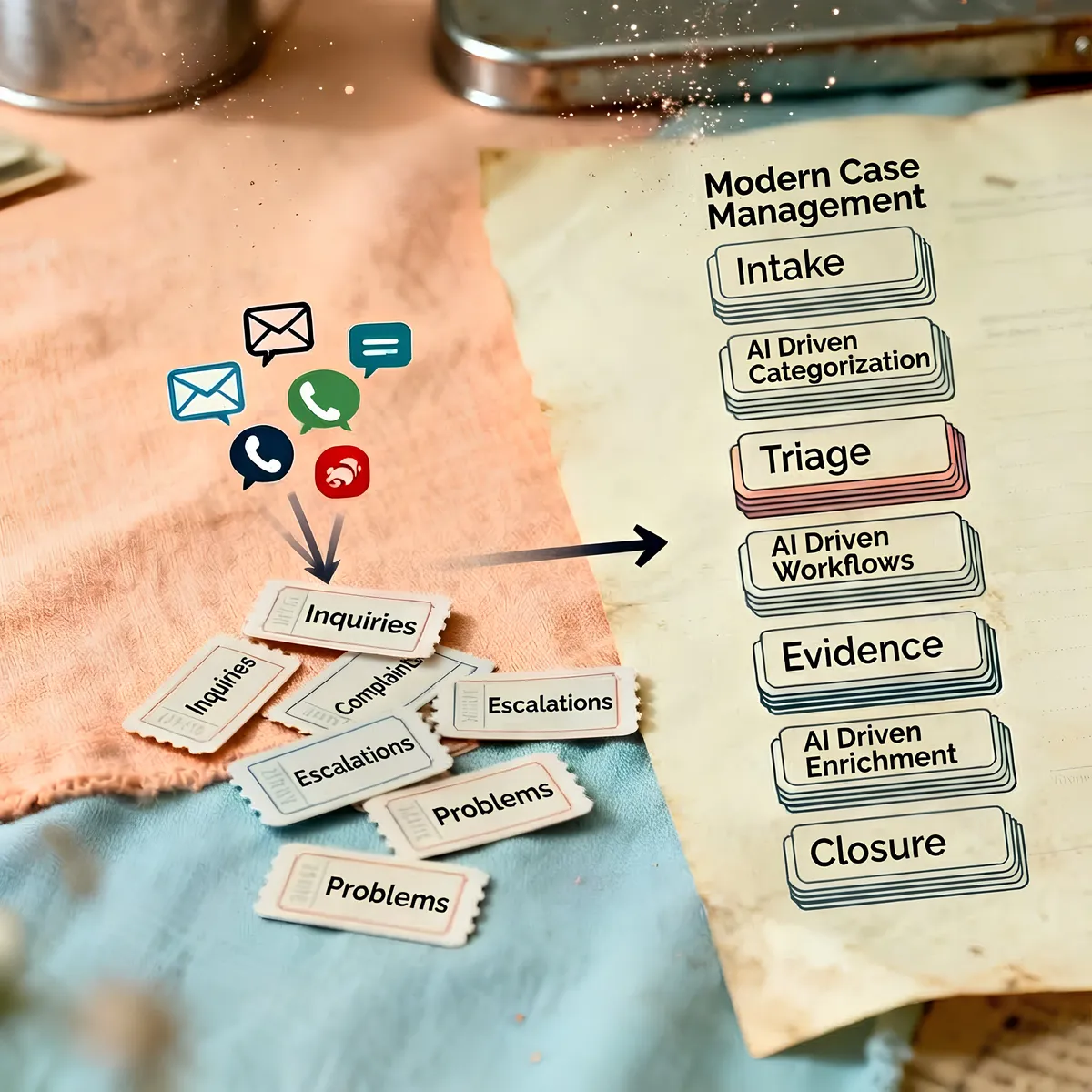
Modern Case Management: Capture, Coordinate, Close
Why ticketing breaks modern CX, what a case-first operating model looks like, and how evidence-rich workflows improve resolution quality and compliance.
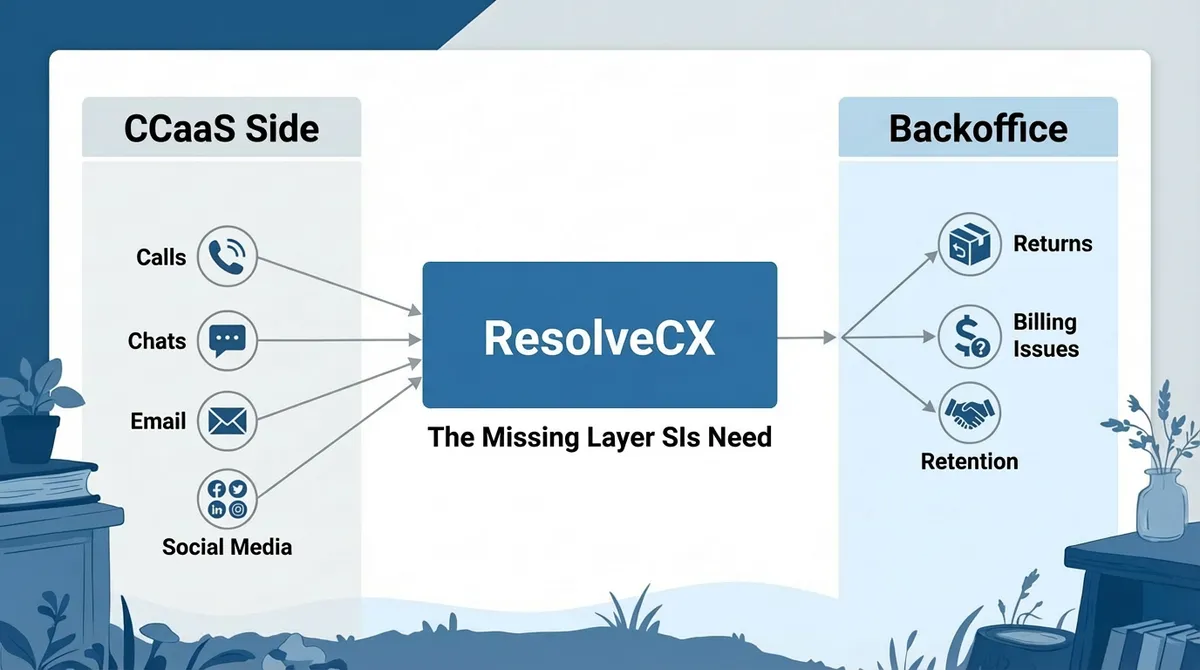
Why System Integrators Need a Case-First Layer
How ResolveCX helps SIs attach higher-margin services by making complaint and escalation handling auditable, consistent, and defensible across every CCaaS deployment.

Patient Grievance Handling in Multi-Hospital Networks
Why inconsistent processes in growing hospital networks create governance risk and how structured standardisation transforms complaint management across sites.