Every CX leader knows the story, even if the details change:
A customer reaches out three times across three channels. An agent emails a partial answer. A chat rep starts from scratch. A phone agent apologizes "for the confusion" and escalates without the full picture.
By the time a supervisor investigates, the issue has splintered into a chain of disconnected tickets, missing evidence, contradictory responses, and a customer who's already reconsidering their loyalty.
This isn't incompetence. It's architecture.
Legacy ticket-based systems were built for transactional throughput, not for preserving a coherent customer narrative. They scatter interactions across multiple threads, bury attachments, obscure ownership, and make it nearly impossible to understand what actually happened.
In regulated industries like telco, finance, insurance, and healthcare, that fragmentation doesn't just slow teams down — it creates risk. Analysts estimate that 30–40% of CX effort is lost to avoidable rework, largely driven by incomplete intake and fragmented context.
McKinsey reports that nearly 70% of escalations in enterprise customer service could be prevented if frontline agents had complete case-level information from the start.
When teams operate without context, customers suffer, agents compensate with guesswork, and leaders are left with metrics that mask the real operational problems underneath.
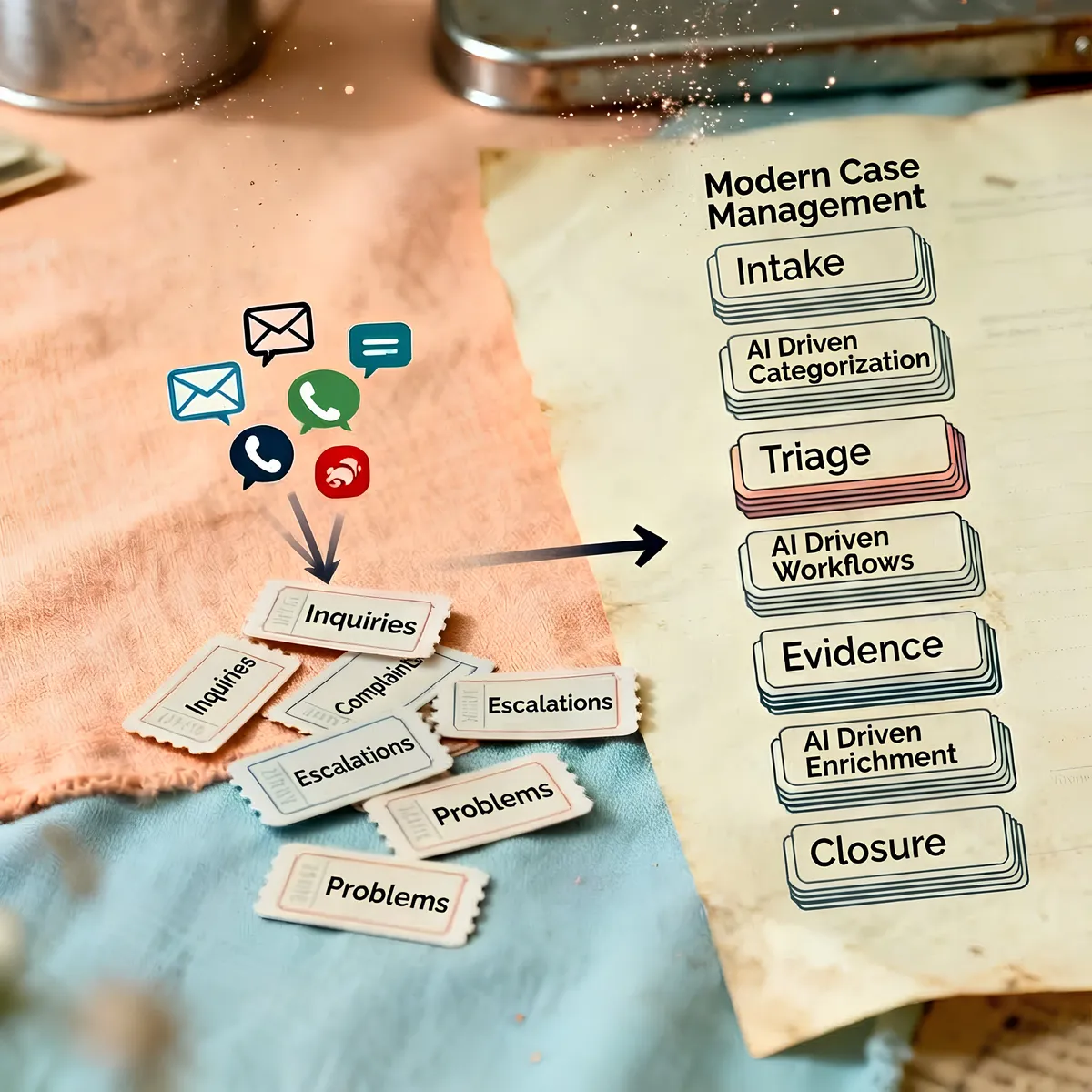
A modern case management system solves this by treating every customer issue as a single, evidence-rich storyline rather than a loose collection of tickets. A single-threaded case view consolidates communications, actions, decisions, documents, timestamps, and ownership into one living record.
This reduces reopens, improves SLA consistency, and gives both frontline teams and compliance officers the traceability they need.
Gartner's research on service experience quality shows that resolution confidence (customers believing the issue was resolved thoroughly and correctly) has over twice the impact on loyalty compared to resolution speed alone in complex service environments.
The move from ticket handling to case-first operations is more than a tooling upgrade. It introduces structure where there was previously improvisation, governance where there was ambiguity, and audit-ready clarity where there was operational noise.
It provides a foundation for scalable triage, high-quality resolution, and transparent collaboration across CX, Ops, Legal, Product, and Risk.
If your customer operations still rely on fragmented ticket threads, this shift reveals what's possible when context isn't hunted down manually but is available from the first interaction to the final resolution — captured, coordinated, and confidently closed.
Why Case Management Needs Reinvention (And Why Tickets Can't Do the Job)
Most CX leaders mistake symptoms — backlogs, training gaps, escalation spikes — for the root problem. The root is architectural: legacy ticketing systems were built for throughput, not for preserving a single, auditable customer story.
In complex environments, that difference costs time, money, and trust.
Ticketing tools optimize dispatch. Modern case management software optimizes truth. Traditional ticket systems scatter interactions across threads, bury attachments, and blur ownership.
The result: agents reconstruct history instead of resolving issues. CCW Digital finds 63% of service leaders say teams waste time reconstructing past interactions, and nearly 40% of tickets arrive with incomplete intake data. Those facts make expensive rework inevitable.
Fragmentation is the hidden operational tax. McKinsey estimates up to 70% of escalations could be prevented if frontline staff had complete case-level context from the start.
In many organizations, rework consumes 25–40% of CX labor hours — hours spent hunting context that a case management workflow should capture once and carry to closure.
For regulated industries (telco, finance, insurance, healthcare), the stakes are higher. These organizations must prove decisions, preserve chain-of-custody, and produce audit-ready case records.
Gartner's 2023 Service Experience research shows that in regulated CX, resolution completeness drives loyalty far more than raw speed — meaning accuracy and traceability matter more than mere handle time.
That's why the shift to a case-first operating model matters.
A true single-threaded case view consolidates multi-channel interactions, decisions, evidence, and ownership into one living record. When your case intake process captures the right metadata and evidence up front, automated case triage and routing work reliably, FCR improves, and audits stop becoming firefights.
And don't confuse band-aids for solutions: adding headcount, slapping AI on top of fragmented data, or grafting automations onto brittle workflows actually amplifies failure modes.
Modern case management fixes the problem structurally: it anchors every action in a governed case timeline so AI suggestions are verifiable, automations are deterministic, and handoffs preserve context.
In short: ticketing tools handle tasks. Modern case management handles truth. Move to a case-first model and you stop chasing context — you start resolving cases with confidence.
The Case-First Operating Model: What It Is and Why It Works
A modern case management system isn't a prettier ticket queue. It's a different operating model entirely — one built around continuity, context integrity, and accountable collaboration.
At its core sits the simplest truth most CX organizations overlook:
A case is not a ticket. A case is a storyline.
A case has a beginning, middle, and end; a clear owner; structured evidence; and a resolution path that can withstand scrutiny from customers, leaders, auditors, and regulators. Tickets capture moments. Cases capture meaning.
A Case Is a Storyline, Not a Transaction
Most customer issues stretch across multiple contacts and multiple teams. Forrester notes that 65% of complex service issues require more than one interaction — which means treating them as isolated tickets destroys the continuity agents need.
A case-first operating model creates that continuity by providing:
- One continuous record of the customer's issue
- Multi-channel consolidation across voice, email, chat, social, and async channels
- Chronological logging of decisions, actions, and communications
- Evidence linked to the exact workflow step it supports
- Clear ownership transitions that never break SLA visibility
This isn't just cleaner documentation, it's operational leverage. When context persists, customers stop repeating themselves, agents stop improvising, and supervisors stop guessing what happened.
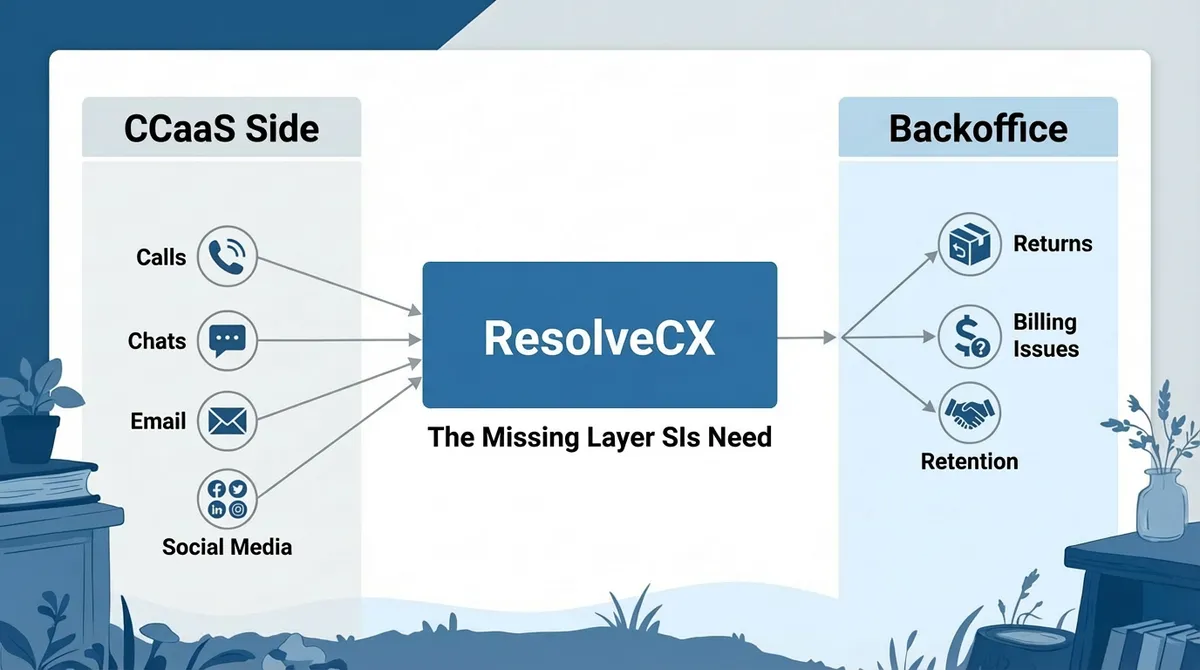
ResolveCX is architected around this exact principle: one case, one timeline, one truth.
Why a Single-Threaded Case View Changes Everything
A single-threaded case view is the backbone of any modern case management workflow. It eliminates the three operational risks that ticketing tools reliably create:
1. Context Loss
Happens when history is scattered across ticket threads.
A single-threaded view ensures:
- all context lives in one timeline
- every step is timestamped
- evidence is organized, not buried in comments
2. Ownership Ambiguity
Tickets fall into queues; cases require accountable owners.
A case-first model provides:
- persistent ownership
- documented, auditable handoffs
- full visibility into who did what and when
3. Audit Gaps
Regulated environments must prove decisions. Ticket notes rarely cut it.
A single-threaded record ensures:
- evidence is tied to workflow steps
- audit logs remain intact
- regulators see the full story without reconstruction
This level of clarity is non-negotiable in industries where compliance, fairness, and traceability aren't "nice to have."
Multi-Team Collaboration Without the Chaos
Most enterprise cases touch multiple functions:
- CX
- Billing or Finance
- Fraud or Risk
- Product or Engineering
- Legal or Compliance
In ticket-based environments, these teams communicate through scattered notes, email threads, Slack channels, and undocumented side decisions.
A case-first operating model fixes that:
- handoffs are explicit and logged
- cross-functional notes live inside the case
- approvals are tied to the case timeline
- escalations carry full context, not blind assignment
Teams collaborate on the same narrative instead of fragmented artifacts.
The Foundation for Every Other Operational Domain
A case-first architecture becomes the substrate for everything else:
- Escalations inherit complete case context
- Problem Management detects patterns from correctly structured cases
- Incident Response depends on accurate, consistent evidence
- AI and automations become safer because the data model is stable and governed
This is why case-first design must precede automation, AI, or workflow orchestration. Without context integrity at the case level, every downstream process becomes noisy, inconsistent, and risky.
A strong case-first operating model isn't a CX enhancement.
It's the operating layer that makes the rest of the business function with clarity and confidence.
Intake: The Root of 40% of Your Rework Problems
Every CX leader knows where most rework begins: bad intake. If the case intake process doesn't capture the right fields, metadata, and evidence cues, the entire case management workflow becomes slower, less accurate, and more expensive.
The numbers back it up. SQM Group shows 22–30% of repeat contacts happen because agents didn't collect the right information upfront. CCW Digital reports 40% of agent time goes into reconstructing missing details. That isn't just inefficiency; it's an operational tax baked into outdated intake design.
Modern case management solves this by treating intake as the moment where context is captured once and carried through the entire case resolution process.
Intake Completeness Predicts Resolution Quality
Most teams assume resolution quality is a coaching or training issue. In reality, intake quality predicts case outcomes more reliably than any other factor.
Strong intake ensures:
- correct classification on first touch
- downstream teams receive the right details
- automated workflows and SLAs trigger correctly
- FCR becomes intentional, not a lucky accident
ResolveCX's structured intake model enforces this discipline with required fields, conditional prompts, and validation rules that prevent downstream "garbage-in, garbage-out" failures.
Industry-Specific Templates Reduce Rework Dramatically
Regulated industries can't rely on generic forms. They require intake templates that align to:
- verification requirements
- policy constraints
- regulatory obligations
- risk classifications
- evidence expectations
Examples:
Finance: identity checks, transaction references, fraud indicators
Telco: service IDs, outage zones, network codes
Insurance: policy numbers, claim types, documentation rules
Healthcare: consent flags, sensitive data categories
Organizations that adopt industry-specific templates typically reduce rework 25–35%, because cases no longer bounce back for missing information.
Multi-Channel Case Linking Begins at Intake
Customers move across channels — email, chat, voice, social — but ticket-based systems treat these as separate records. Modern customer case management relies on multi-channel case linking, where all interactions enrich the same case timeline.
A unified intake process must consolidate:
- the initial contact
- subsequent channel interactions
- metadata from phone, chat, email, social, and third-party systems
This prevents orphaned tickets and ensures AI summarization, triage, and case routing workflows have complete context.
Operational impact:
customers stop repeating themselves
agents stop guessing
supervisors stop hunting for history
triage accuracy improves significantly
Intake Drives Better Triage, Routing, and SLA Accuracy
Intake isn't clerical. It's architectural, because it directly determines whether:
- categorization is correct
- severity is scored accurately
- regulated workstreams trigger reliably
- handoffs follow policy
- SLAs reflect the true case state
Bad intake breaks every downstream process.
This is why telco, finance, insurance, and healthcare teams treat intake as a compliance function, not an admin task.
A case that starts wrong rarely ends right — and no amount of coaching or automation can compensate for intake done poorly.
Case Prioritization, Triage, and Routing: Designing for Speed and Accuracy
Even the strongest intake process collapses if triage is weak. Once a case enters the system, two questions determine whether resolution will be smooth or painful:
What is this case?
Who should handle it?
Legacy ticketing tools answer both questions poorly. Triage is manual, inconsistent, and error-prone — which is why 37% of escalations occur due to incorrect routing (HDI). Cases bounce between teams, SLAs slip, and customers feel like they're dealing with an organization that can't coordinate itself.
Modern case management fixes this by using richer intake data, structured workflows, and governed automation to classify, prioritize, and route cases accurately the first time. The results are immediate: faster case resolution, higher FCR, fewer SLA breaches, and dramatically cleaner operations.
The Triage Logic That Reduces SLA Breaches
Effective triage requires understanding the meaning of the case, not just its metadata. In a modern case management workflow, triage depends on four inputs:
Issue Type
Accurate classification is the foundation of routing and SLA reliability.
Severity & Customer Impact
Severity-based models reduce time-to-resolution by up to 33% (Gartner).
Regulatory or Risk Classification
Fraud, billing disputes, safety concerns, and compliance cases must trigger governed workflows automatically.
Customer Segment or Value
Enterprise and high-value customers often require differentiated routing or faster SLAs.
When these factors work together, triage becomes predictable instead of discretionary. ResolveCX enforces this through structured intake, conditional fields, and metadata-driven rules that eliminate guesswork.
Governed Automation Makes Triage Faster — and Safer
Automation accelerates triage, but only when governed. In regulated industries, "best-guess AI" is a liability.
A modern triage model includes:
- Automated classification with AI-assisted suggestions and human-in-the-loop validation
- Automated SLA assignment that aligns timers with risk and regulatory requirements
- Automated evidence prompts when required fields are missing
- Automated risk flags for safety, fraud, or vulnerable-customer indicators
Automation here isn't for speed alone, it enforces consistency and compliance.
Routing: Getting Cases to the Right Team the First Time
Incorrect routing is one of the fastest ways to destroy trust and inflate cost. A strong routing workflow incorporates:
- Role-based and skill-based routing
- Contextual routing using issue type, product context, risk level, customer attributes, and geography
- Governed handoffs with documented rationale, acceptance, and uninterrupted SLA tracking
ResolveCX captures ownership transitions directly on the case timeline so cases never fall into "no-man's-land."
Routing accuracy itself becomes a KPI. ICMI data shows 20–40% of delays come from misrouted cases — meaning accuracy is a direct proxy for operational health.
How Modern Triage Improves Resolution Quality
Improved triage and routing deliver immediate CX and operational gains:
- Lower customer effort — no repetition, fewer transfers
- Lower agent effort — less reconstruction, more resolution
- Higher FCR — correct classification on first touch
- Stronger SLA adherence — severity and routing logic stay accurate
- Better compliance — regulated case types follow governed paths automatically
Modern case management doesn't just move work faster.
It moves work correctly — and correctness is what creates trust, efficiency, and regulatory safety.
Case Workflows: Repeatability, Compliance, and Auditability
Most CX failures aren't caused by bad agents, they're caused by inconsistent workflows. When every case type is handled differently, reopens spike, escalations multiply, and regulated environments become risky. Modern case management fixes this by turning best practices into governed, repeatable, auditable workflows that any agent can execute reliably.
Deloitte reports that standardized workflows cut unnecessary escalations by 30–50% and increase resolution accuracy by 25%. Consistency is not a nice-to-have; it's operational risk control.
Workflow Templates: Turning Expertise Into Something Repeatable
In ticket-based systems, workflows live in people's heads. Two agents can follow two entirely different paths, producing:
- reopens
- escalations
- compensation leakage
- inconsistent outcomes
- regulatory exposure
Workflow templates eliminate this variability. A billing dispute, verification case, outage investigation, or refund request follows the same sequence every time. Templates ensure:
- agents don't guess next steps
- customers get consistent answers
- supervisors coach against shared standards
- shift changes don't disrupt progress
- audits evaluate one predictable process
ResolveCX's governance model focuses on high-risk categories where inconsistency is expensive: refunds, disputes, and verification.
Evidence Capture: The Core of Audit-Ready Case Records
A workflow without evidence is just a story — and regulators don't accept stories. Modern case management requires capturing the right evidence at the right moment:
- required documents
- multi-channel transcripts
- decision rationales
- customer confirmations
- approvals
- timestamped activity logs
Legacy tools scatter evidence across comments and emails. Modern platforms capture evidence within the workflow, before approvals or closure. Organizations with enforced evidence workflows see 60–80% fewer audit exceptions.
Compliance Built Into the Workflow
Compliance isn't something reviewed later, it must be enforced in real time. Modern workflows embed guardrails that prevent risky deviations:
Field-level requirements
mandatory inputs
conditional fields
structured regulatory formats
Policy constraints
refund limits
verification steps
dual approvals
standardized messaging
Role-based controls
Sensitive steps move only through authorized teams.
A policy PDF can't enforce compliance. A workflow can.
Workflow Visibility: Making the Resolution Process Manageable
Teams can't manage what they can't see. Modern case management platforms provide visibility into:
- completed vs. remaining steps
- pending approvals
- collected evidence
- SLA risks
- bottlenecks
ResolveCX's unified timeline and dashboards ensure agents, supervisors, Compliance, and Ops all see the same truth.
Why Workflow Standardization Builds Customer Trust
Training helps. AI helps. But nothing replaces consistency.
Standardized workflows reliably produce:
- higher FCR
- fewer reopens
- lower compensation leakage
- more accurate triage
- consistent policy enforcement
HBR notes customers are 3.5× more likely to trust companies with consistent service quality. That consistency comes from workflow design, not agent heroics.
Case Quality: The Metrics That Actually Matter
Most CX organizations obsess over speed — AHT, SLA compliance, backlog size — while ignoring the metric set that actually predicts customer trust, regulatory readiness, and long-term efficiency: case quality. Fast resolutions mean nothing if they're incomplete, inconsistent, or impossible to defend.
Gartner notes that resolution confidence has 2.1× more impact on loyalty than speed alone. McKinsey finds that teams with strong quality controls reduce reopens by 25–40%. Quality is the real driver of operational health.
Modern case management demands measurement across completeness, accuracy, consistency, and evidence integrity — not just throughput.
The Quality Metrics That Matter Most
1. Resolution Completeness Score
Evaluates whether the case followed the required workflow, captured evidence, and met closure criteria. Completeness includes:
- correct classification
- accurate root cause
- aligned decisions
- required approvals
- customer-facing confirmation
- attached evidence
In regulated industries, completeness is compliance.
2. Reopen Rate (and Reopen Reasons)
Reopens expose upstream failure. High rates usually signal:
- poor intake
- missing evidence
- inaccurate resolution paths
- unclear customer messaging
Top-performing organizations maintain <5% reopen rates; legacy environments often sit at 15–25%.
3. Case Accuracy Score
Measures whether the final outcome was correct, policy-aligned, and supported by evidence. Accuracy failures quickly escalate into complaints, disputes, or regulatory risk.
4. Case Consistency Index
Assesses whether similar cases lead to similar outcomes across agents. This metric reflects fairness, predictability, and operational discipline — all impossible when workflows aren't standardized.
5. Customer Understanding & Confirmation
Explicit confirmation messaging reduces reopens by 20–30% (HBR). Customers trust clarity, not speed alone.
6. Evidence Completeness Score
If evidence is missing or scattered, the case isn't audit-ready. ResolveCX's architecture enforces evidence collection at the right workflow stages, ensuring one defensible narrative.
Case Closure: Proving Resolution with Confidence
Most CX teams treat closure as a formality — the last checkbox at the end of a service interaction. In modern CX operations, especially in regulated industries, closure is not a formality; it's a verification step that proves resolution quality, protects the brand, and ensures the case can withstand scrutiny months or years later.
According to Gartner, over 60% of customer dissatisfaction related to "poor resolution" stems not from the resolution itself, but from unclear or incomplete closure communications. Customers don't just want speed; they want certainty.
A modern case management system approaches closure as its own discipline — one that validates, documents, and communicates the outcome clearly.
Closure Is Not a Checkbox, It's a Verification Step
In a ticket-based workflow, closure simply marks the ticket as "done." In a case-first operating model, closure verifies:
- all required workflow steps were completed
- evidence is attached, organized, and audit-ready
- classification and status codes are correct
- customer confirmation is logged
- policy and compliance rules were followed
- no open dependencies remain (approvals, refunds, adjustments)
This ties closure directly to the resolution completeness and case accuracy metrics introduced earlier.
ResolveCX emphasizes closure criteria and structured resolution paths — which prevent premature or incorrect closures, especially in cases involving financial adjustments, compliance checks, or multi-team interactions.
Why it matters:
Premature or inconsistent closure leads to:
- unnecessary reopens
increased escalations
audit findings
compliance breaches
customer churn
Closure is where organizations prove that they not only solved the issue — they solved it correctly.
Customer-Facing Closure Communications
Customers rarely see the workflow, but they always experience the closure. Poor closure messaging — vague, incomplete, or inconsistent — undermines trust even when the operational work was executed well.
Effective closure communication includes:
- a clear summary of what was done
- confirmation of any refunds, credits, or adjustments
- what to expect next
- timelines (if applicable)
- a simple invitation to confirm or clarify
Harvard Business Review reports that cases with explicit resolution summaries experience 30% fewer follow-up contacts, primarily because customers understand the outcome without confusion.
ResolveCX's case-first design supports consistent messaging by enabling templates and structured fields that populate closure summaries accurately and automatically.
Post-Resolution Analytics: Closure as Signal, Not Afterthought
Closure events are high-value signals for both CX and the wider enterprise.
Well-instrumented closure data supports:
1. Trend Analysis
Which categories produce the most reopens?
Which resolution paths yield the best outcomes?
2. Product & Operations Feedback Loops
Closure metadata often reveals systemic issues, such as:
- recurring billing errors
- chronic service outages
- policy friction points
3. Compliance Monitoring
Closure is where evidence requirements are validated.
Incomplete closures often expose the workflow gaps regulators focus on.
4. Customer Sentiment Models
Machine learning models perform significantly better when fed accurate, complete closure summaries rather than fragmented ticket notes.
5. SLA Accuracy Review
Closure timestamps allow teams to assess whether SLAs reflect true effort and complexity.
This is why closure is not merely administrative. It's analytical. It's operational. It's strategic.
And in a case-first operating model, closure becomes the moment where teams transition from solving today's issue to preventing tomorrow's issue.
Conclusion: The ROI of Modern Case Management
Modern CX environments are complex, cross-functional, and highly scrutinized — by customers, auditors, regulators, executives, and even automated monitoring systems. Ticket-based workflows simply weren't engineered to withstand that level of complexity.
A modern, case-first management system solves problems that no amount of staffing, training, or process documentation can compensate for:
1. Operational ROI
25–40% fewer reopens
30–50% reduction in misrouted cases
20–40% faster supervisor investigations
predictable SLA adherence
2. Customer ROI
higher FCR
fewer contradictory answers
clearer resolution summaries
stronger trust in service quality
3. Compliance ROI
consistent evidence capture
audit-ready case timelines
enforceable policy workflows
reduced compensation leakage
4. Strategic ROI
- cleaner signals for problem detection
- more accurate reporting
- downstream efficiency across escalations and incidents
- better cross-functional alignment
In an era where customer trust is fragile and regulatory expectations are rising, enterprises cannot afford operational blind spots. The shift to modern case management is not just an upgrade — it is an operating model transformation that makes CX safer, faster, and dramatically more predictable.
Organizations that embrace a case-first approach don't just resolve issues more effectively — they run their businesses with more clarity, resilience, and confidence.
About ResolveCX Team
The ResolveCX team consists of case management experts, CX architects, and enterprise solution specialists with decades of combined experience building governed resolution systems for regulated industries.
Key Takeaways
- Modern CX fails when context is fragmented. Ticket-based tools were built for throughput, not for preserving a single, audit-ready customer story.
- A case-first operating model fixes this by consolidating all interactions, evidence, decisions, and ownership into one continuous timeline.
- Strong case management depends on five pillars: structured intake, accurate triage, governed routing, repeatable workflows, and evidence-rich closure.
- When these components work together, organizations reduce rework by 25–40%, prevent 70% of escalations, improve FCR, and strengthen compliance.
- Workflow standardization and evidence discipline create consistency, which is the strongest predictor of customer trust and regulatory resilience.
- The shift to case-first operations isn't a tooling upgrade. It's an operational transformation that makes CX safer, faster, and more predictable across the entire enterprise.
ResolveCX delivers modern case management with structured complaint resolution and automated escalation workflows built in from the start. Book a demo to see it in action.
References