2Both routes can run in parallel under one accountable customer owner.
3Route the blocked action, not the customer's tone or the recipient's rank.
4Record acceptance, evidence, decision requests, deadlines and fallback roles.
5Verify findings, authorized decisions and the communicated outcome.
Functional vs hierarchical escalation distinguishes the expertise a case needs from the authority needed to decide it. Functional escalation moves an issue to a specialist. Hierarchical escalation brings in someone who can approve, allocate resources or oversee risk. A complex complaint can need both paths at once. Ask what is missing: capability, authority or both.
For customer operations, the distinction matters because an escalation should change what happens next, not simply move the customer between queues. Explore ResolveCX's approach to governed customer operations to see how ownership, evidence and decisions can stay connected while a case crosses teams. This guide gives complaint managers and service leaders rules, examples and a handoff checklist they can adapt to their own policies.
What is functional escalation?
Functional escalation sends a case to a specialist function because the current handler lacks the required expertise, access or operational responsibility. The path is across skills or departments, although the receiving specialist may have a more senior job title. In service management, a first line desk moving an incident to a technical support group is the familiar example. 1
The cited escalation terminology comes from ITIL v3 Service Operation, not current ITIL 4 practice evidence. The customer-operations rules below are adaptable operating policies, not universal requirements.
A billing complaint that needs ledger reconciliation may move from a contact centre agent to the billing investigations team. A telecom outage complaint may need a network engineer's diagnosis. In each case, the reason is the work required, not the customer's frustration or the specialist's rank.
On a small screen, scroll this labeled region in both directions to read the diagram, or open the full-size image. A text description follows.
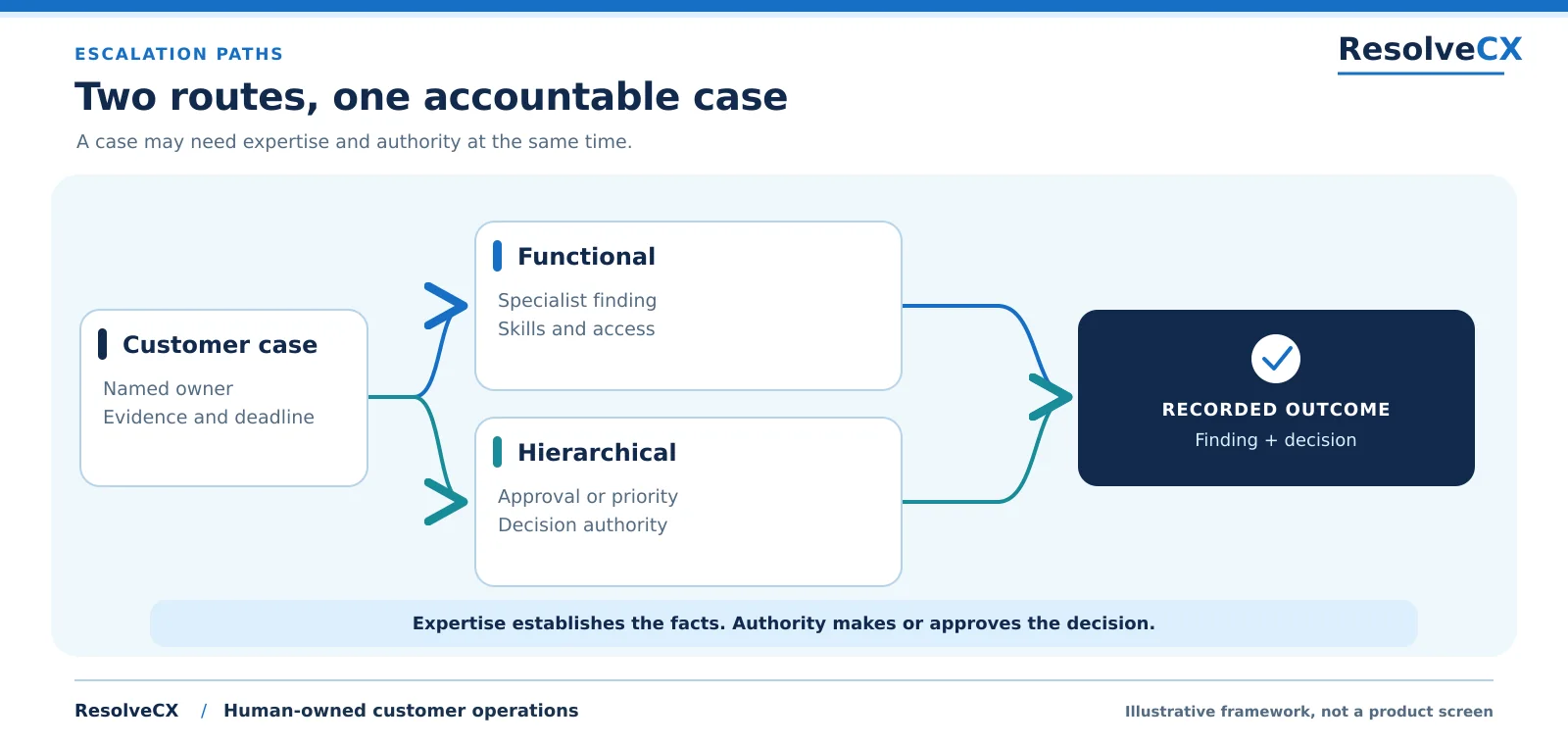
A named customer case owner coordinates a specialist functional route for findings and a hierarchical route for approval or priority. Both routes may run together before a recorded outcome.
ESCALATION PATHS
A case may need expertise and authority at the same time.
Illustrative framework, not a product screen
Customer case
Named owner
Evidence and deadline
Functional
Specialist finding
Skills and access
Hierarchical
Approval or priority
Decision authority
RECORDED OUTCOME
Finding + decision
Expertise establishes the facts. Authority makes or approves the decision.
Two routes, one accountable case
A named customer case owner coordinates a specialist functional route for findings and a hierarchical route for approval or priority. Both routes may run together before a recorded outcome.
ESCALATION PATHS
A case may need expertise and authority at the same time.
Illustrative framework, not a product screen
Customer case
Named owner
Evidence and deadline
Functional
Specialist finding
Skills and access
Hierarchical
Approval or priority
Decision authority
RECORDED OUTCOME
Finding + decision
Expertise establishes the facts. Authority makes or approves the decision.
Figure 1. Two routes, one accountable case. Functional expertise and hierarchical authority can be needed at the same time.
What is hierarchical escalation?
Hierarchical escalation raises an issue to a supervisor, manager or authorised decision maker because the present role lacks decision authority, resources or the appropriate oversight. The manager may approve an exception, resolve a conflict over ownership, prioritise scarce capacity or review a high risk outcome. ITIL v3 Service Operation describes this as escalation through management levels, potentially alongside functional escalation. 1
For example, a complaint handler may establish that a billing error occurred but need an authorised reviewer to approve redress outside their delegated limit. The investigation is already technically complete. The unresolved part is the decision. Sending the case to another specialist would delay the answer.
Functional vs hierarchical escalation at a glance
Decision point
Functional escalation
Hierarchical escalation
Primary need
Specialist skill, access or function
Authority, priority, resources or oversight
Typical route
Agent to specialist team
Handler to manager or authorised reviewer
Example
Billing team traces a disputed charge
Manager approves an exception or redress
Decision rights
Specialist investigates within remit
Senior role makes or approves a decision
Customer owner
Usually retained or explicitly reassigned
Usually retained unless policy transfers it
Main failure mode
Queue transfer with lost context
Manager copied without a decision request
Completion test
Specialist returns a finding and evidence
Decision and rationale are recorded
This is a routing distinction, not a severity scale. A routine case can need specialist expertise, and an urgent case can require immediate managerial authority. Both types can be initiated before a deadline is missed.
How do you choose the right escalation path?
To choose functional vs hierarchical escalation, start with the blocked action. If a specialist can perform the next step under existing rules, use a functional route. If the step needs an exception, resources or approval beyond delegated limits, use a hierarchical route. When both are missing, open coordinated tasks under one accountable case owner.
Ask five questions before routing:
What exactly prevents the current handler from moving forward?
Which team has the skill or system access to establish the facts?
Who has authority to decide, approve or prioritise the outcome?
Who owns the customer update and the next deadline during the handoff?
What evidence will prove the escalation achieved its purpose?
On a small screen, scroll this labeled region in both directions to read the diagram, or open the full-size image. A text description follows.
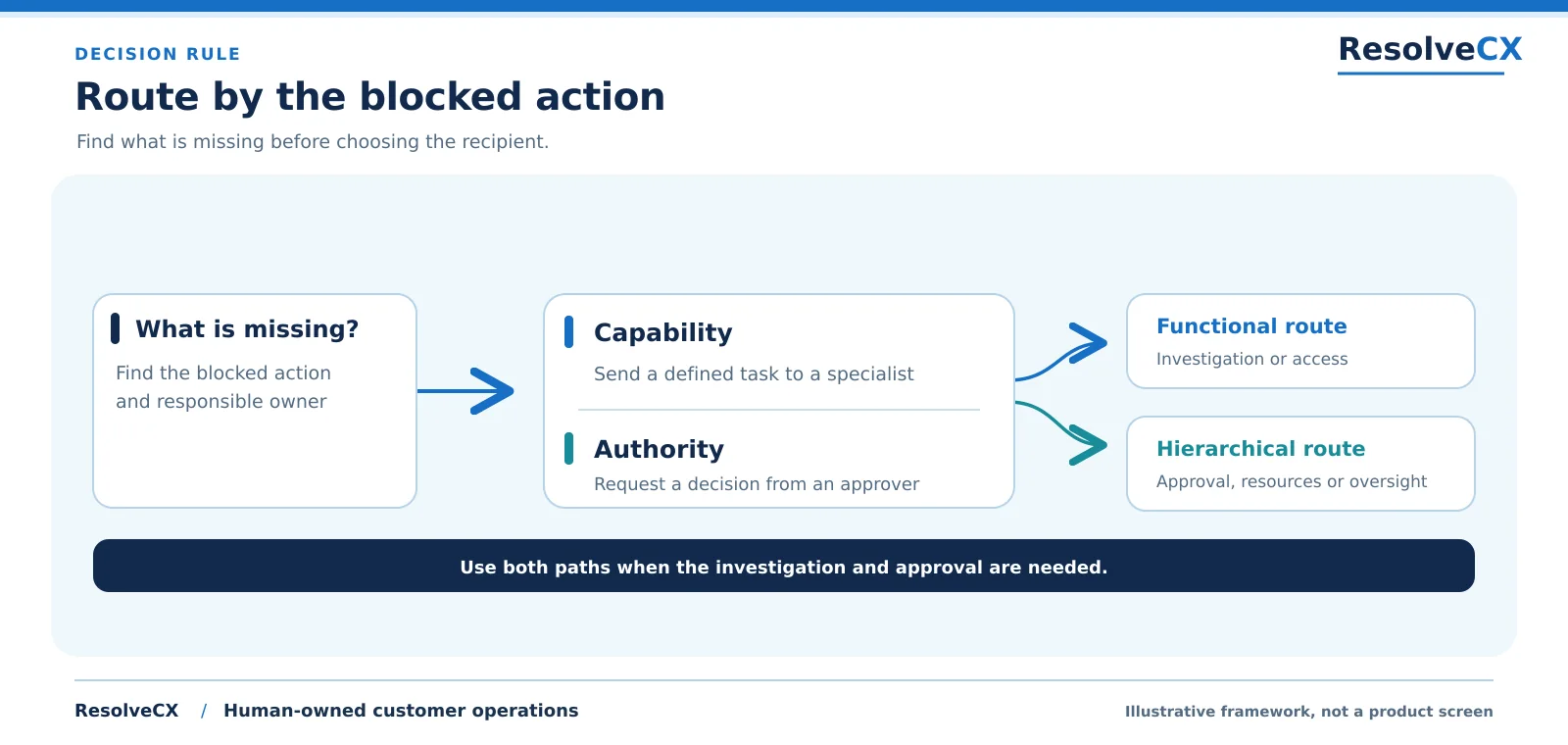
A blocked action is analyzed for missing capability or authority. A capability gap routes a defined task to a specialist; an authority gap requests a decision. Both routes can be used when investigation and approval are both needed.
DECISION RULE
Find what is missing before choosing the recipient.
Illustrative framework, not a product screen
What is missing?
Find the blocked action
and responsible owner
Capability
Send a defined task to a specialist
Authority
Request a decision from an approver
Functional route
Investigation or access
Hierarchical route
Approval, resources or oversight
Use both paths when the investigation and approval are needed.
Route by the blocked action
A blocked action is analyzed for missing capability or authority. A capability gap routes a defined task to a specialist; an authority gap requests a decision. Both routes can be used when investigation and approval are both needed.
DECISION RULE
Find what is missing before choosing the recipient.
Illustrative framework, not a product screen
What is missing?
Find the blocked action
and responsible owner
Capability
Send a defined task to a specialist
Authority
Request a decision from an approver
Functional route
Investigation or access
Hierarchical route
Approval, resources or oversight
Use both paths when the investigation and approval are needed.
Figure 2. Route by the blocked action: identify missing capability, authority or both, with one responsible owner.
What triggers functional escalation?
An effective functional trigger identifies a capability gap and a receiving function. Useful triggers include a technical fault requiring engineering access, a disputed transaction requiring finance records, a healthcare service concern requiring an appropriately qualified reviewer, a data request requiring privacy expertise or a repeated defect requiring problem investigation.
Write the trigger as an observable condition: “Account ledger and customer statement differ, and frontline staff cannot reconcile them.” Avoid “complex case” without a reason. The functional team needs the customer issue, attempted steps, relevant evidence, due date and a clear question to answer.
What triggers hierarchical escalation?
Hierarchical triggers concern authority or exposure. Examples include a request beyond the handler's approval limit, an unresolved conflict between teams, a likely missed response deadline, a material customer impact, repeated failure after prior commitments, or a sensitive allegation needing independent oversight. These conditions should point to a named role and a defined decision.
Severity and urgency should be assessed separately. A strong customer tone is a cue to review context, not proof that management approval is needed. Similarly, a low volume complaint may carry a serious risk that calls for prompt oversight. Teams should document criteria and let authorised people override a mistaken route with reasons recorded.
In regulated work, escalation thresholds must reflect the organisation's actual obligations and policy. Software can notify owners and preserve a record, but it does not determine legal compliance. Compliance and legal teams should approve applicable decision rules.
Can a case follow both paths at the same time?
Yes. A functional specialist can investigate facts while a manager controls priority, resources or the final decision. A useful design is a single parent complaint case with a specialist task and an approval task. The case owner keeps the timeline and customer communication coherent.
Consider an insurer's complaint about a delayed claim. Claims operations examines the transaction trail, while an authorised manager assesses a proposed exception. The specialist's finding informs the decision; the manager should not approve before the relevant evidence is available. If an applicable deadline approaches, the manager can arrange resources without pre-judging the outcome.
What does a governed handoff look like?
An escalation handoff is complete only when the receiving party understands the request and accepts the work. A message sent to a group inbox is not the same as an accepted handoff. Define the expected response time for acknowledgement, the owner for chasing a silent queue and the route when the assigned person is unavailable.
Use this minimum handoff record:
Original complaint or case identifier and customer contact preference.
Reason for escalation, path selected and trigger time.
Current owner, receiving person or team and acceptance time.
Facts established, work attempted and source evidence.
Specific question, approval or deliverable requested.
Customer promise, internal due date and applicable external deadline.
Next update owner, expected update time and contingency route.
On a small screen, scroll this labeled region in both directions to read the diagram, or open the full-size image. A text description follows.
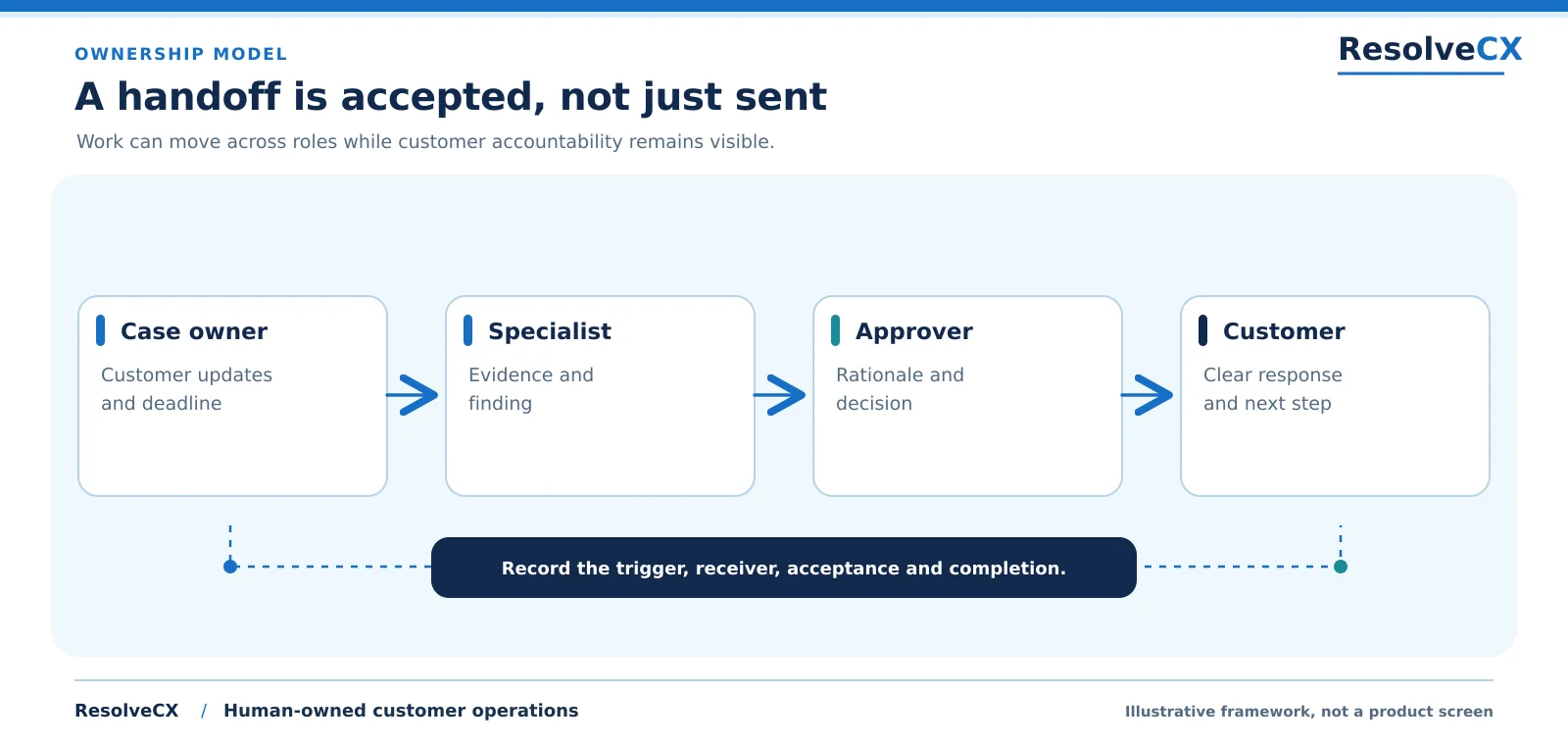
The case owner coordinates customer updates and deadlines, the specialist returns evidence and a finding, the approver records rationale and a decision, and the customer receives a clear response. Record trigger, receiver, acceptance and completion.
OWNERSHIP MODEL
Work can move across roles while customer accountability remains visible.
Illustrative framework, not a product screen
Case owner
Customer updates
and deadline
Specialist
Evidence and
finding
Approver
Rationale and
decision
Customer
Clear response
and next step
Record the trigger, receiver, acceptance and completion.
A handoff is accepted, not just sent
The case owner coordinates customer updates and deadlines, the specialist returns evidence and a finding, the approver records rationale and a decision, and the customer receives a clear response. Record trigger, receiver, acceptance and completion.
OWNERSHIP MODEL
Work can move across roles while customer accountability remains visible.
Illustrative framework, not a product screen
Case owner
Customer updates
and deadline
Specialist
Evidence and
finding
Approver
Rationale and
decision
Customer
Clear response
and next step
Record the trigger, receiver, acceptance and completion.
Figure 3. A handoff is accepted, not just sent. Record the trigger, receiver, acceptance and completion while retaining customer updates.
Who owns the customer during an escalation?
Assign one accountable case owner at every point. A specialist may own the technical investigation, and a manager may own an approval, but the customer still needs one person or team responsible for updates and follow through. If ownership changes, record acceptance and tell the customer who will contact them.
The handoff rule should state whether the clock continues, which it usually does under internal service targets. An SLA timer should not restart simply because a case changed queue. For a regulated complaint, calculate any statutory or regulatory deadline from the applicable receipt and event rules, not from the latest escalation timestamp.
Write a realistic update promise. “Our specialist is reviewing the transaction; I remain your contact and will update you by Thursday” is clearer than “Your case has been escalated.” The first statement names the work, relationship and next communication.
Examples across customer operations
Situation
Functional path
Hierarchical path
Accountable customer owner
Retail refund dispute
Payments team verifies settlement
Manager reviews an exception above limit
Complaint handler
SaaS service failure
Engineering identifies defect and workaround
Incident lead prioritises response resources
Customer case owner
Telecom billing complaint
Billing analyst reconciles charges
Supervisor resolves an ownership dispute
Complaint owner
Healthcare service concern
Qualified team reviews care facts
Appropriate leader approves response or action
Designated grievance handler
These are illustrative operating examples, not universal legal procedures. A safety concern, suspected fraud or data breach may require a separate incident response path and immediate specialist controls. Do not force every event through an ordinary customer service ladder.
How should an escalation matrix be designed?
A functional vs hierarchical escalation matrix connects observable triggers with roles, decisions and time limits. List customer impact, case type and deadline risk, then name the specialist team and decision authority. Include an out of hours path and an exception owner. Test the matrix against realistic cases rather than only organisational charts.
A practical matrix has these fields: trigger, priority, current owner, specialist function, decision authority, acknowledgement target, decision target, customer update interval, evidence required and fallback owner. Keep regulatory deadlines separate from internal targets. A four hour internal review target is an operational choice, not a substitute for an applicable external requirement.
For each exception, compare the intended route with the actual handoff and final response. A monthly review can reveal missing access, unclear approval limits or a queue that repeatedly accepts work too late to meet customer promises.
AI can suggest a complaint category, surface language that deserves closer review, summarise available case context or propose a specialist queue where those capabilities are configured. The handler should inspect the underlying message and correct uncertain suggestions. AI should not decide vulnerability, approve redress or silently change the accountable owner.
A sentiment cue may help a team notice a distressed customer, but the original words and circumstances determine the appropriate response. See how ResolveCX presents sentiment routing for human review when considering an assisted triage design. Access to source content, permissions and connected channels must be checked before deployment.
Measure false routes as well as speed. If a model repeatedly sends billing disputes to technical support, human correction and taxonomy changes are more valuable than an impressive automation rate. Keep an audit trail of the suggestion, the human decision and any later override.
How do you measure whether escalation works?
Measure whether the path supplied expertise or authority in time to help the customer. Raw escalation count alone can mislead: more appropriate early referrals may raise the count while improving outcomes. Review measures by case type and severity.
Time from trigger to accepted handoff, separated by functional and hierarchical path.
Time to specialist finding and time to authorised decision.
Percentage of cases with a named owner throughout the journey.
Missed customer updates and deadlines after escalation.
Reassignment loops and returns caused by missing information.
Repeat contact, reopened cases and complaints about the escalation itself.
On a small screen, scroll this labeled region in both directions to read the diagram, or open the full-size image. A text description follows.
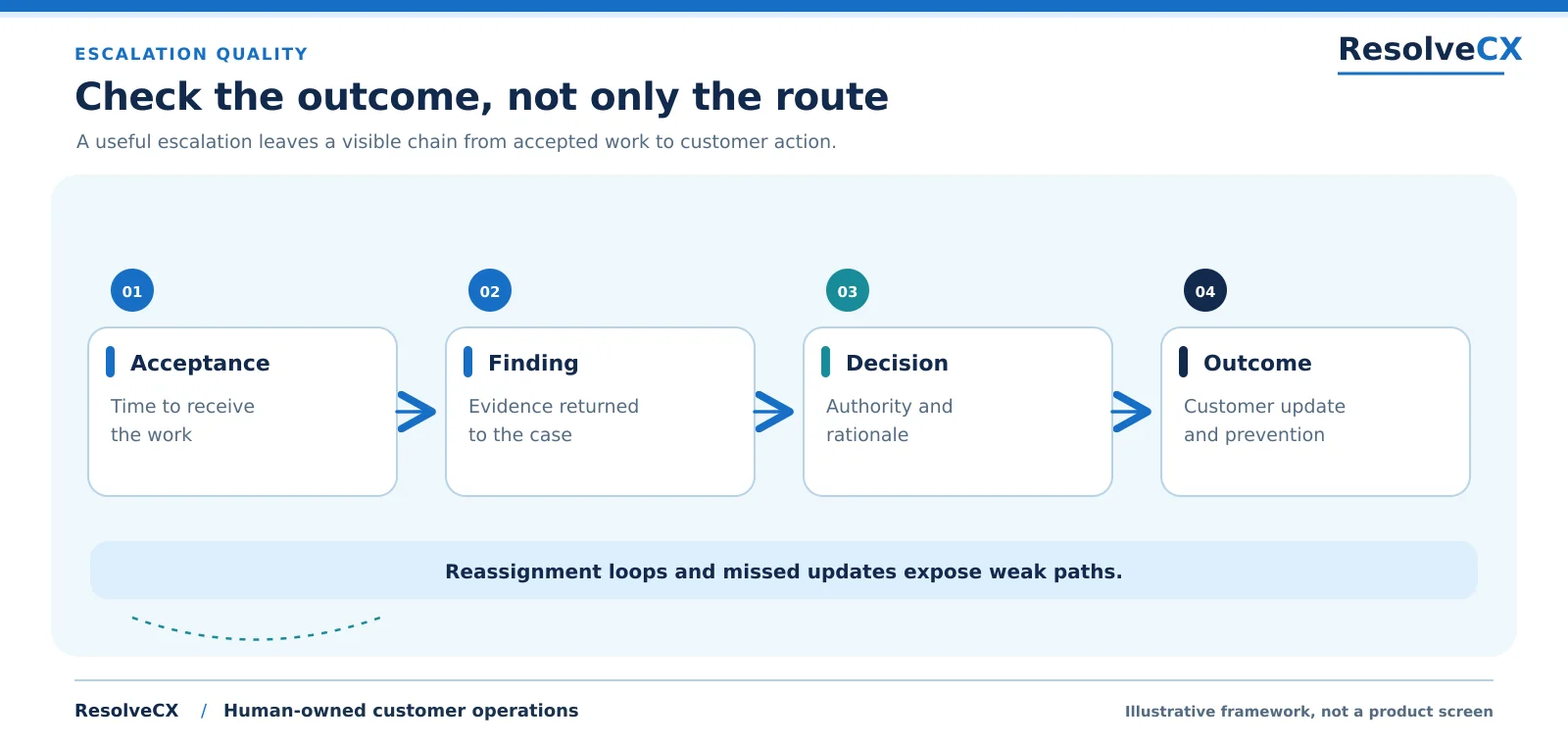
Escalation quality is reviewed through acceptance time, evidence returned in a finding, an authorized decision with rationale, and a customer update with prevention. Reassignment loops and missed updates expose weak paths.
ESCALATION QUALITY
A useful escalation leaves a visible chain from accepted work to customer action.
Illustrative framework, not a product screen
01
Acceptance
Time to receive
the work
02
Finding
Evidence returned
to the case
03
Decision
Authority and
rationale
04
Outcome
Customer update
and prevention
Reassignment loops and missed updates expose weak paths.
Check the outcome, not only the route
Escalation quality is reviewed through acceptance time, evidence returned in a finding, an authorized decision with rationale, and a customer update with prevention. Reassignment loops and missed updates expose weak paths.
ESCALATION QUALITY
A useful escalation leaves a visible chain from accepted work to customer action.
Illustrative framework, not a product screen
01
Acceptance
Time to receive
the work
02
Finding
Evidence returned
to the case
03
Decision
Authority and
rationale
04
Outcome
Customer update
and prevention
Reassignment loops and missed updates expose weak paths.
Figure 4. Check acceptance, finding, decision and outcome, including evidence, rationale, customer updates and prevention.
Common mistakes and how to prevent them
The first mistake is treating seniority as expertise. A manager may have authority but not the records or skills to diagnose a fault. Route the investigation to the right function and the approval to the right authority.
The second is treating a copied manager as a resolved escalation. Specify the decision requested, due time and fallback. Acknowledgement without a decision should remain visible as pending work.
The third is losing ownership when work crosses departments. A customer should not have to retell the complaint to each queue. Preserve the original narrative, evidence, prior commitments and one update owner.
The fourth is letting an internal SLA hide an external obligation. Track the applicable complaint deadline and evidence of receipt separately. If a deadline is at risk, escalate for resources or authority while continuing the required customer communication.
Finally, closure requires more than a specialist answer or a manager approval. The case owner should confirm the decision was communicated, actions were implemented and recurring causes were referred for prevention where appropriate.
Conclusion
Functional vs hierarchical escalation is a choice between expertise and authority. Use both when those needs coexist, with one accountable customer owner and shared evidence. Build observable triggers, confirm acceptance and test the path through to a communicated outcome. To discuss how these rules could fit your operation, book a ResolveCX workflow discussion.
Frequently Asked Questions
Neither path automatically changes the customer owner. A transfer changes a queue or assignee; an escalation defines work or a decision. Record any reassignment explicitly, preserving customer context and due dates.
No. The appropriate recipient is the role with authority for the required decision. That may be a supervisor, complaint lead, risk owner or authorised reviewer. Escalating through every management level can add delay without adding decision rights.
Yes. A clear specialist need, sensitive allegation, urgent risk or authority limit can justify immediate escalation. The team should document the trigger and use its approved policy. There is no need to exhaust every frontline step first.
Not necessarily. A specialist can own an investigation while a named complaint handler retains customer communication and deadline accountability. If the whole case is reassigned, the receiving owner should accept it explicitly.
A frontline handler confirms a refund error but lacks authority to approve redress above their delegated limit. An authorised manager reviews the evidence, decides the amount and records the rationale. The complaint handler then communicates the decision.
Separate the factual finding from the decision. Record the specialist's evidence and the manager's reasoning, identify the policy owner or independent reviewer for unresolved conflict and keep the customer update schedule. Do not alter evidence to match an approval.
Your policy should define the threshold and response. A predicted miss may warrant earlier intervention than a completed breach. Confirm the cause, resources and customer communication, and distinguish internal service targets from external legal deadlines.
AI may suggest a route based on available content where configured. A person should review the original evidence, especially for sensitive or uncertain cases, and retain authority for decisions and approvals. Track and correct unsuitable suggestions.
Define the question and acceptance criteria before handoff, assign one accountable owner and provide a fallback when the receiving team rejects a request. Monitor repeated reassignments and repair the taxonomy or permissions causing them.
The specialist finding or management decision must be recorded, the case owner must act on it and the customer must receive the appropriate response. A task marked done is insufficient if the complaint remains unresolved or the promised update never happened.
ResolveCX Team are practitioners and product specialists in complaint governance, escalation management, and regulated CX operations. Our articles draw on real implementation experience across financial services, healthcare, and telecommunications.