Complaint Handling for Law Firms: SRA and Legal Ombudsman Guide
Handle law firm service complaints with clear ownership, receipt-based clocks, fair review and accurate Legal Ombudsman signposting in England and Wales.
ResolveCX Team23 November 202622 min read
Key Takeaways
1Recognize oral and written concerns, preserving the original receipt date.
2Service complaints, conduct concerns and potential claims may need parallel routes.
3LeO referral and notification rules have specific conditions, time limits and discretion.
4The voluntary MCRP retains Early Resolution, Full Investigation and written outcomes.
5Keep people accountable for findings, remedy approval, confidentiality and client updates.
Complaint handling for law firms begins when a client expresses dissatisfaction, not when a partner agrees to open a formal investigation. A reliable process identifies the concern, protects the underlying legal matter, gives one person responsibility and reaches an evidenced outcome. This guide explains the duties affecting SRA-regulated firms in England and Wales and the operational choices that make them workable. Explore ResolveCX's approach to complaint governance when assessing how to connect those choices in one record.
This is general operational information about England and Wales, not legal advice. Primary sources were technically inspected on November 22, 2026. That inspection is not professional legal or compliance sign-off; confirm current applicability with qualified advisers.
What counts as a complaint to a law firm?
A complaint is an expression of dissatisfaction about a firm's service or charges. It need not say “formal complaint” or arrive on a prescribed form. Record telephone, email and representative concerns with the original words, receipt date, matter and requested outcome. Route them to the handler even when resolving them promptly.
Who can raise a concern?
Clients, beneficiaries, prospective clients and third parties may raise concerns. LeO eligibility is separate and depends on the complainant and the services involved under Scheme Rules chapter 2. Do not promise that every third party can use LeO. Verify a representative's identity, authority and scope before disclosing confidential information; LeO rule 2.5 provides for written authorization of a representative. Use an appropriate lawful authority for anyone unable to act. Offer accessible communication and reassure the client about the ongoing matter.
Is it about service, conduct or a possible claim?
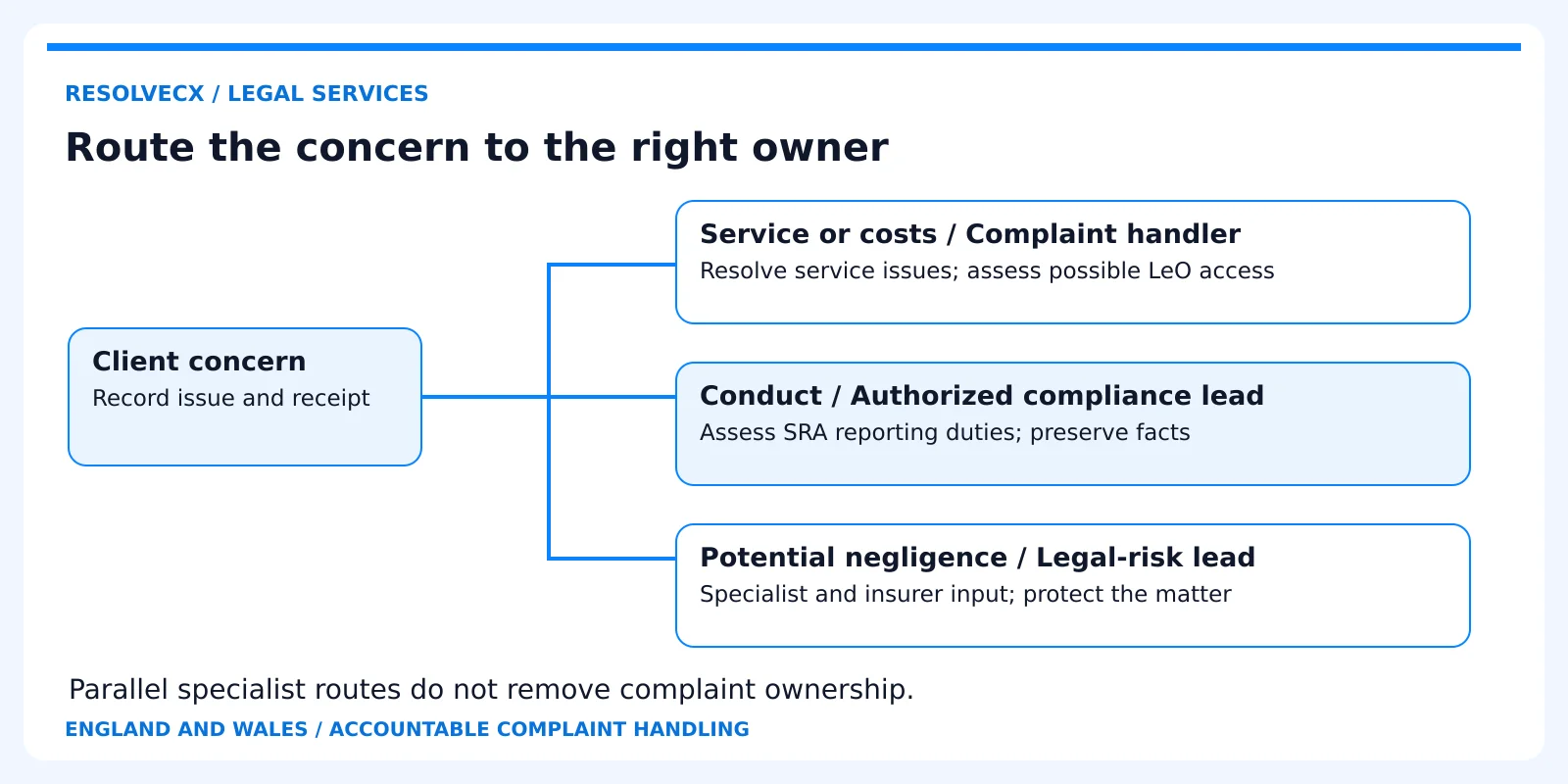
These routes require different judgments. A delay, unclear costs information or failure to update the client may be a service complaint for the firm to address and potentially for the Legal Ombudsman to consider. Dishonesty, discrimination or client-money concerns may also warrant an SRA report; alleged negligence may require specialist and insurer input. Preserve the complaint route alongside specialist referrals.
Issue raised
Immediate firm action
Possible external route
Decision owner
Delay or poor communication
Log and assess service impact
Legal Ombudsman after first-tier opportunity
Complaint handler
Alleged misconduct
Preserve facts and assess reporting duties
SRA
Authorized compliance lead
Possible negligent advice
Protect matter and seek specialist advice
Claim route may be separate
Designated legal-risk lead
Figure 1. Service, conduct and potential claims may need parallel routes.
Figure 1. Service, conduct and potential claims may need parallel routes.
Text equivalent: Record the client concern. Service or costs goes to the complaint handler, with possible Legal Ombudsman access. Conduct concerns go to an authorized compliance lead for SRA reporting assessment. Potential negligence goes to the legal-risk lead for specialist and insurer input. These routes may run in parallel; the complaint owner keeps the client updated.
SRA Code paragraphs 8.2 through 8.5 require an appropriate complaints procedure; written engagement information about the right to complain, how and to whom, and any right to approach the Legal Ombudsman and when; written LeO information if a complaint remains unresolved to the client's satisfaction within eight weeks; and handling that is prompt, fair and free of charge. The eight-week notice must explain any LeO right, the time frame and full contact details. If the complaints procedure has been exhausted, also explain that the firm cannot settle the complaint, name a competent approved ADR body with its website, and state whether the firm agrees to use that scheme. 1
For bodies and individuals within its scope, SRA Transparency Rule 2.1 requires website details of the complaints procedure, including how and when to complain to LeO and the SRA. Rule 3.1 requires that information on request where there is no website. Check the actual scope in the SRA Transparency Rules, rather than extending every obligation to every legal business. 2
The eight-week period runs from when the complaint is made to the provider, not when someone labels it "formal" or starts investigating. Record the original receipt date, including oral complaints. Ordinarily the provider must first have an opportunity to address it. An eligible complainant may approach LeO after the internal process ends, or if the complaint has not been resolved to their satisfaction within eight weeks. Under rules 4.2 and 4.3, LeO may consider a complaint sooner or without first-tier referral for exceptional reasons, or where in-house resolution is not possible because of irretrievable relationship breakdown.
Rule 4.4's six-month limit applies only if the written response prominently explains LeO availability if the complainant remains dissatisfied, gives full LeO contact details and warns that referral must be made within six months of the date of that written response. This is not an unconditional six months after any closure message. Ordinarily, rule 4.5 also requires referral within one year of the act or omission, or one year from when the complainant should reasonably have known there was cause for complaint. Rule 4.6 includes specific estate and knowledge provisions. Under rules 4.7 and 4.8, an ombudsman may extend time limits where fair and reasonable, including examples involving serious illness or a complaint raised with the provider before the limit expired. The firm should not decide LeO eligibility from its own closed status. These are legal-services rules, not the FCA DISP framework. See the current LeO Scheme Rules index and the April 2023 rules it currently identifies. 7
At intake, set an internal review point well before week eight. If a fee earner is absent or an insurer must be consulted, the clock still needs an owner. Record the reason for delay, what remains outstanding and when the client will receive an update. A transfer, reviewer absence or specialist referral does not restart the receipt clock.
Source
What it establishes
Operational control
SRA Code, paragraphs 8.2–8.5
Procedure, client information, eight-week notice, prompt and fair free handling
Document policy and receipt clock
SRA Transparency Rules, rules 2.1 and 3.1
Public information about procedure and external routes
Check website or request copy
LeO Scheme Rules
Referral, final-response signposting and time limits
Validate response before sending
LeO Model Complaints Resolution Procedure
Voluntary framework with specified features
Adopt consciously, not by assumption
The SRA's 2026 supplementary consultation proposed providing a resolution timeline when a complaint is first notified and regular progress updates. As inspected on November 22, 2026, its official page marks the consultation closed on September 1, 2026 and continues to describe these as proposals. The current Code inspected for this guide retains paragraphs 8.2 through 8.5 as summarized above. A closed consultation is not evidence that its proposals have taken effect. Recheck the final decision and effective rules before implementation; the article does not present these proposals as operative requirements. Clear plans and updates remain sensible operational practices. 4
How should a firm handle a complaint from receipt to closure?
Effective complaint handling for law firms tells staff who acts next, what the client will hear and which record proves the action occurred. Review ResolveCX complaint management for its approach to case ownership, evidence and response tracking. The firm must define its own duties and verify required access controls and workflow behavior before relying on a deployment.
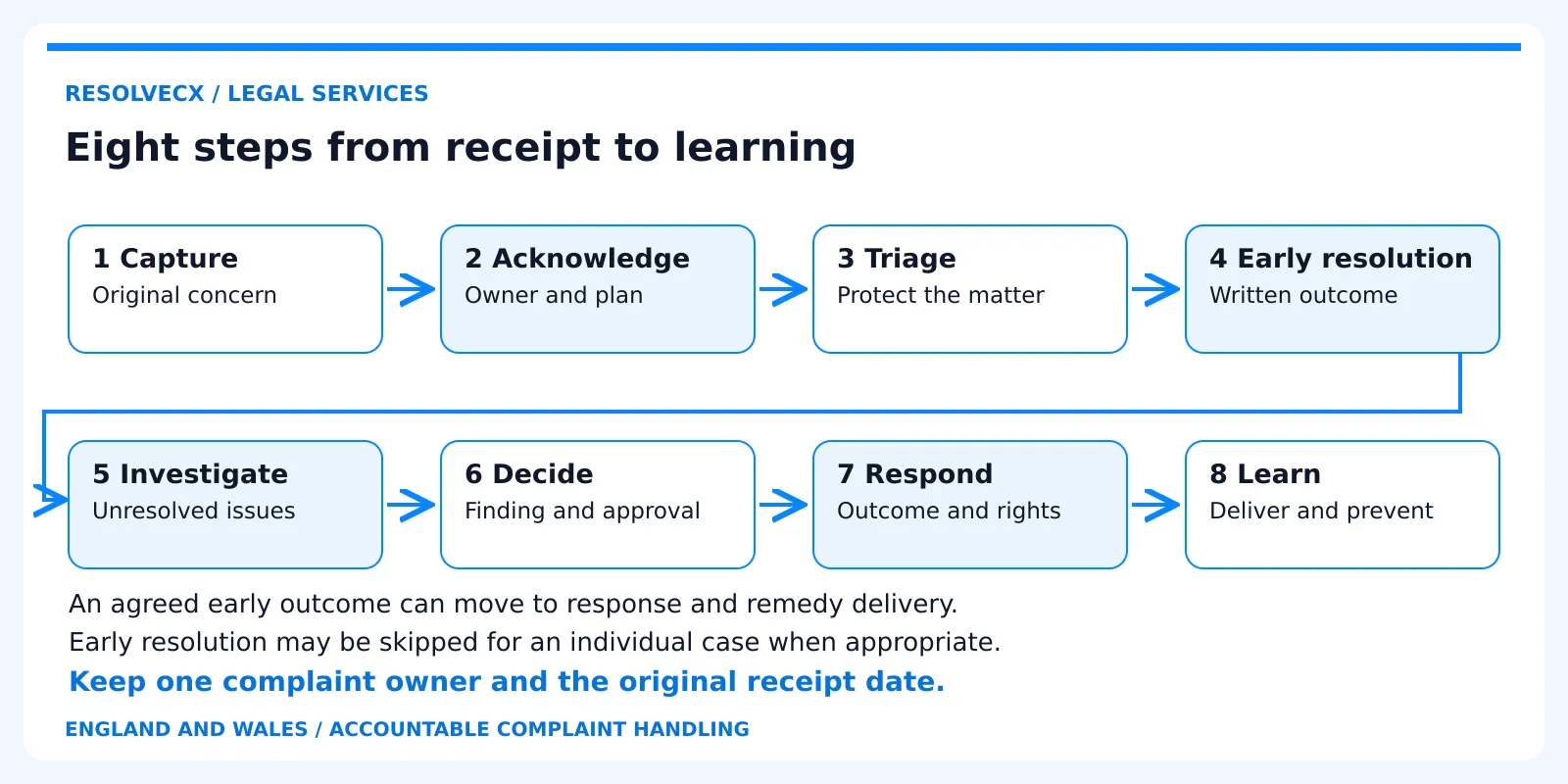
Capture the concern. Record the original expression of dissatisfaction and receipt date, including calls and informal messages. Identify the matter, affected service, charges, desired outcome and any immediate deadline. Keep the original wording.
Acknowledge and assign. Tell the complainant who owns the response, what happens next and when they will hear more. Confirm contact and accessibility needs; accept verbal complaints.
Triage and protect. Check for ongoing matter deadlines, vulnerable clients, confidentiality, conflicts, possible misconduct, client-money issues and potential claims. Refer urgent risks while retaining the client update owner.
Explore early resolution. Ask what would put the issue right. A clear bill explanation, prompt correction or sincere apology may resolve a straightforward concern. Confirm any agreed outcome in writing and record what was delivered. Never pressure acceptance merely to close a case.
Investigate unresolved issues. Define each allegation, review the engagement letter, estimates, matter chronology and communications, and hear from the relevant people. Separate facts from disputed accounts. Use a sufficiently independent reviewer where feasible and document conflicts and safeguards. Independent review is a recommended safeguard here, not a claim that the cited Code mandates an external reviewer for every case.
Decide and approve. Make a finding on every issue, explain why and assess an appropriate remedy against actual impact. Obtain the required authorization for a refund, fee adjustment or other corrective action. An offer cannot replace the finding.
Respond and signpost. Send a concise written outcome addressing each issue, the reasons, any apology, remedy, delivery plan and accurate external options. Check Legal Ombudsman details and relevant time-limit wording. If unresolved at eight weeks, send required written information.
Deliver and learn. Verify that the remedy happened. Retain the record, identify causes and assign prevention. Close only when the firm's outcome and outstanding commitments have been properly recorded.
Figure 2. Keep the original receipt date and one accountable complaint owner.
Figure 2. Keep the original receipt date and one accountable complaint owner.
Text equivalent: Follow eight steps: capture the concern; acknowledge and assign; triage and protect; explore early resolution; investigate unresolved issues; decide and approve; respond and signpost; deliver and learn. Where appropriate, a case can move directly to full investigation. Keep the original receipt date, evidence and client-update owner throughout.
Consider a conveyancing client who complains about a higher-than-expected fee and missed completion updates. Capture both issues. Compare engagement terms, estimate changes, invoice and messages. A fee adjustment might address costs while an explanation addresses missed updates; protect the underlying matter's deadlines.
Where does the Legal Ombudsman's model procedure fit?
The Legal Ombudsman's 2026 Model Complaints Resolution Procedure, or MCRP, is voluntary. It emphasizes Early Resolution through a constructive interaction and Full Investigation where the issues require detailed review. An internal policy alone does not establish MCRP use. LeO specifies five features for a provider to state that it uses the model:
A link to LeO's MCRP resources.
Acknowledgment of receipt, confirming the complaint and explaining what happens next.
An Early Resolution stage focused on constructive resolution.
A Full Investigation stage leading to a final decision where needed.
A written outcome after either stage.
A case may skip Early Resolution when appropriate, but a procedure described as using the MCRP must include that stage. Using selected resources is not the same as adopting all five features. 6
The model requires a written outcome even after early agreement and does not replace SRA duties. Serious loss, contested advice or conflicted reviewers may require full investigation. Record why the route was chosen. Do not withhold signposting or stop complaint communication while seeking specialist advice. 5
LeO's July 29, 2026 launch report describes a three-month pilot involving ten legal service providers, including two sets of chambers, selected across business sizes, regulators and practice areas. Providers handled 631 complaints using the MCRP; 57% were reported resolved at Early Resolution. This is a participating-provider complaint cohort, not all complaints to LeO, a representative sector success rate or a forecast for an individual firm. The launch page does not state the pilot's exact calendar start and end dates, and it does not establish a randomized comparison. Preserve the Full Investigation route. 8
Who should own, investigate and approve the response?
The fee earner may be the first person to hear the concern, but an accepting complaint handler must take responsibility for the response clock and communications. Until acceptance is recorded, the current owner keeps responsibility and uses the backup route if necessary. A supervisor reviews disputed findings. The Compliance Officer for Legal Practice (COLP) assesses regulatory matters rather than automatically investigating every service complaint. Specialist or insurer input must not prevent appropriate client updates, and task referral must not silently transfer the whole case.
Role
Accountable action
Evidence to retain
Recipient or fee earner
Forward the original concern promptly
Receipt and hand-off time
Complaint handler
Own chronology, contact and investigation
Issue list, updates and findings
Independent reviewer
Challenge conflicted or contested decisions
Review comments and rationale
Compliance or legal-risk lead
Assess specialist duties and restrictions
Referral and decision record
Remedy approver
Authorize offer and delivery
Approval and completion proof
For a complaint about a partner, identify a sufficiently independent person under the firm's policy. A small firm may use another partner or an external reviewer, subject to conflicts, competence, confidentiality and an appropriate engagement. Explain their role, check disclosure authority and restrict sensitive specialist material. Seek qualified advice on privilege, professional indemnity notifications and any reporting duties rather than copying specialist advice into a broadly accessible complaint record.
What should the final response and case record contain?
A final response should make clear that the firm has finished its internal review. Address each distinct issue with the finding, key evidence, reasoning and proposed remedy. State who will deliver each action and by when. Use plain language. Obtain approval before making remedy commitments, and investigate even when apologizing.
Before dispatch, a reviewer should verify the client's name, original complaint date, all issues, decision authority, remedy, correct LeO contact details, eligibility wording and the prominent conditional six-month warning. Check eight-week and applicable ADR disclosures. LeO guidance says inadequate signposting can prevent the six-month limit from applying; review templates regularly. Use the current signposting pack for the website, postal address, telephone and email, not an old letter template. It currently gives 0300 555 0333, enquiries@legalombudsman.org.uk and Legal Ombudsman, PO BOX 6167, Slough, SL1 0EH. Verify those details again before dispatch. 7
Retain a proportionate, access-controlled record: original message or call note; acknowledgment; engagement terms and relevant matter evidence; investigation notes; client updates; approval; final response; proof of remedy; and any LeO or SRA correspondence. Preserve version history under the firm's retention policy. Limit access to those with a justified need, assess confidentiality and privilege before sharing, and confirm representative authority. A complete chronology does not alone prove fairness, and this record design does not establish that software enforces those safeguards.
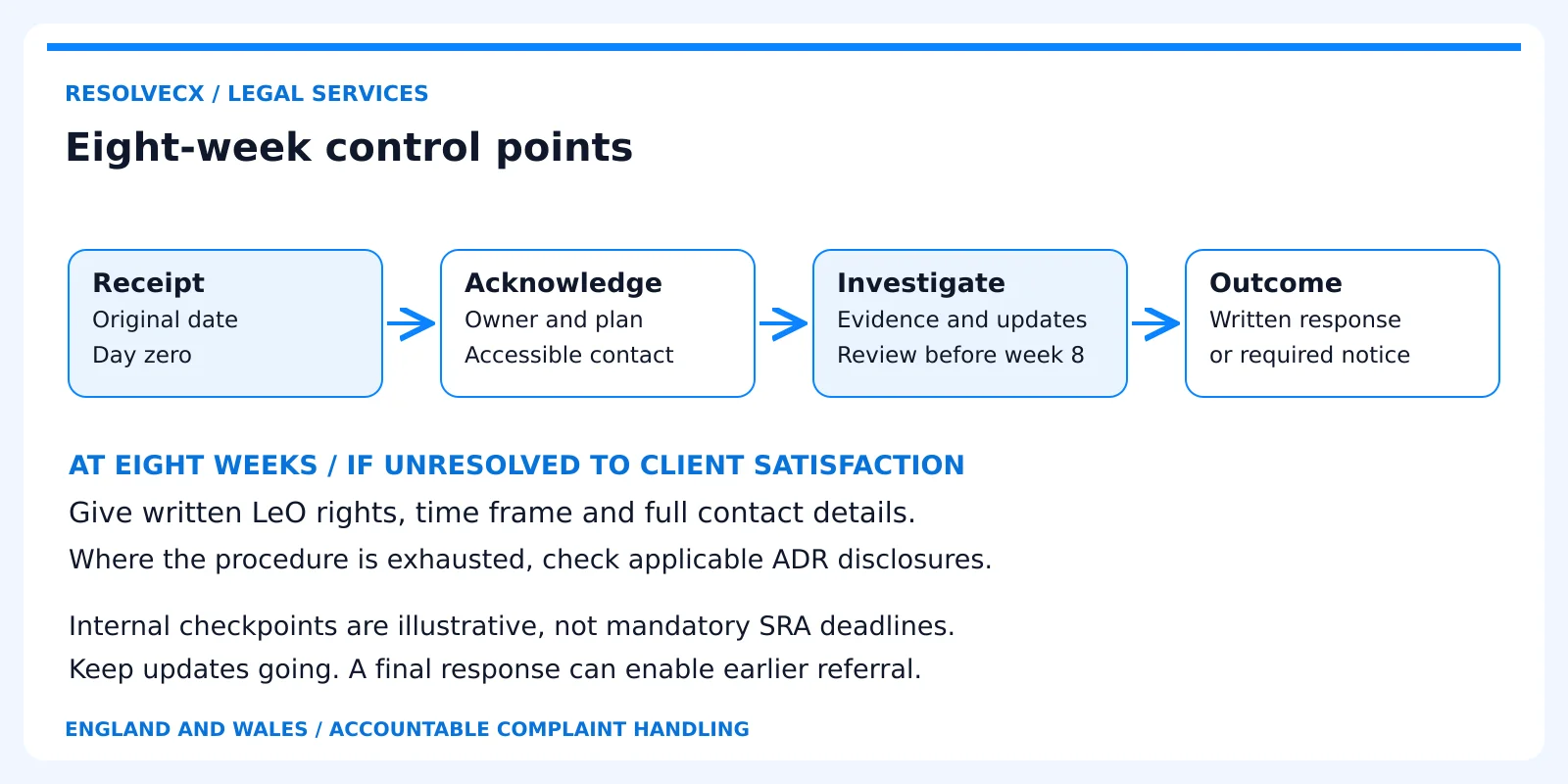
Figure 3. Internal checkpoints are illustrative, not mandatory SRA deadlines.
Figure 3. Internal checkpoints are illustrative, not mandatory SRA deadlines.
Text equivalent: Receipt starts the original clock. Acknowledge with an owner and plan. Investigate with evidence and continuing updates. Seek an earlier written outcome. At eight weeks, if unresolved to the client's satisfaction, provide written information about any Legal Ombudsman right, time frame and full contact details. Where the procedure is exhausted, include applicable ADR disclosures. Internal checkpoints are illustrative, not mandatory deadlines; a final response may enable earlier referral.
The SRA's thematic review, published October 14, 2025, reports visits to 25 firms and examination of 50 complaint files between January and March 2025. Responses exceeded eight weeks in 30% of those 50 files, equivalent to 15 reviewed files. That file-review result is not a rate for all law firms or the separate survey sent to 750 firms. The report's sampling and weighting discussion must not turn this small file cohort into a sector-wide statistic. The review also noted defensive language, inaccessible procedures and incomplete handling of concerns. Examine recognition, ownership, timing and response quality. A late response is not by itself proof that all required eight-week information was missing. 3
Informal concern lost: log expressions of dissatisfaction from every channel and verify hand-off.
Clock starts late: keep the original receipt date even if the complaint is reclassified or moved.
Fee earner judges their own work: use the firm's independent review route where feasible.
Client left in the dark: name the contact and give a credible update commitment when facts remain unresolved.
Letter answers only one issue: compare the agreed issue list against each response paragraph.
Remedy promised but not delivered: assign an owner and verify completion before closure.
A rejected decision is no reason to delay LeO information. Explain specialist delays and preserve the external route. A possible negligence claim may need a separate specialist route, but that does not erase the service complaint or its original timeline.
How should a firm measure and improve its process?
For complaint handling for law firms, track time from receipt to owner acceptance, acknowledgment, final response and remedy completion separately. Measure final-response timeliness separately from provision of the required unresolved-complaint notice: eight weeks is not a general permission to delay. Sample whether every issue received a finding, whether signposting was accurate and whether the client could use the procedure. Review repeat causes by practice area and matter stage, such as unclear estimates in conveyancing or long gaps in probate updates. Low complaint counts may reflect poor access; check client feedback.
Measure
What it may reveal
Check before interpreting
Eight-week timeliness
Late final response or missing required notice, measured separately
Original receipt date, satisfaction and notice applicability
Reopened complaints
Unresolved issue or failed remedy
Reason for reopening
LeO referrals
First-tier outcome or expectation gap
Case mix and eligibility
Repeat issue category
Systemic service weakness
Quality of categorization
Sample records and assign dated prevention actions. If AI assists classification or summarization, people should check whether it preserved the client's words, identified all issues and used only appropriately authorized material. The firm must verify confidentiality, access restrictions and any external processing before use. Human reviewers should control findings, redress and final communication. See ResolveCX's AI-assisted complaint classification when evaluating suggested categories and human review. Do not infer that the product automatically enforces privilege, independent review, retention or legal signposting.
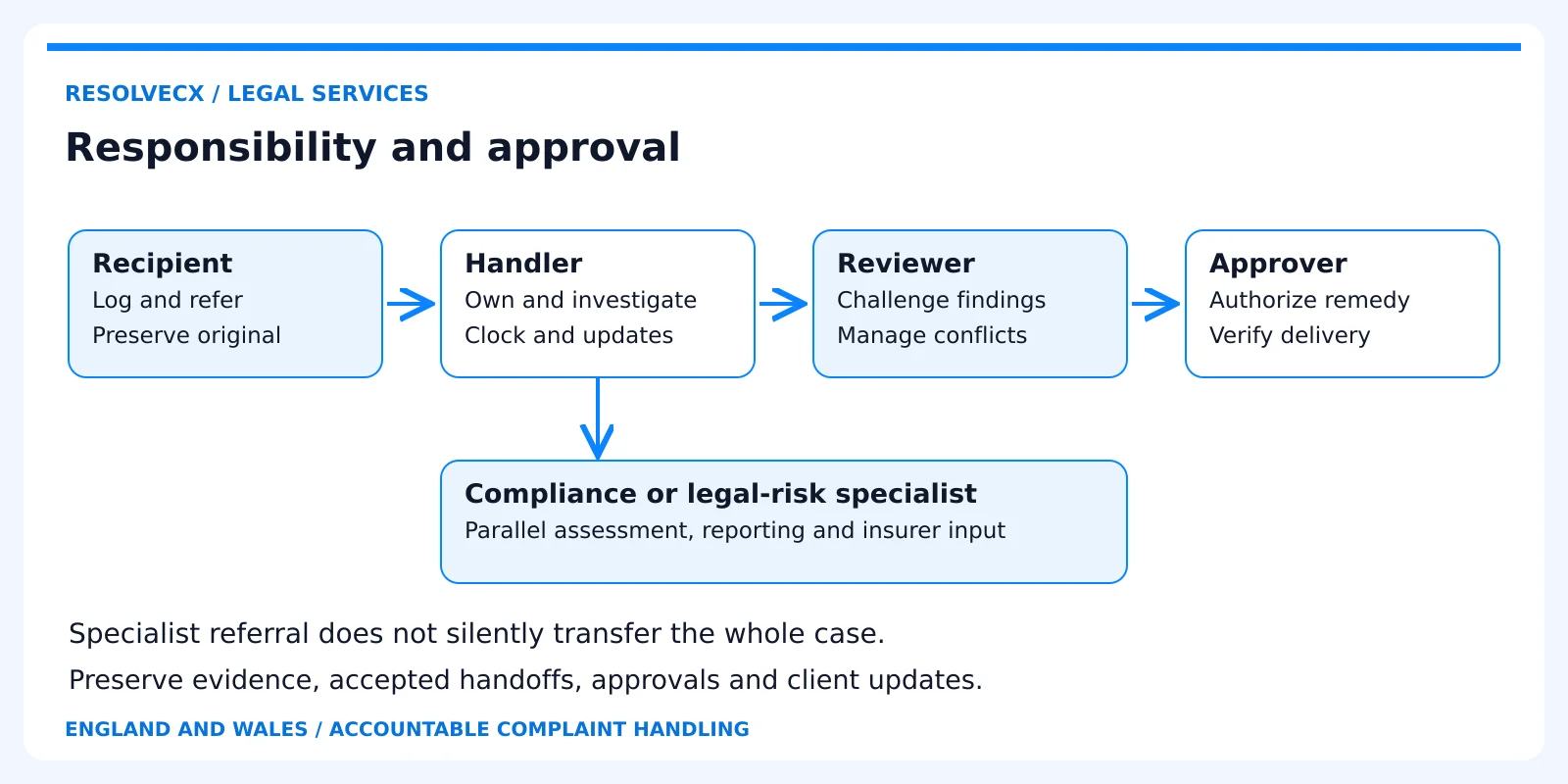
Figure 4. Specialist tasks and remedy authority remain distinct from case ownership.
Figure 4. Specialist tasks and remedy authority remain distinct from case ownership.
Text equivalent: The recipient logs and refers the original concern. An accepting handler owns investigation, the receipt clock and client updates. An independent reviewer challenges findings where feasible. A remedy approver authorizes the remedy and checks delivery. A compliance or legal-risk specialist assesses conduct and potential claims in parallel. Record handoff acceptance, decisions and evidence; the complaint handler keeps overall accountability.
How can ResolveCX support governed complaint handling?
ResolveCX describes complaint intake, case ownership, evidence, escalation and reviewable decisions as connected workflows. AI classification can assist with suggested categories using available case information, while people retain responsibility for exceptions and decisions. Confirm feature availability and deployment-specific behavior with the team. The firm still defines and verifies confidentiality, representative authority, approvals, retention and signposting. This guide does not verify automated controls, legal-sector integrations, regulatory compliance or legal outcomes.
Conclusion
For complaint handling for law firms, begin with the original client concern and keep the clock, owner, evidence and external rights visible through resolution. Test the written procedure against a real missed-update or fee dispute, including who reviews the decision and delivers the remedy. To examine the workflow with your team, discuss complaint governance with ResolveCX.
Frequently Asked Questions
An expression of dissatisfaction about service or charges may be a complaint whether made orally or in writing. Record what the person says, when it arrived and the outcome sought. Assess eligibility for an external scheme separately.
A firm should recognize and handle a verbal expression of dissatisfaction. LeO guidance says a complaint need not be in writing, and the SRA thematic review treats mandatory written submission as poor practice. Make a reliable call note and confirm the issues with the client.
The key LeO referral point is eight weeks after the complaint is made to the provider. If it remains unresolved to the client's satisfaction, the SRA requires written information about LeO rights. Aim for earlier fair resolution under the firm's published procedure.
Generally after the internal procedure ends or after eight weeks without a satisfactory resolution. Eligibility and time limits depend on the LeO Scheme Rules. The six-month response limit is conditional on prominent required information; the one-year event or reasonable-awareness limits also apply ordinarily. LeO has discretion, including for earlier consideration and fair and reasonable time extensions.
LeO considers eligible complaints about legal service; the SRA investigates concerns about regulated conduct. The same facts may require consideration under both routes. The firm should explain the difference without obstructing either route.
The SRA Code requires complaints to be handled promptly, fairly and free of charge. A firm should not bill for investigating its own client complaint. Any separate matter or claim requires an appropriately explained arrangement.
Identify each issue, finding, reasons, remedy and next action, and make clear whether the internal procedure has ended. Include accurate LeO signposting and relevant time-limit warning. Have a second person check the letter against the complaint record.
No. The MCRP is voluntary. A provider that says it uses the model must include LeO's five core features, including Early Resolution, Full Investigation and a written outcome. Existing regulatory duties still apply.
The firm should designate someone sufficiently independent and authorized under its policy. Depending on size and conflict, that may be another partner or an external reviewer. Keep the client informed of who owns the response.
AI may help identify themes, summarize a record or suggest routing, subject to confidentiality, authority and quality checks. An appropriately qualified and authorized person should assess evidence, conduct concerns, remedy and the final response. The firm remains accountable for the outcome.
2. SRA, Publishing complaints procedure. Inspected November 22, 2026 together with Transparency Rules 2.1 and 3.1; distinguish website publication from on-request information.
7. Legal Ombudsman, Signposting consumers to the Legal Ombudsman. Living signposting guidance and current Scheme Rules index inspected November 22, 2026. The index identifies April 2023 rules as current; rules 4.1 through 4.8 govern referral and timing, including conditions and discretion.
8. Legal Ombudsman, MCRP launch and pilot results, 2026. Published July 29, 2026; inspected November 22, 2026. Ten providers, three-month pilot, 631 complaints and 57% at Early Resolution; exact pilot calendar dates and causal effects are not established by this report.
About ResolveCX Team
The ResolveCX Team writes about complaint handling, case ownership and customer operations. This guide is general information, not legal advice.