9 Customer Escalation Mistakes and How to Avoid Them
Diagnose nine escalation failures, from late routing to unverified remedies, with scenarios, preventive controls, audit steps, and meaningful measures.
ResolveCX Product Management Team23 November 202622 min read
Key Takeaways
1Diagnose all nine failures across timing, handoff, decision, and outcome controls.
2Retain the current case owner until the receiving owner accepts responsibility.
4Verify remedy delivery, not only internal task completion, before closing a case.
5Use defined metric populations and human-governed AI to test whether controls work.
A customer has contacted support four times about the same failed refund. Each agent apologizes, opens another ticket, and promises an update. The case moves between billing and operations, but nobody owns the outcome. This is not simply a slow response; it is a breakdown in escalation control.
Customer escalation mistakes often begin before a supervisor sees the case. Weak triggers, missing evidence, unclear approval rights, and premature closure compound across handoffs. The best prevention is to identify the failure signal, assign a corrective control, and measure whether it works.
This guide examines nine recurring failures with practical scenarios, root causes, governance controls, and management metrics. The aim is not to eliminate escalation: it is to make necessary escalation timely, accountable, and useful to customers.
Escalation means moving an issue to additional expertise, authority, or oversight when the current owner cannot resolve it appropriately. A successful escalation preserves accountability while changing the resources available to solve the problem. A transfer alone does not prove that a customer has received help.
ISO 10002:2018 provides guidance on internal complaints handling, evaluation, and improvement. It does not prescribe a universal escalation ladder or deadline. 1
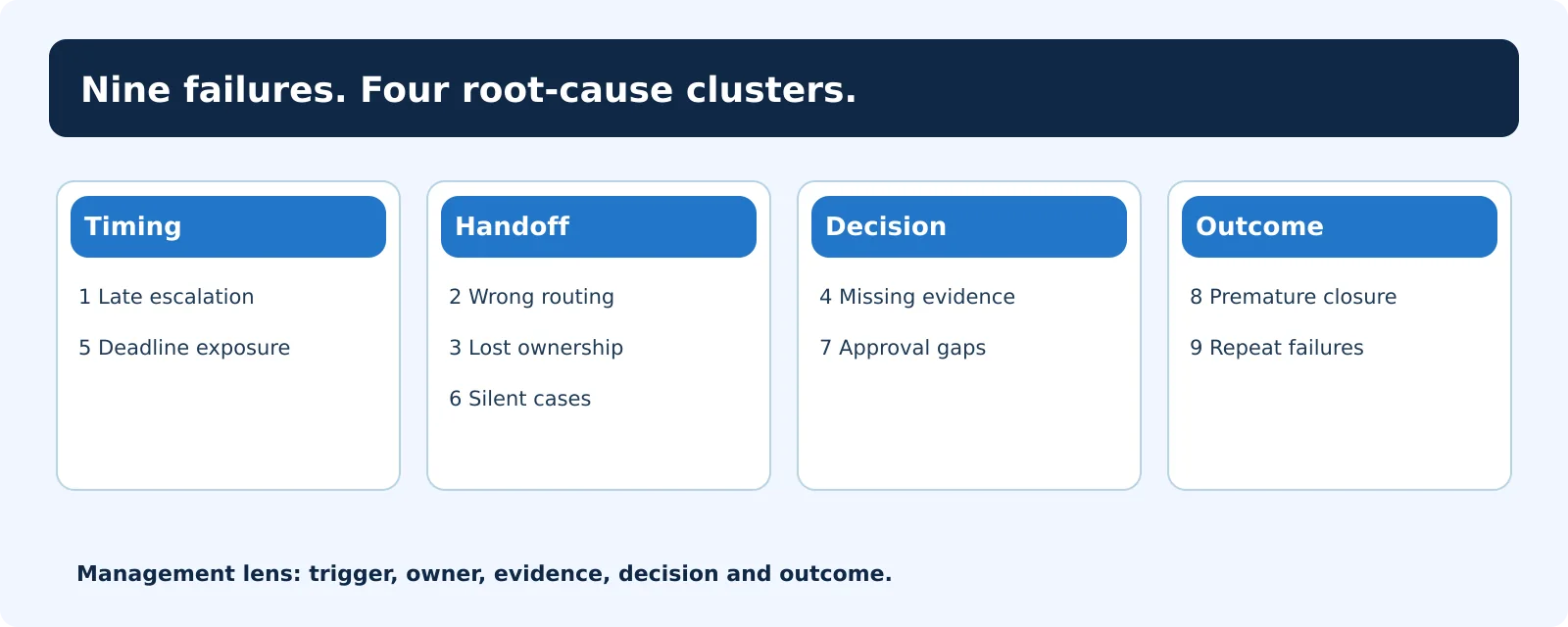
Customer escalation mistakes can be diagnosed through four root-cause clusters. Timing covers late escalation (1) and deadline exposure (5). Handoff covers wrong routing (2), lost ownership (3), and silent cases (6). Decision covers missing evidence (4) and approval gaps (7). Outcome covers premature closure (8) and repeat failures (9). For example, a ticket might reach a senior manager promptly but still fail because the manager cannot see previous troubleshooting or approve a remedy. Conversely, a technically perfect handoff can breach an applicable deadline if nobody monitors the clock.
Figure 1. Four clusters account for all nine escalation failures.
Text equivalent: Four root-cause clusters map all nine numbered mistakes: Timing includes 1 late escalation and 5 deadline exposure. Handoff includes 2 wrong routing, 3 lost ownership and 6 silent cases. Decision includes 4 missing evidence and 7 approval gaps. Outcome includes 8 premature closure and 9 repeat failures.
Failure: an agent continues troubleshooting after the issue has exceeded their expertise, decision authority, or reasonable handling window. The visible symptom is repeat contact without a meaningful change in action. Behind it may be an escalation policy that says "use judgment" but provides no actionable trigger.
Example: a payment reversal has failed twice. Frontline support keeps requesting screenshots even though the remedy requires finance approval. By the time a specialist receives the case, the customer has already made several contacts and the expected response window is at risk.
Prevention: define triggers for repeated failure, safety or vulnerability concerns, high business impact, authority limits, and approaching deadlines. Route an urgent issue directly to the appropriate qualified owner when policy allows; do not insist on every intermediate tier.
Measure the elapsed time from the first qualifying trigger to accepted escalation, not simply the time from ticket creation. Sample late cases each week to determine whether staff, rules, or tooling caused the delay.
2. Escalating Too Early or to the Wrong Team
Failure: agents transfer routine requests to senior teams or choose a department based on an imprecise ticket category. The receiving specialist has to redirect the case, and the customer is asked to repeat details. The root cause is usually ambiguous routing criteria rather than agent unwillingness.
Example: a customer requests a standard invoice copy, but the ticket enters an executive complaints queue. Meanwhile, a disputed charge requiring billing investigation is sent to general technical support.
Prevention: distinguish additional expertise from additional authority. Use a short decision matrix that maps issue type, customer impact, urgency, and requested decision to a receiving team. Allow exceptions with recorded reasons, especially for sensitive matters.
Measure avoidable reassignments among transferred cases in the review period. Separately record appropriate specialist or authority escalation; a lower escalation count is not the goal.
3. Transferring Cases Without Clear Ownership
Failure: the original agent clicks "assign" and assumes accountability has ended, while the receiving team has not accepted the case. The ticket becomes effectively unowned even though a queue name remains visible. This is among the most damaging customer escalation mistakes because every other control depends on knowing who must act next.
Example: a telecommunications complaint is sent from the contact center to network operations. Operations investigates the outage, but nobody remains responsible for updating the customer or reviewing the promised remedy.
Prevention: identify a case-accountability owner and an action owner where responsibilities differ. Require handoff acknowledgment, a named backup, a next action, and an expected update time. Keep the current owner accountable until the receiving case owner accepts responsibility. Acknowledgment confirms receipt, not resolution. Use a supervisor-controlled exception queue for unaccepted handoffs, or configured alerts where those controls have been independently verified.
Measure the interval from the transfer request to explicit acceptance for all sampled handoffs, including pending requests aged to the audit cutoff. Investigate gaps without treating a visible queue label as accepted accountability.
Failure: the specialist receives a short label such as "customer unhappy" without the transaction history, earlier decisions, customer expectations, or supporting evidence. Investigation restarts and customers repeat their stories. This often results from fragmented inboxes or inconsistent note-taking.
Example: an insurance customer disputes a previously rejected claim. The escalation record omits the original explanation and documents submitted during an earlier review. The new reviewer cannot distinguish a new fact from previously considered evidence.
Prevention: standardize a minimum handoff record: issue and desired outcome, chronology, actions already attempted, attachments, relevant customer communications, urgency, deadline, decision needed, and current owner. Do not indiscriminately expose sensitive data; apply role-based access and retention rules.
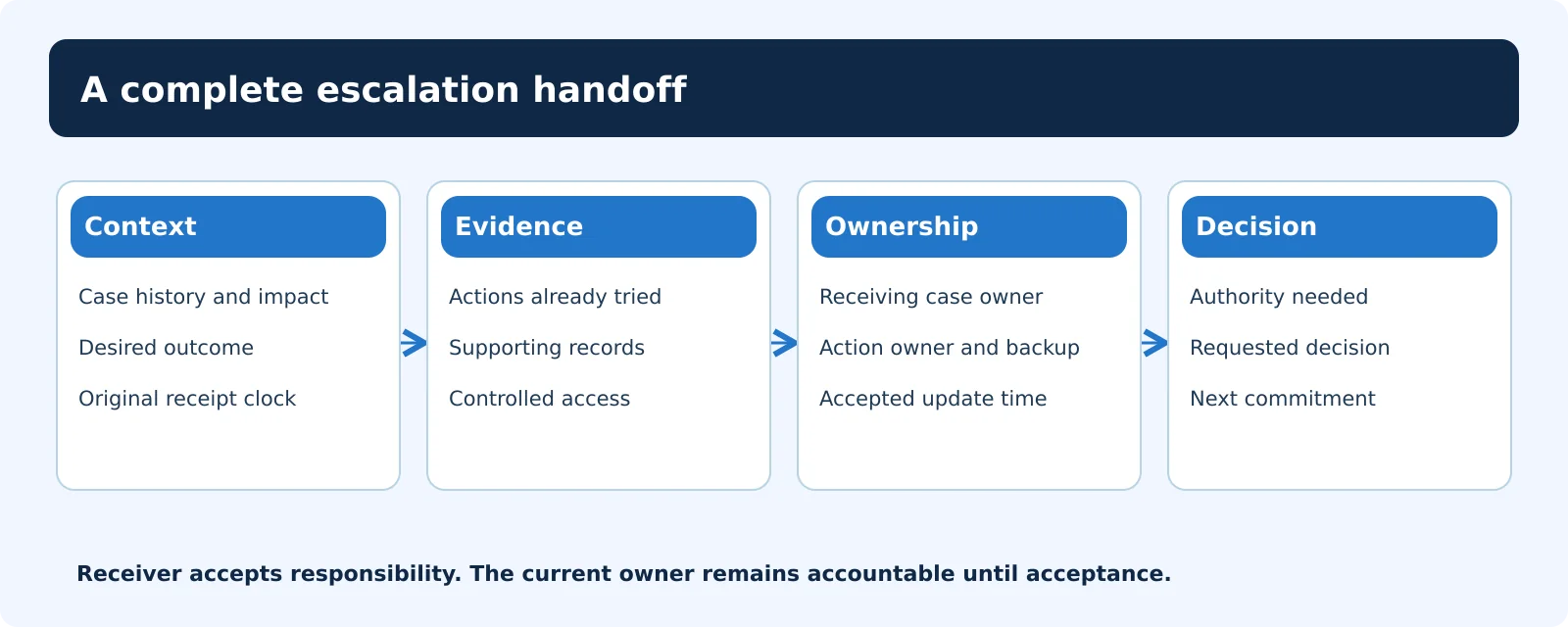
A complete handoff also retains the original receipt time, desired outcome, case and action owners, receiving owner's acceptance, backup route, requested approval, and next customer update. Role-based access should expose only the evidence needed for the receiving role.
Measure the proportion of handoffs returned for missing information, repeated evidence requests, and elapsed investigation time after transfer. Review samples for factual completeness, not merely whether mandatory fields were populated.
Figure 2. Transfer accountability explicitly, together with evidence and commitments.
Text equivalent: A complete handoff connects Context, Evidence, Ownership and Decision. Context includes case history, desired outcome, customer impact and original receipt clock. Evidence includes actions tried and permission-controlled records. Ownership names the receiving case owner, action owner, backup and update time. Decision states the authority needed and next commitment. Transfer completes only when the receiver accepts responsibility; acknowledgment is not resolution.
Failure: teams treat escalation as a fresh ticket or assume the original deadline has disappeared. They may miss a new risk signal while concentrating on queue age. Root causes include inconsistent clocks, weak prioritization policies, and poor visibility of external obligations.
Example: a complaint is reassigned to a specialist one day before the response deadline. The receiving team starts a new internal target instead of preserving the relevant original date. Customers then receive an overdue update without explanation.
Prevention: preserve the original receipt timestamp, record applicable contractual and statutory obligations, and distinguish internal response targets from legal requirements. Reassess impact and urgency when new evidence appears. Do not apply a universal regulatory deadline across different jurisdictions or complaint types.
An SLA is a service-level agreement, usually contractual; an internal target is not a statutory requirement. For UK financial-services complaints within scope, FCA DISP 1.6 requires a prompt written acknowledgment and progress updates. Its general eight-week rule concerns a final response or a compliant written response explaining delay and referral rights, not a universal eight-week resolution guarantee. EMD and PSD complaints generally have a 15-business-day final-response rule, with an exceptional holding-response route and a 35-business-day final-response limit. Check application, complaint type, exceptions, and current rules before adopting a timetable. Reassignment does not restart the relevant receipt clock. 3
Measure missed applicable deadlines among obligations due in the review period, not among all open tickets. Report contractual, internal, and statutory results separately, and record any valid exception and its basis.
6. Leaving Customers Without Meaningful Updates
Failure: the customer receives "we are investigating" repeatedly, without a next action, owner, or reasonable expectation for further communication. Even a valid technical investigation can feel abandoned when internal progress is invisible.
Example: engineering is reproducing a software defect, but frontline support cannot explain whether a workaround exists or when the next update will arrive. The customer contacts support again, creating duplicate tickets and conflicting promises.
Prevention: assign a communication owner even when a specialist owns technical work. Updates should explain what has happened, what remains unresolved, what the team is doing next, and when another update will be provided. Avoid invented resolution dates; communicate uncertainty accurately.
The root cause may be a split between technical work and customer communication with no explicit update owner. A technical action owner does not automatically become the accountable case owner.
Track missed update commitments, repeated inbound contacts while a case is open, and complaints about lack of communication. Audit quality as well as frequency: a punctual but meaningless message is not a successful update.
7. Escalating Without Defining the Decision or Approval Needed
Failure: cases reach managers as a narrative of frustration rather than a clear decision request. Managers must reconstruct the issue, determine their authority, and request missing evidence. This creates avoidable loops, especially in complaints requiring exceptions or financial remedies.
Example: an agent escalates a request for a fee waiver but does not identify the amount, applicable policy, prior offers, or whether a supervisor can authorize the proposed remedy.
Prevention: state the decision explicitly: approve an exception, interpret policy, authorize a remedy, accept a risk, or refer the matter to an independent reviewer. Record the policy boundary, evidence, recommended option, decision maker, and approval outcome. Keep preparation separate from approval authority.
FCA DISP 1.4, where applicable, requires competent, diligent, impartial investigation and fair, consistent, prompt assessment. It also requires a clear explanation of the decision and prompt compliance with an offer of remedial action or redress accepted by the complainant. An internal approval alone does not prove delivery of that remedy. 2
Measure clarification returns, approval turnaround time, and decisions overturned because the wrong authority was used. Important customer escalation mistakes arise when an approval is assumed from silence rather than recorded affirmatively.
8. Closing Escalated Cases Before Verifying Outcomes
Failure: the system marks a case complete when an internal task finishes, even though the agreed remedy has not been delivered or the customer still faces the original problem. Operational completion and customer resolution are different events.
Example: billing authorizes a refund and closes the ticket. The transaction fails during processing, and nobody checks whether the funds reached the customer. The resulting repeat complaint starts another escalation cycle.
Prevention: define closure evidence appropriate to the remedy. That might be a completed transaction, tested technical fix, documented explanation, or confirmed customer communication. Where confirmation is not practical, specify an objective verification method and disclose unresolved limitations.
Premature closure often reflects a closure rule tied to task completion rather than remedy evidence. Do not equate approval, transaction initiation, or lack of customer reply with a verified outcome.
Monitor reopen rates, failed remedies, and repeat contacts linked to recently closed cases. A low closure time is not automatically a sign of quality if outcomes are unverified.
9. Failing to Learn From Repeated Escalations
Failure: the organization addresses individual cases but never examines why the same issue recurs. Agents become skilled at managing symptoms while the product, process, or policy defect persists.
Example: customers repeatedly escalate subscription cancellations because the cancellation status is not synchronized across billing and account systems. Each complaint is handled separately, but the underlying integration error remains open.
Prevention: review clusters by root cause, service, team, journey stage, and corrective action. Link related cases to a problem investigation when warranted. Assign an owner, deadline, verification method, and follow-up review for prevention work.
Measure repeat escalations, recurrence after corrective action, and overdue prevention tasks. Do not rely only on the total escalation count: more documented escalation can initially reflect better issue detection.
Customer Escalation Mistakes: Warning Signs and Preventive Controls
Use this operating matrix during weekly quality reviews. The measures are diagnostic indicators rather than universal benchmarks; define denominators and exclusions before comparing teams.
Failure signal
Preventive control
Management metric
Late routing
Trigger rules and review
Trigger-to-escalation delay
Wrong destination
Routing matrix
Avoidable reassignment rate
Unowned transfer
Accepted handoff and backup
Time without owner
Missing evidence
Required handoff record
Incomplete handoff share
Deadline exposure
Original clock and alerts
Applicable deadline breach rate
Silent case
Named update owner
Missed update commitments
Missing approval
Decision request and authority
Clarification returns
Premature closure
Remedy verification
Reopens after closure
Repeated patterns
Root-cause action register
Repeat escalation rate
Define the population before interpreting each metric
Use the same review period and a documented case-linking method. Segment by severity, complexity, channel, and complaint type; record exclusions and missing evidence. These are diagnostic examples, not universal benchmarks.
Trigger-to-escalation delay: elapsed time from the first evidenced qualifying trigger to accepted escalation for cases meeting a trigger during the period. Include still-pending cases as censored at the audit cutoff rather than dropping them; state whether elapsed or business time is used.
Avoidable reassignment rate: transferred cases with at least one unnecessary redirect divided by all transferred cases reviewed. Exclude justified parallel specialist work and recorded risk exceptions from the avoidable numerator, not from visibility.
Time without owner: time between a transfer request and acceptance for sampled handoffs, with pending time aged to the cutoff. Record any actual accountability gap separately; policy should retain the sender until acceptance.
Incomplete handoff share: reviewed handoffs returned for missing necessary information divided by all handoffs reviewed. Repeated evidence requests and post-transfer investigation time provide context.
Applicable deadline breach rate: missed obligations divided by obligations due in the period, separated by contractual, internal, and statutory basis. Use the original relevant receipt clock.
Missed update commitments: promised updates not delivered by the committed time divided by updates due during the period. Review message substance and count linked repeat inbound contacts while cases remain open.
Clarification returns: approval requests returned for an unclear decision, missing evidence, or wrong authority divided by approval requests reviewed. Report approval turnaround and overturned decisions alongside it.
Reopens after closure: closed cases reopened for the same issue within a stated window, such as 30 days, divided by closed cases with that full observation window. Record failed remedies and linked repeat contacts even if no reopen was logged.
Repeat escalation rate: cases linked to a previously identified cause divided by escalated cases reviewed. For prevention effectiveness, compare recurrence before and after corrective action among cases exposed to that cause, and report prevention tasks overdue at the review cutoff.
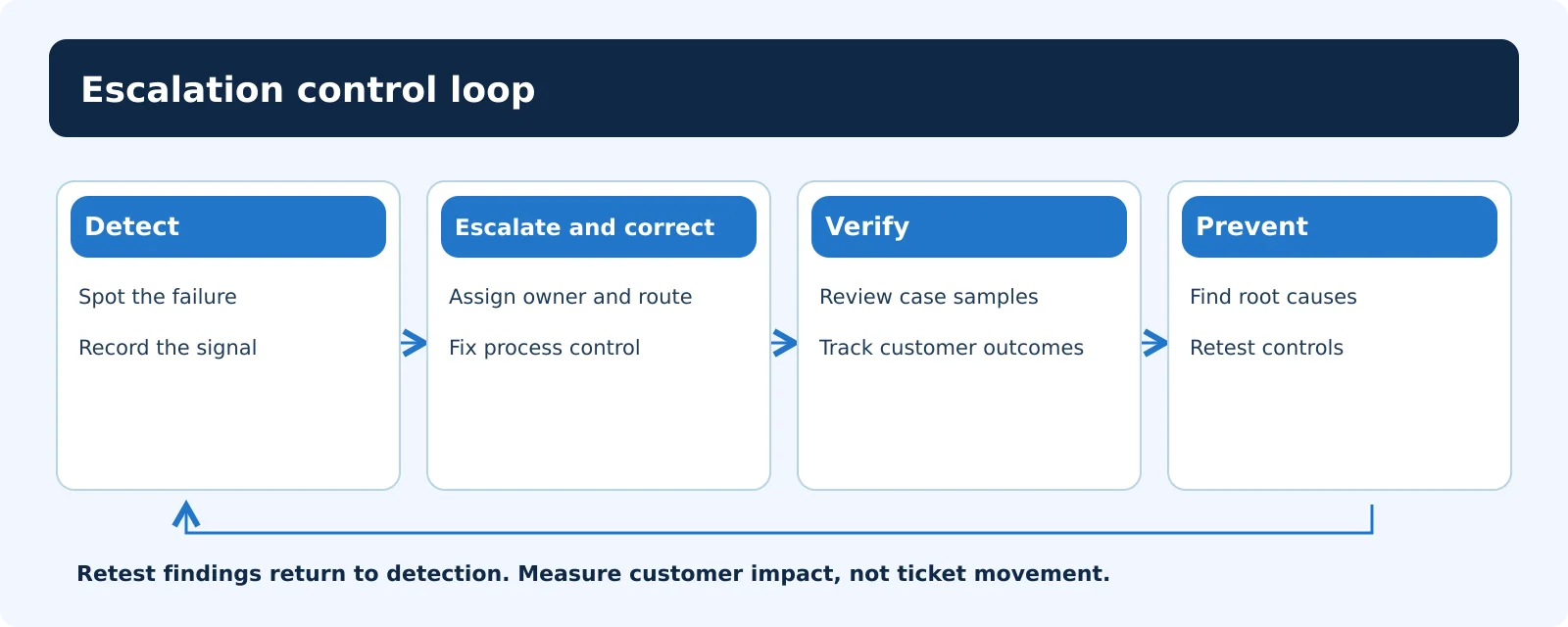
Figure 3. Detect, escalate and correct, verify, then prevent recurrence.
Text equivalent: The control loop starts with Detect: spot the failure and record the signal. Escalate and correct: assign an accountable owner, use the appropriate route and fix the process control. Verify: review case samples and track customer outcomes. Prevent: find root causes, assign prevention actions and retest controls. Feed the retest findings into detection. Measure customer impact, not ticket movement.
A useful audit tests actual case histories rather than accepting a written escalation policy as proof of execution. Sample straightforward cases, high-impact cases, and cases with repeat contact. Include a mix of teams, channels, customer groups, and outcomes.
Identify the first moment escalation criteria were met, then compare it with the actual escalation time.
Trace each transfer: who sent the case, who accepted it, who owned customer updates, and what evidence moved?
Check whether deadlines, priorities, policy exceptions, and approvals remained visible through every handoff.
Examine closure evidence and whether the promised remedy was actually delivered.
Group recurring failures by root cause and assign owners to improvements, not only individual case fixes.
Document findings as a control gap, supporting example, severity, responsible owner, corrective action, and verification test. Review again after changes are implemented to see whether the same failure mode persists.
Use a repeating control loop: detect the signal; escalate to an accepted owner and correct the control; verify the customer outcome using case samples; prevent recurrence through owned root-cause actions and retesting. Feed retest results back into detection. This preserves corrective action as well as appropriate escalation.
How to Measure Escalation Quality
A balanced escalation scorecard combines six dimensions: timing, ownership, quality, customer experience, outcome, and prevention. No single number is sufficient. Escalations may increase after a new routing policy because hidden cases are finally reaching the correct teams.
Dimension
Useful metric
What it reveals
Timing
Trigger-to-accepted-escalation time
Delayed recognition or handoff
Ownership
Unaccepted handoff time
Accountability gaps
Quality
Incomplete handoff share
Missing context
Customer experience
Missed update commitments
Communication breakdowns
Outcome
Reopens and failed remedies
Premature closure
Prevention
Repeat escalations by cause
Unresolved systemic defects
How AI Can Help Prevent Customer Escalation Mistakes
AI can help teams identify likely issue categories, detect rising customer frustration, summarize case histories, and suggest a suitable escalation destination. These capabilities can reduce manual searching, but they do not eliminate the need for accountable human decisions.
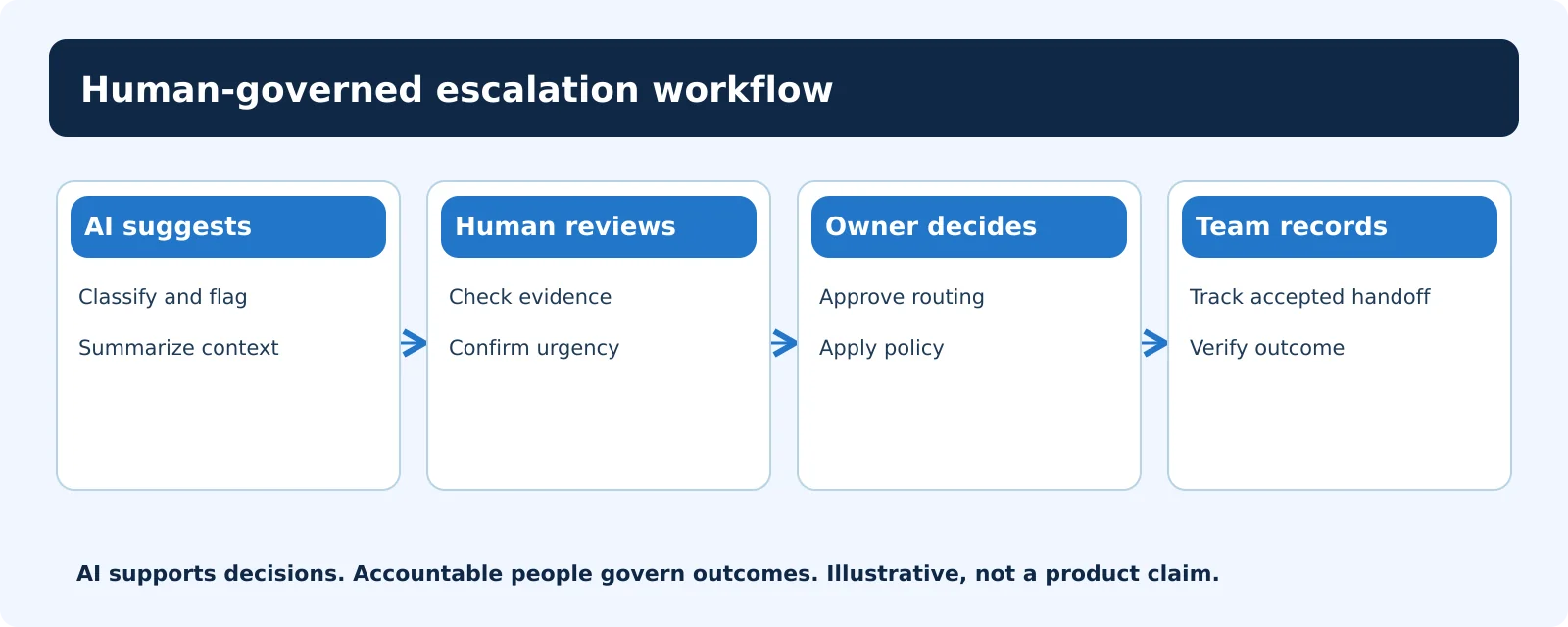
For instance, a classification model may flag repeated billing disputes for review. A human owner should confirm risk, apply policy, check permissions, and approve any high-impact remedy. AI summaries should retain source links so agents can verify chronology and evidence rather than trusting an unsupported statement.
Source-linked summaries are a recommended control to evaluate, not a claim that ResolveCX currently supplies that function. Test factual accuracy, missing context, inappropriate routing, and performance across case groups before operational use. Keep consequential routing, policy exceptions, risk acceptance, and remedies with authorized people. NIST AI RMF 1.0 is voluntary risk-management guidance, not law, certification, or proof of a deployed capability. 4
ResolveCX positions AI as assistance within governed complaint and case operations: ownership, evidence, approvals, escalation records, and outcomes should remain reviewable. Capabilities and workflow details depend on actual configuration; no system can guarantee accurate classification or regulatory compliance. For an AI-assisted case, compare the proposed route and summary with the underlying evidence, record the authorized person's decision, and verify that the agreed remedy was delivered before closure.
Figure 4. AI assists; authorized people review evidence, decide and verify outcomes.
Text equivalent: AI suggests a category, flags possible risk and summarizes context. A human reviews the evidence and confirms urgency. The authorized owner decides the route, applies policy and approves any remedy within their authority. The team records the accepted handoff and verifies the outcome. AI supports decisions; accountable people govern outcomes. This is an illustrative workflow, not proof of shipped automation.
Publish triggers for urgency, repetition, authority limits, and heightened customer risk.
Define receiving teams, named owners, backups, and required acceptance of handoffs.
Keep customer history, evidence, obligations, and decisions together.
Preserve original deadlines and provide substantive customer updates.
Record approvals and verify remedies before closure.
Review repeat cases and assign measurable prevention actions.
Treat customer escalation mistakes as signals about the operating system, not simply individual agent errors. A well-designed control should make the correct behavior easy to perform and exceptions visible for review.
Conclusion: Turn Escalation Failures Into Better Outcomes
Customer escalation mistakes become expensive when a case moves faster than the evidence, ownership, or decision needed to resolve it. Prevent them by making triggers explicit, requiring accepted handoffs, preserving deadlines, verifying remedies, and reviewing repeat causes.
Start with a small case sample, fix the most consequential control gaps, and check whether customer outcomes actually improve. Strong escalation governance is measured by accountable resolution, not just completed transfers.
Late routing, wrong-team transfers, lost ownership, missing evidence, deadline failures, poor communication, unclear approvals, premature closure, and failure to investigate repeat problems are common patterns. The priority depends on impact and frequency.
Escalations commonly fail when the receiving team cannot act, the customer communication owner is missing, or the original obligation is not preserved. Weak processes make these gaps hard to detect.
A delayed escalation can extend resolution time, increase repeat contacts, and reduce time available to meet applicable deadlines. Escalation criteria should identify risk before the last possible moment.
Publish clear routing guidance, equip frontline agents with appropriate knowledge and authority, and distinguish specialist expertise from management approval. Review avoidable reassignment trends without discouraging necessary escalation.
The organization should identify a named accountable case owner, even when a specialist owns particular tasks. The ownership transfer and responsibility for customer updates should be explicitly confirmed.
Include the issue, desired outcome, chronology, previous actions, evidence, customer promises, risk, deadline, receiving owner, and specific decision or help needed. Apply appropriate privacy controls.
Breaches can trigger additional review, communication, or remediation under applicable policy. Reassignment should not silently erase original timestamps or legally relevant obligations.
Combine trigger-to-escalation delay, handoff completeness, owner acceptance, communication commitments, remedy verification, and repeat-case trends. Compare similar severity groups and inspect underlying cases.
AI may assist classification, summarization, and routing recommendations. Human review, data quality, clear permissions, and evaluation remain important, especially when decisions could materially affect customers.
Link similar cases, investigate underlying causes, assign corrective actions with deadlines, and verify whether recurrence declines. Treat repeated complaints as possible evidence of a systemic issue.
2. Financial Conduct Authority: DISP 1.4 Complaints resolution rules. Current rule text inspected November 22, 2026; the page reports its last update as March 17, 2026. UK financial-services application depends on the respondent, activity, and complaint. Technical source inspection is not professional compliance sign-off.
3. Financial Conduct Authority: DISP 1.6 Complaints time limit rules. Current rule text inspected November 22, 2026; last update shown as June 1, 2026, with a separate future version dated October 25, 2027. General and EMD/PSD time limits differ; application, exceptions, response content, and referral rights need qualified review. Do not apply one deadline to all customer support cases.
4. NIST: Artificial Intelligence Risk Management Framework, AI RMF 1.0. Official overview inspected November 22, 2026. The framework was released January 26, 2023, for voluntary use. NIST reports revision in progress. It does not certify products, establish an escalation timetable, or prove ResolveCX functionality.
Editorial note: Sample cases, metrics and controls are illustrative. Applicable deadlines and product capabilities must be verified for the relevant jurisdiction and configuration.
About ResolveCX Product Management Team
The ResolveCX Product Management Team writes about accountable customer operations, case ownership and governed escalation workflows. Examples in this guide are illustrative, not legal advice.