Callback Management: How to Stop Missed Callbacks Becoming Lost Cases
A practical guide to callback commitments: connect promises, accepted owners, safe contact windows and recovery actions to the customer case.
ResolveCX Team28 October 202615 min read7 views
Key Takeaways
1Queue callbacks, scheduled follow-ups and substantive case updates have different completion tests.
2Link every investigation callback to its case, accepted caller, local-time window and next action.
3Keep the case owner accountable while specialists, callers and supervisors own distinct actions.
4Recover failed contact through approved preferences, realistic coverage and an owned manual fallback.
5Measure promises, attempts, contacts and case outcomes separately; a dial is not a resolution.
A promised return call is a customer commitment, not a reminder on an agent's calendar. When the promise sits apart from the issue being investigated, an unanswered or overdue callback can disappear while the case appears to be progressing. Effective callback management connects the promised window, owner, attempt history and next action to the customer record. Explore ResolveCX's governed customer workflows to see how accountable case work is structured.
What is callback management in customer service?
Callback management is the process of capturing a return-call request or promise, assigning responsibility, scheduling the contact, monitoring its due time, recording what happened and deciding what the customer issue needs next. It includes operational recovery when an agent, customer or phone system cannot complete the call. A successful dial does not necessarily mean the customer was reached; reaching the customer does not necessarily resolve the case.
A queue callback lets someone leave a hold queue while the system retains a request for an available agent. A scheduled follow-up is a promise to contact the customer at an agreed time about a specific matter. A case update is the substantive communication about an investigation or decision. These can coincide, but they need different completion tests. ISO 10002 frames complaint handling as a process spanning operation and improvement, which supports keeping substantive follow-up connected to the complaint record. 1
ISO 10002 provides complaints-handling guidelines, not a callback timing standard or software certification. Its scope excludes disputes referred outside the organization and employment-related disputes.
Callback type
Trigger
Completion test
Main risk
Queue callback
Customer leaves a voice queue
Agent connects or failed request receives follow-up
Queue failure goes unnoticed
Scheduled follow-up
Agent promises a return call
Contact occurs within the agreed window or exception is handled
Promise has no accepted owner
Case update
Investigation needs customer communication
Customer receives a meaningful status or decision and next step
Call logged while case stalls
The practical unit is the commitment attached to the customer record. Simple inquiries may need only a task. A complaint or investigation needs a case linking evidence, decisions and future contact.
Why do promised callbacks get missed?
The failure often starts before the due time. An employee says “someone will call tomorrow,” but nobody checks capacity, accepts ownership or records the customer's time zone. A calendar reminder can prompt a person; it cannot reliably show a supervisor which customer promises remain at risk across the team.
Scattered notes: A voicemail, chat and spreadsheet can each contain part of the request. Create one authoritative commitment linked to the case.
Unaccepted handoff: Sending a message to a specialist is not proof that the specialist took responsibility. Require acceptance and retain the original case owner.
Impossible timing: The promised window may fall outside staffed hours or overlap an investigation. Agree a feasible window and identify the next update if the decision is pending.
Misleading completion: A ring without answer or an internal transfer can be recorded as activity. Separate attempted, connected, updated and resolved states.
Silent failure: A disabled route, unavailable agent or exhausted retry can end an automated request. Make failures visible to a person who can recover them. A failed automated request should create a visible exception that a person can accept and resolve.
What information belongs in a callback commitment?
A usable record answers who made the promise, to whom, about which issue, by when and what should happen if contact fails. Capture only personal information needed for the contact, under access and retention rules. UK ICO guidance explains the data minimisation principle for relevant UK processing. 2 The customer's preferred safe channel may matter as much as the number.
The ICO page currently notes that its guidance is under review following the Data (Use and Access) Act. Check the current guidance and applicable requirements when configuring contact records.
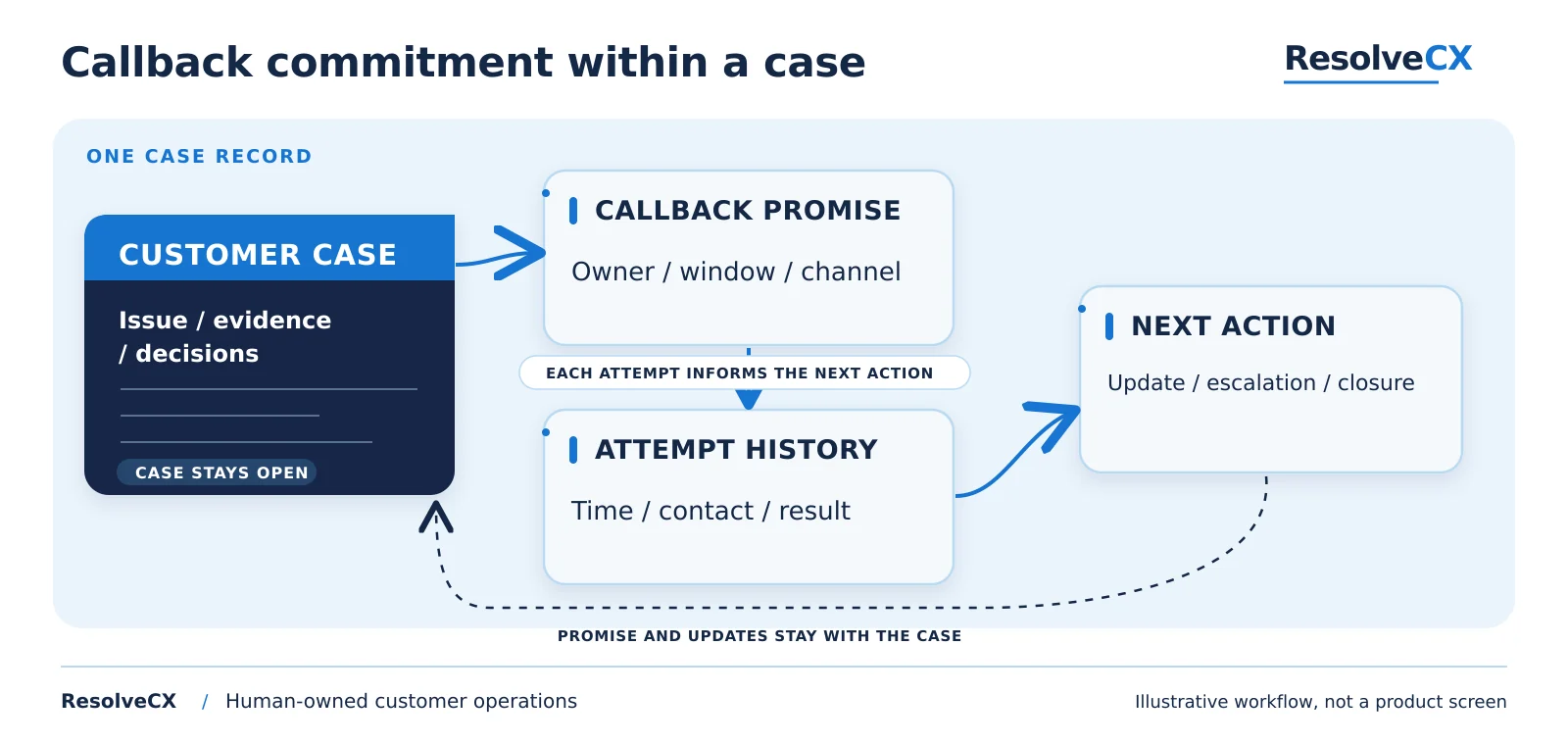
Record the originating case or interaction; reason and required update; agreed date and local-time window; verified contact method; named callback owner; accountable case owner; priority; attempt status; outcome; next action; and escalation threshold. Keep the investigation, attachments, decisions and approvals in the case record rather than duplicating them in a disconnected callback list. This makes a handler's work reviewable after a shift change.
A callback commitment stays linked to its case, contact history and next action.
For example, a disputed charge needs a billing review and a Thursday afternoon call in the customer's time zone. The callback action refers to the dispute case and names the person who will speak to the customer. An incomplete review still warrants the agreed update.
How should the workflow run from promise to outcome?
Reliable callback management treats each return call as a time-bound customer commitment. Configure the steps for local operating hours, contact preferences and any applicable rules. Then test them with failures, not only a successful dial.
Before launch, rehearse a missed promise with a second shift. Check who sees the alert, whether the replacement accepts responsibility, what the customer is told and whether the case remains open. Record the result, amend the rule and repeat the exercise.
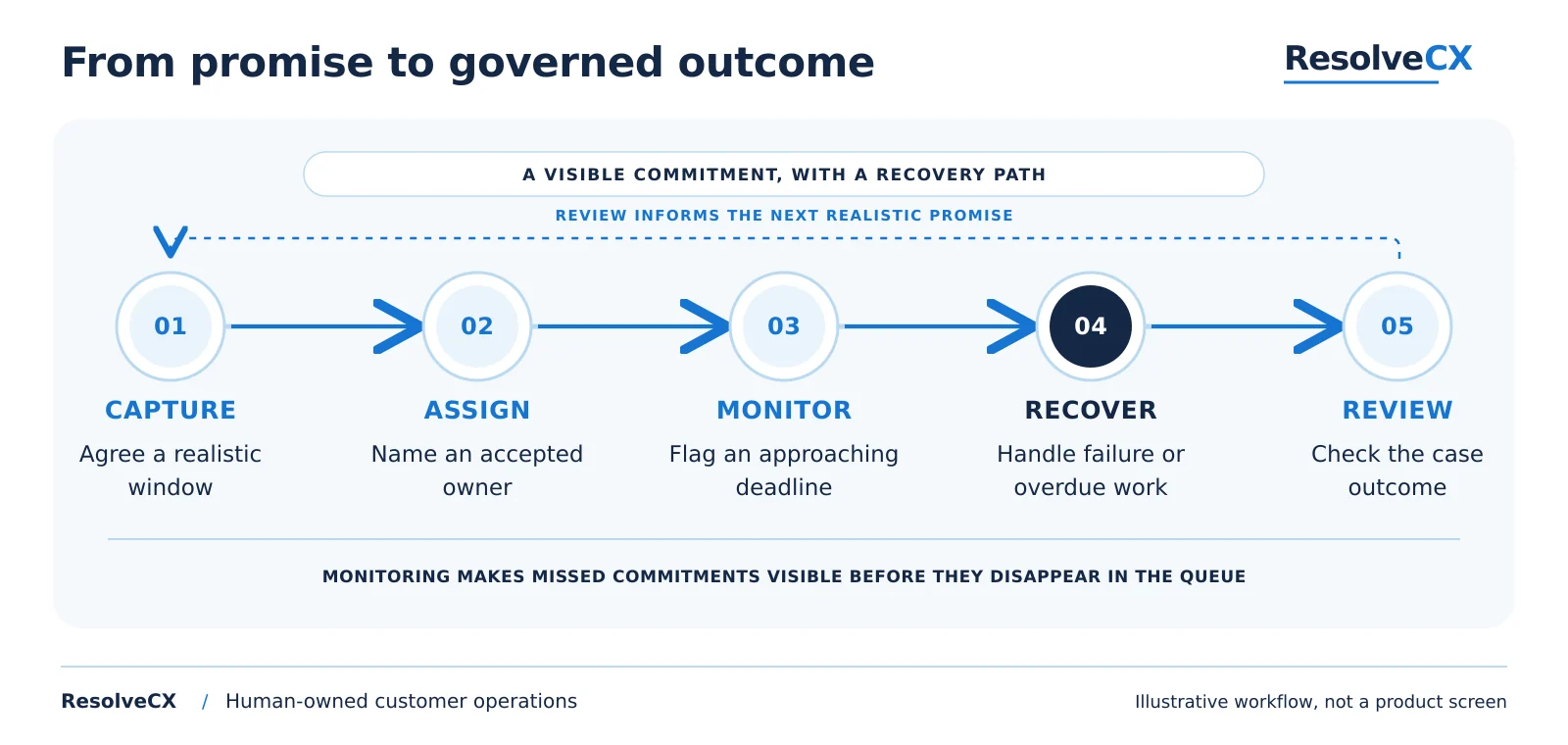
Capture the commitment. Confirm the reason, appropriate number or channel, customer's local time and realistic window. Avoid promising a precise time that staffing cannot support.
Link and assign. Connect the action to an existing case or create a case when investigation is needed. Name the caller and the accountable case owner; require a receiving team to accept a transfer.
Monitor the window. Show due and approaching-due work to the owner and supervisor. Route an exception early enough for a useful intervention.
Prepare the caller. Review evidence, previous contact, pending decision and permitted disclosures. AI may draft a case summary, but a person carefully verifies the facts before speaking.
Attempt and classify. Record actual time, contact result and what was communicated. Do not turn “dialled” into “customer updated.”
Recover the exception. If the customer cannot be reached or the promise is missed, follow the agreed retry or alternative-channel rule, document it and set a new owned action.
Review the case. Close the callback commitment only with an accurate outcome. Keep the underlying case open until its own resolution and closure criteria are met.
Capture, assign, monitor, recover and review the commitment without confusing a call with case resolution.
When the window must change, tell the customer as soon as the risk is known, give an honest reason within disclosure rules, propose a new time and record who owns the revised promise. A missed commitment should alert the supervisor when its importance, age or repeated failure crosses a defined threshold. An urgent complaint or safety-related issue may require a different route immediately; a routine update can follow the organization's standard recovery window.
These are illustrative operating controls, not a promise of a native ResolveCX dialler, virtual queue or scheduling connector. Verify supported events, configuration and accountable manual recovery before relying on automation.
Who owns the callback when several teams are involved?
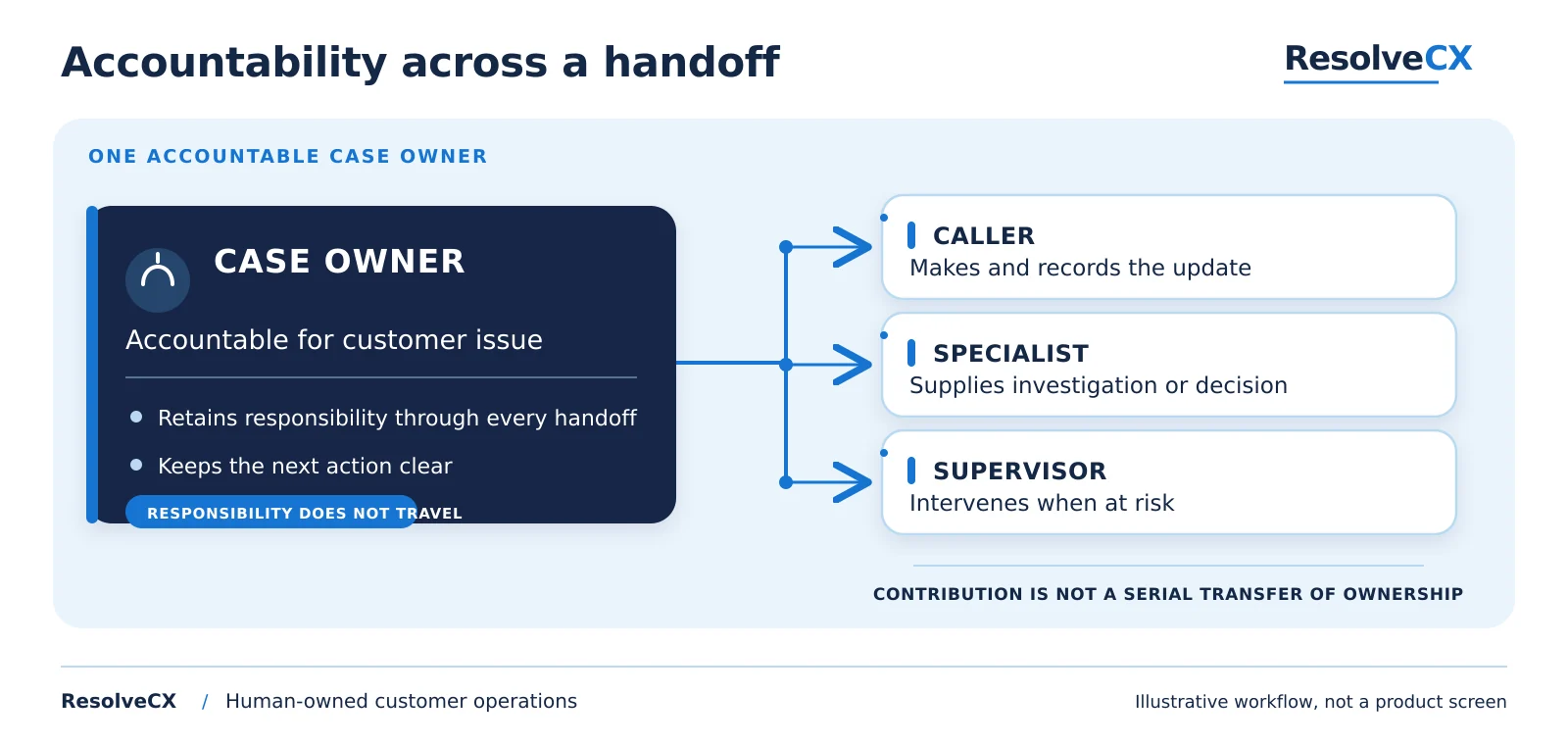
The person placing the call and the person accountable for the case may differ. The case owner remains responsible for ensuring a customer receives a meaningful update, even when a specialist supplies the answer. A supervisor owns intervention when a commitment is at risk. Handoff changes should be explicit and visible, so an internal request never becomes an ownerless customer promise.
Event
Accountable owner
Action owner
Review point
New promise
Case owner
Assigned caller
Window and contact details confirmed
Specialist investigation
Case owner
Specialist for technical task
Acceptance and decision due time
Owner unavailable
Case owner or designated cover
Replacement caller
Coverage accepted before deadline
Missed window
Supervisor or designated escalation owner
Reassigned caller
Customer update and revised commitment
Case resolution
Case owner
Relevant decision maker
Evidence, approval and outcome recorded
Separate case accountability, customer contact, specialist work and supervisor intervention.
Consider a telecom billing dispute. The frontline agent promises a Friday call, while a billing specialist investigates the adjustment. The specialist can own the investigation task; the case owner still monitors Friday's customer commitment. If the adjustment needs approval, the callback should explain the current status and next decision date without promising an unapproved outcome. This division prevents a completed internal task from being mistaken for completed customer contact.
What should happen when a callback fails?
First determine the failure type. “No answer” means a timely attempt occurred but contact was not established. “Missed promise” means no valid attempt or customer update occurred within the agreed window. “Failed route” means the technology did not deliver the request to an available handler. Each requires a different remedy and a distinct reporting status.
For no answer, check the contact preference and documented retry rules; a voicemail may be inappropriate for a sensitive matter. For a wrong number, verify the permitted method before another attempt. For owner absence, reassign the action with an accepted handoff. For an overdue promise, notify the supervisor, contact the customer through an approved channel and set a realistic new window. For duplicate requests, preserve the history while preventing two agents from making inconsistent commitments.
Do not invent a universal retry count or callback SLA. Actual timing should reflect staffing, the promise made and relevant policy. Specify offer hours, capacity, attempt limits and manual recovery when technology cannot complete the request. Test these settings across holidays, shifts and customer time zones.
Which measures show whether callback promises are kept?
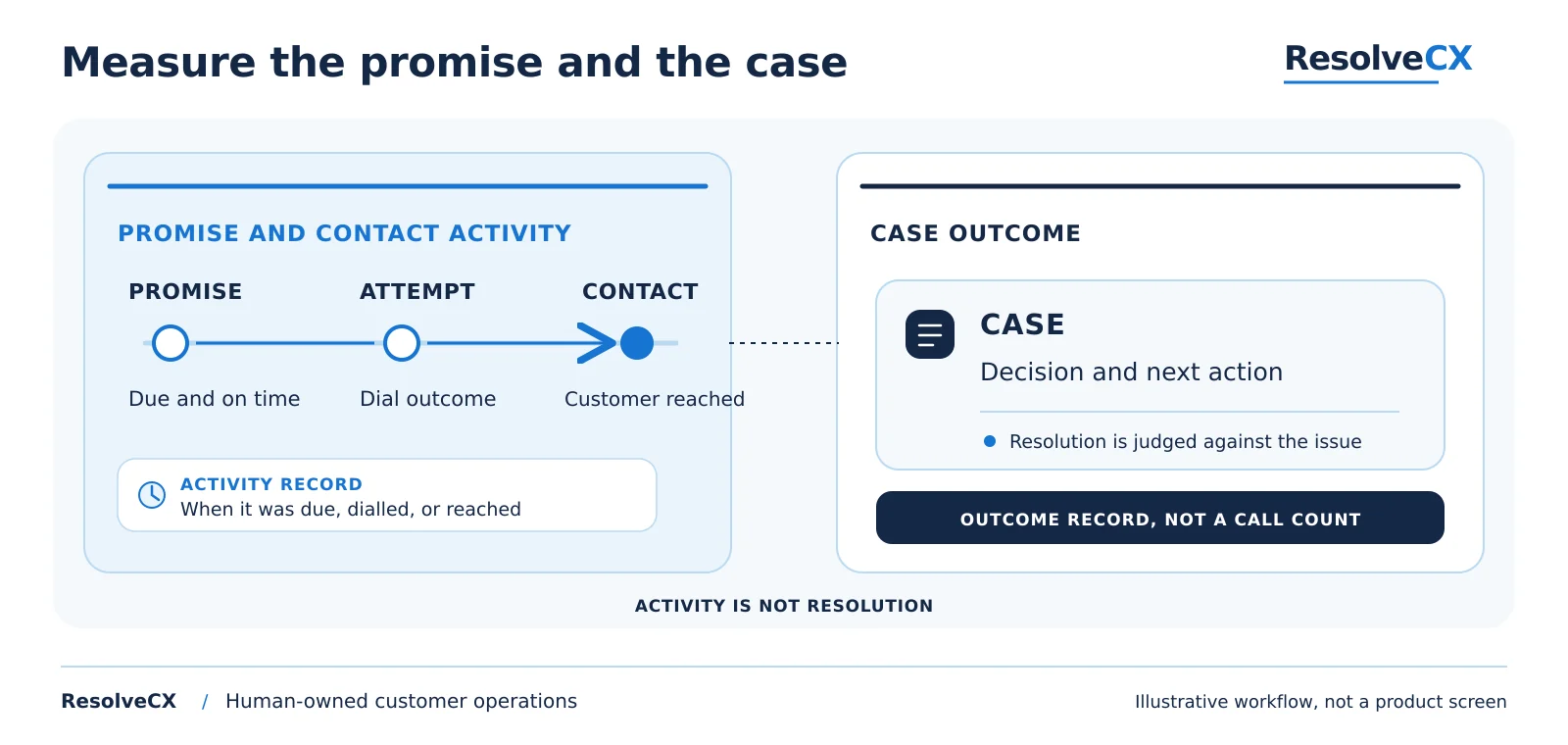
Effective callback management counts commitments, attempts, contacts and case outcomes separately. A high call-attempt count can coexist with poor customer follow-up. Define denominators and exclusions before comparing teams; otherwise rescheduled or duplicate actions can make the dashboard look better than the customer experience.
On-time promise rate: commitments fulfilled within their agreed windows divided by commitments due in the period, with documented exclusions disclosed.
Overdue open commitments: promised windows passed without a valid outcome or owned recovery action.
Contact rate: callbacks that connected with the intended customer divided by valid attempts; this is not a resolution measure.
Repeat-contact rate: customers who recontact about the same issue before the promised update, measured against a defined case population.
Case progression: cases with a recorded decision, next action or approved outcome following contact; analyze by issue type.
Promise, attempt, contact and case measures answer different questions; contact alone does not prove resolution.
Review a sample weekly. Inspect not just the number missed, but whether time-zone errors, absent coverage, delayed specialist decisions or misclassified dispositions caused the failures. Compare the original promise with the actual contact and case chronology. Correcting a scheduling rule or handoff may help more than telling agents to make more calls. Avoid publishing a benchmark without matching definitions and a reliable source. For every breach, record its cause, replacement owner, customer notification, review date and corrective action so failures can be identified and the fix verified.
What should buyers ask software vendors to demonstrate?
Start with the operating problem. A virtual-queue feature may reduce hold time yet provide little support for a complex complaint after the first conversation. A case platform may govern investigation and ownership yet depend on a separate telephony system to place the call. Verify event coverage, integration scope and failure behavior instead of assuming that either product performs both jobs.
Ask for a live demonstration using one issue. The agent promises a callback, a specialist receives a task, the assigned caller becomes unavailable, the agreed window passes, and the customer recontacts through another channel. The demo should show the original promise, accepted ownership, alert, reassignment, customer update, attempt history and case status without reconstructing an email thread.
Use these decision criteria:
Can a callback be linked to the correct case without creating duplicates?
Can a supervisor see approaching and breached commitments across queues?
What happens when the dialler fails, an agent declines or a customer does not answer?
Are the promise, actual attempt, conversation and next action separately recorded?
Can permissions restrict sensitive contact details while preserving reviewable history?
Can reports distinguish on-time contact from final case resolution?
Which integrations and event types are available in the proposed configuration, and how are exceptions reconciled?
In financial services, a promised return call should be visible alongside a complaint's separate formal deadlines and approval requirements. Do not treat a callback promise as a substitute for regulatory obligations. For applicable UK financial complaints, FCA DISP 1.6 addresses response timing and keeping complainants informed. 3 In healthcare, confirm identity, privacy, safe contact preferences and who may disclose an outcome. A voicemail may need to say less than an authenticated conversation.
Telecom and BPO operations must account for shift coverage, outsourced handoffs, queue volume and customer time zones. Retail teams may need to connect a return call to an order, refund or delivery case so the resolution survives channel changes. These are operational examples, not universal legal rules. Legal, compliance, security and privacy stakeholders should review sector-specific requirements and retention settings.
Conclusion
Audit a sample of recent callback promises. Check whether each has a customer case, feasible window, accepted owner, accurate attempt result and recovery path. Fix the first point where a missed promise becomes invisible, then test the workflow across shifts and channels. Discuss your callback and case workflow with ResolveCX using a real example of a delayed customer update.
Frequently Asked Questions
It is the controlled process of recording, assigning, delivering and reviewing customer return-call commitments. For complex issues, the commitment should remain linked to the case and its next action.
No. Queue callback replaces waiting on hold with a return call when capacity is available. A promised follow-up often concerns investigation or an agreed update on an existing issue. Both need failure handling.
Confirm a feasible customer-local window, assign a named owner, display approaching deadlines, require accepted handoffs and define an escalation route. Review failed attempts and overdue promises separately.
The receiving caller should explicitly accept the action. The case owner remains accountable for the customer issue unless the entire case ownership has also been transferred and accepted.
An attempt proves a dial occurred. Whether it fulfills the promise depends on the commitment and the approved contact policy. Record connection, message, customer update and case resolution as different outcomes.
Record the timely attempt and follow the approved retry or alternate-channel rule. Keep the case and any still-required customer update visible; respect safe-contact preferences.
Escalate when the promised window is at risk or missed under a defined rule, or sooner when the issue's urgency or impact demands intervention. Name the person responsible for recovery.
No. A simple return call may only need a tracked task. Investigation, formal dissatisfaction or coordination across teams warrants a continuing case with the callback linked to it.
Track on-time commitments, overdue promises, contact success, repeat contacts and case progression. Define each measure clearly and sample records to see whether the customer received a useful update.
AI may flag risk or draft a handoff summary from authorized context. A person should verify the record, approve customer-facing decisions and determine whether the promise and underlying case are actually complete.
ResolveCX Team are practitioners and product specialists in complaint governance, escalation management, and regulated CX operations. Our articles draw on real implementation experience across financial services, healthcare, and telecommunications.