Complaint Trend Analysis: How to Spot Patterns in Complaint Data
Compare complaint rates fairly, validate recurring themes in source cases, and turn evidence into owned action with a clear effectiveness review.
ResolveCX Team30 October 202614 min read
Key Takeaways
1A signal invites inquiry, a pattern shows repetition, and a verified cause requires investigation.
2Compare counts and exposure-adjusted rates using stable categories and counting rules.
3Validate source cases, alternative explanations and uncertainty before approving findings.
4Serious harm may require immediate intervention even when a sample is tiny.
5Assign action to an accountable owner and check recurrence and customer outcomes afterward.
Complaint trend analysis turns individual complaints into a clearer view of recurring customer problems. A useful review compares consistent categories over time, checks rates against the population exposed, and examines original cases before anyone declares a cause. A rising queue can reflect volume, intake changes, or failure. Explore ResolveCX complaint governance to see how complaint records can remain connected to accountable follow-up.
What is complaint trend analysis?
Complaint trend analysis is the ongoing comparison of categorized complaints across periods, products, channels, locations, and customer groups. Teams look for emerging issues, persistent themes, and changes in impact. They then inspect the underlying evidence and assign investigation where warranted. A trend is a signal for inquiry, not proof of a root cause or a prediction that a particular customer will leave.
A complaint describes expressed dissatisfaction. A case may hold the investigation and customer response. An incident records a service failure and its impact, while a problem investigation examines a recurring cause. Linking these records allows a team to see whether many complaints concern one failure without treating every contact as a separate root cause.
Term
What it establishes
What it does not establish
Signal
A noticeable change or unusual cluster
That the change is statistically reliable
Pattern
Repetition across comparable records
Why the issue occurred
Verified cause
An explanation supported by investigation
That corrective action has worked
Why analyze complaint patterns?
The practical benefit is earlier, better directed action. A repeated billing error may require a product or process fix; a single severe complaint may require immediate escalation. Trend review helps leaders distinguish those decisions. It can also show whether a proposed improvement reduced recurrence after implementation, rather than merely closing old cases.
Complaint analysis gives operations, compliance, and product teams a shared evidence base. It supports prioritization by customer harm, breadth, persistence, and ability to intervene. It does not replace listening to individual customers. Low volume can conceal serious harm in a small segment, and customers who never complain remain absent from complaint data.
A useful review also protects against misplaced effort. Teams can compare the number affected, severity, recurrence, and feasibility of a remedy before assigning resources. Documenting the reason for priority helps explain later decisions to stakeholders.
The FCA's review of UK financial firms describes trend and theme analysis, escalation routes, accountability, and evidence of changes made after root-cause work. Those observations apply to the firms reviewed and should not be presented as a universal legal requirement. ISO 10002:2018 offers broader guidance for organizational complaint handling and improvement. 15
What data should a complaint record contain?
Start with fields that let a reviewer reconstruct the issue and compare like with like. The minimum useful record contains receipt date, customer statement, product or service, issue category, channel, location or segment, assigned owner, outcome, and links to evidence. Record response deadlines, escalation, reopenings, and affected customer count where appropriate. Restrict access to personal information and retain it according to applicable policy.
Use an issue category to describe what the customer experienced, such as an incorrect invoice. Use a cause code only after investigation supports an explanation, such as a faulty pricing rule. If the cause is unknown, say so. A taxonomy that forces a speculative cause at intake makes later reports look more certain than the evidence allows.
Separate new complaints from repeat contacts about the same unresolved issue. Link them and clearly decide whether the measure counts complaints, contacts, customers, or cases. Document changes to categories, intake channels, and counting rules so a sudden jump does not become a false operational alarm.
How do you analyze complaint trends step by step?
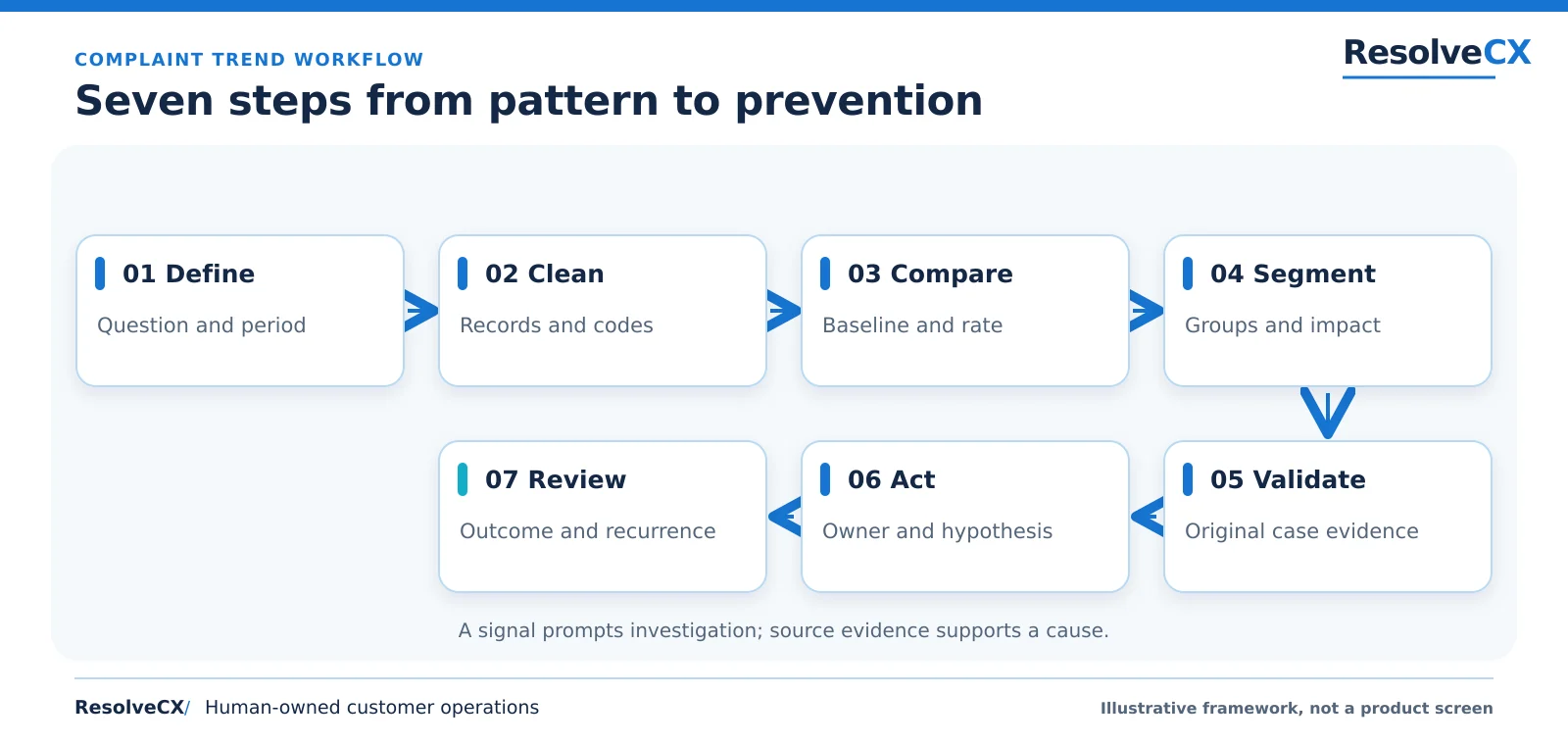
Seven steps from pattern to prevention. A signal prompts investigation; source evidence supports a cause.
Use these seven steps to test patterns and measure the result.
Frame the question. Define the issue, period, population, and decision. For example, did billing complaints increase after an invoice change?
Prepare comparable records. Remove duplicates, link repeat contacts, check missing fields, and apply a stable category definition across periods.
Choose a baseline and denominator. Compare the current period with a sensible prior period. Divide by invoices, transactions, accounts, or another exposure measure when volume changes.
Segment the pattern. Break the issue down by product, channel, region, cohort, vulnerability indicator where lawful, and relevant journey stage. Watch for tiny groups.
Read source cases. Examine a sample of original statements, evidence, decisions, and timelines. Confirm that records share a meaningful issue rather than a broad label.
Investigate and assign action. State competing hypotheses, nominate an owner, record the evidence required, and escalate serious or time-sensitive harm promptly.
Measure after the change. Track recurrence using the same definitions and denominator, check customer outcomes, and reopen the investigation if the pattern persists.
This sequence is an operational recommendation, not a statistical significance test. A serious safety or customer harm signal should be assessed immediately even when the sample is too small for a stable rate. See ResolveCX complaint management for the product context around ownership, evidence, and follow-up.
Which patterns deserve attention first?
Prioritize by potential harm and credibility, not count alone. The table separates common shapes from the next decision a reviewer should make.
Pattern
First check
Likely next action
Sudden spike
New channel, campaign, outage, or coding change
Validate source cases and scope
Persistent theme
Stable rate over several periods
Investigate process or product cause
Small severe cluster
Impact and affected customer group
Escalate without waiting for volume
Repeat or reopened cases
Previous remedy and linked records
Review whether the fix actually held
A complaint can fit several shapes. One customer may report a repeated failure during a broader incident. Record both the customer's outcome and the operational connection, then avoid counting the same underlying event as several independent failures in executive reporting.
How do you avoid misleading complaint trends?
Complaint counts need context. An ecommerce firm with twice as many orders may see more complaints even if the complaint rate falls. Conversely, a low absolute count may mask a sharp increase for a newly launched service. Compare complaints per relevant exposure unit and display both numerator and denominator.
Check seasonality, customer mix, product launches, outage windows, and policy changes before interpreting movement. A redesigned web form can increase captured complaints by making reporting easier. A newly trained team can change classifications without changing customer experience. Preserve the old and new taxonomy mapping when possible and annotate dashboards when measurement changes.
The US Consumer Financial Protection Bureau warns that its public Consumer Complaint Database is not a statistical sample of all consumers' experiences. It advises considering company size and market share when comparing volumes. The same caution applies to an internal queue: a report reflects the people who complained through channels you captured, not everyone who encountered a problem. 4
Avoid overly precise claims from tiny segments. Show the count alongside each rate, explain uncertainty, and read the affected records. A moving average can reduce visual noise, but it can also hide a sudden serious event. Keep the unfiltered series available for investigation.
What does a worked example look like?
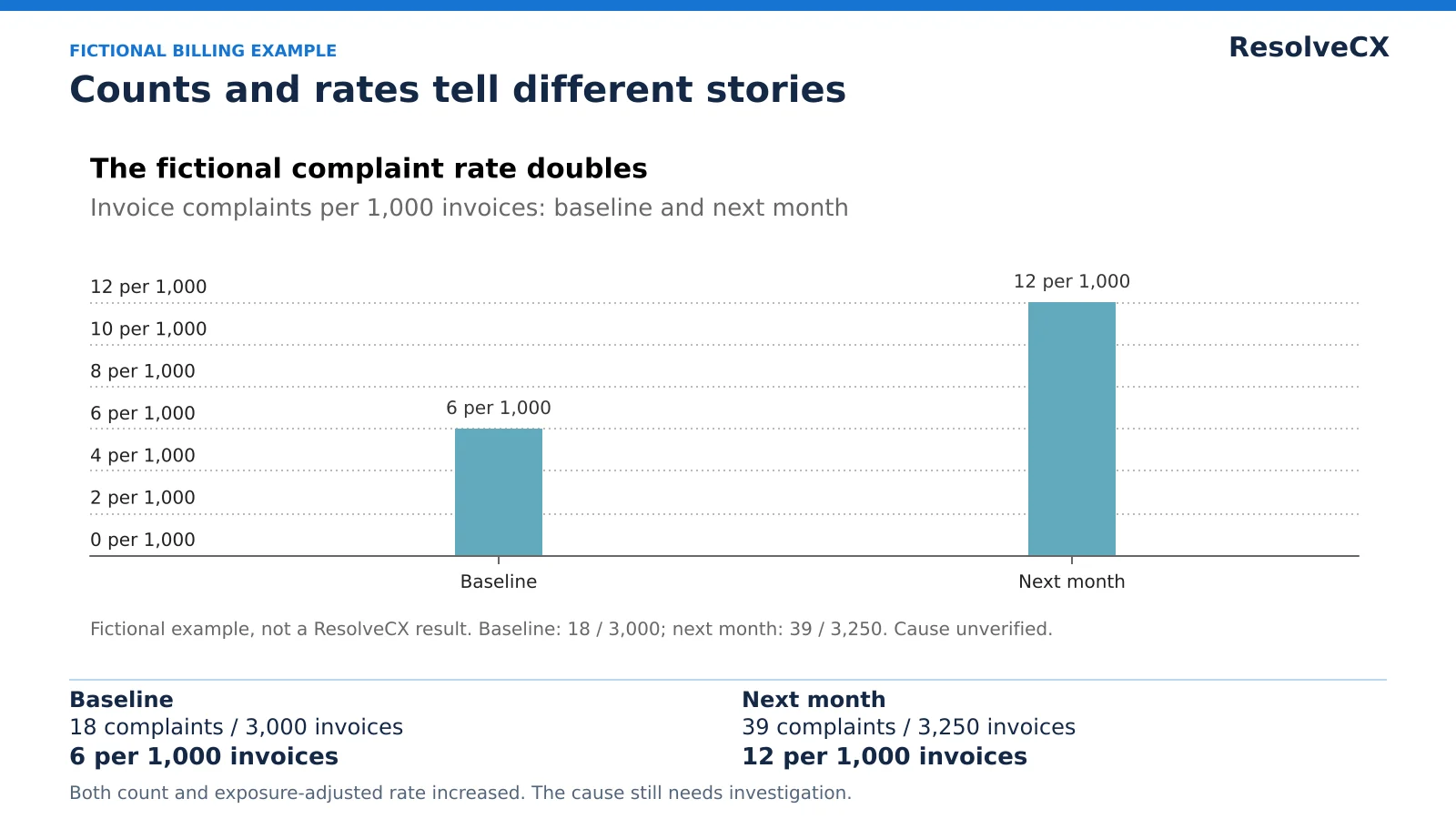
Fictional example, not a ResolveCX customer result. Counts and exposure-adjusted rates increased; the cause still needs investigation.
The following billing example is fictional and illustrates the calculation, not a ResolveCX customer result. In the baseline month, a team receives 18 invoice complaints from 3,000 invoices: six complaints per 1,000 invoices. In the following month it receives 39 from 3,250 invoices: 12 per 1,000. The count more than doubles, and the exposure-adjusted rate also doubles.
That comparison justifies review, but it does not establish that a software release caused the change. The complaint handler checks whether categories were applied consistently, whether multiple contacts concern the same invoices, and whether the affected accounts share a pricing plan or issue date. An operations owner tests the invoice-change hypothesis against release logs and sample invoices. The team records a corrective action only after evidence supports it, then follows the rate and customer outcomes in subsequent periods.
For a manufacturing team, an equivalent analysis might compare complaints by SKU or production lot and connect a verified cause to corrective and preventive action. Those traceability fields are useful only where products and operating processes warrant them; service teams should select denominators relevant to their own customer journey.
When should a trend become a problem investigation?
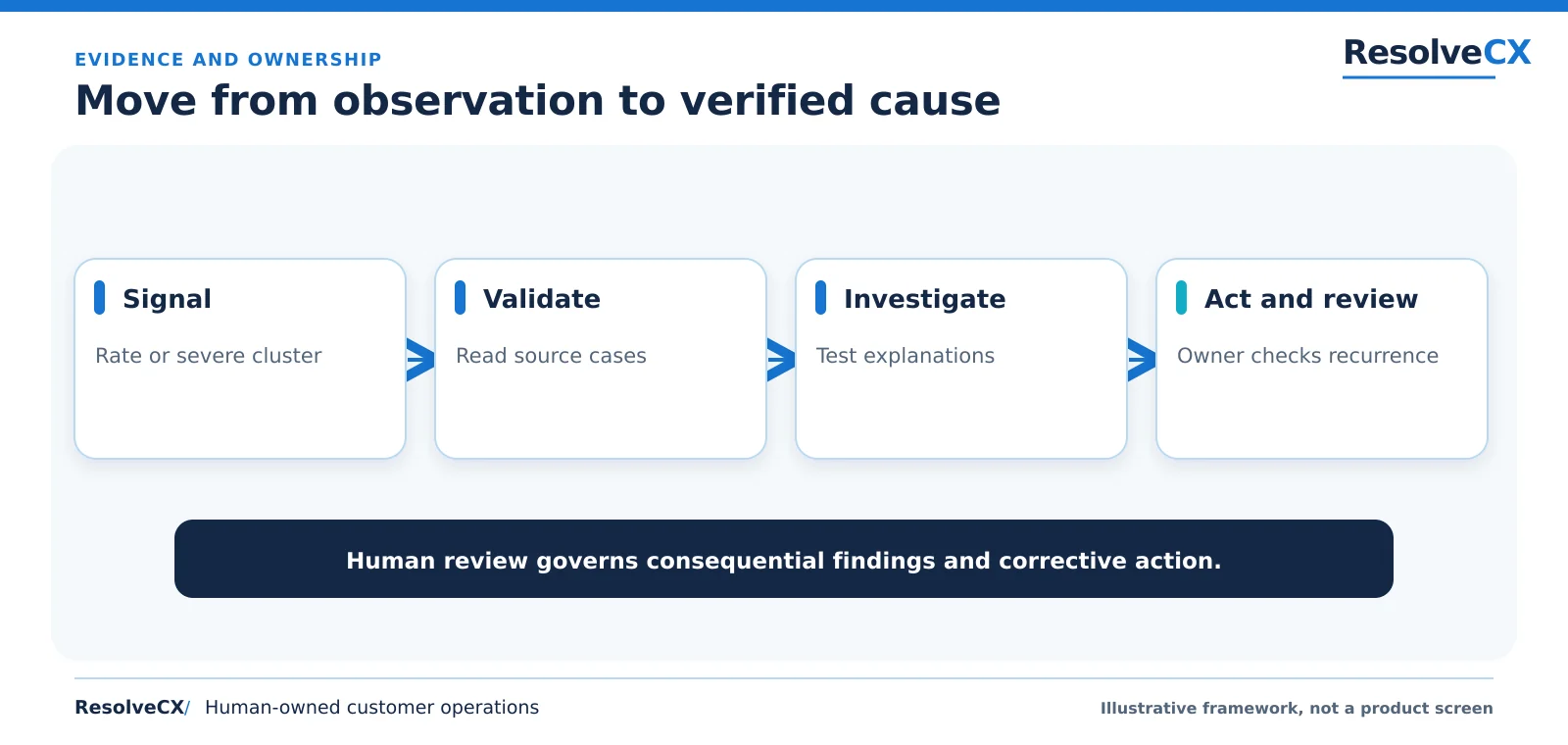
Move from observation to verified cause, then assess the effectiveness of owned corrective action.
Open a problem investigation when multiple complaints plausibly share an underlying cause, the impact is material, or the issue keeps returning after case-level remedies. Document the evidence, affected scope, owner, hypotheses, decision rights, actions, and review date. Link relevant complaints and incidents while preserving each customer's separate response obligations.
The distinction between symptom and cause matters. The FCA illustrates this in its root-cause guidance: an apparent system fault can expose deeper weaknesses in testing and oversight. For in-scope UK financial firms, FCA DISP rules include analysis of complaint causes and management information; legal and compliance teams should assess the applicable requirements. For other sectors, use the principle of documented, accountable learning without implying the same rules apply. 23
An action is incomplete until someone checks its effect. Compare the recurrence rate, look for migration into a neighboring category, and inspect a fresh sample of cases. Explore ResolveCX problem management for a related route to investigate recurring issues with ownership and linked context.
Which metrics belong on a complaint trend dashboard?
Keep the dashboard small enough to support decisions. Every chart should identify the population, period, counting rule, and person responsible for acting on a threshold. Include a route from the summary to source records.
Measure
Useful denominator or context
Decision supported
Complaint rate
Relevant orders, accounts, or contacts
Is exposure-adjusted frequency changing?
Severity and affected customers
Scope and customer impact
Is urgent intervention needed?
Repeat contacts and reopenings
Original cases or customers
Did the initial remedy hold?
Escalations and overdue cases
Cases and deadlines
Are ownership or capacity failing?
Recurrence after action
Same category and population
Did the corrective action work?
Do not treat faster closure as sufficient evidence of improvement. It may mean customers received good remedies, or it may mean cases closed before the underlying problem was fixed. Pair operational measures with sampled outcomes and recurrence.
The analysis should make its limits visible. Show missing data, changed labels, and unresolved hypotheses beside the chart. When complaint trend analysis produces an intervention, record the decision maker, expected effect, review date, and alternative explanation so teams can assess what changed over time.
Can AI help identify complaint themes?
AI can suggest categories, cluster similar language, and summarize long records so analysts find candidates for review. A human should validate ambiguous cases, sensitive signals, and proposed actions against original evidence. Record category corrections and monitor whether suggestions differ across products, channels, languages, or customer groups. A confidence score is a routing cue, not a decision about a complaint's merit.
The control is practical: define when an automated suggestion may populate a draft label, when a reviewer must confirm it, and when low confidence or high impact requires specialist assessment. Restrict source access, preserve the original wording, and prevent summaries from replacing material evidence. AI-assisted classification is useful only if the resulting categories remain consistent enough for comparisons over time.
How often should teams review the data?
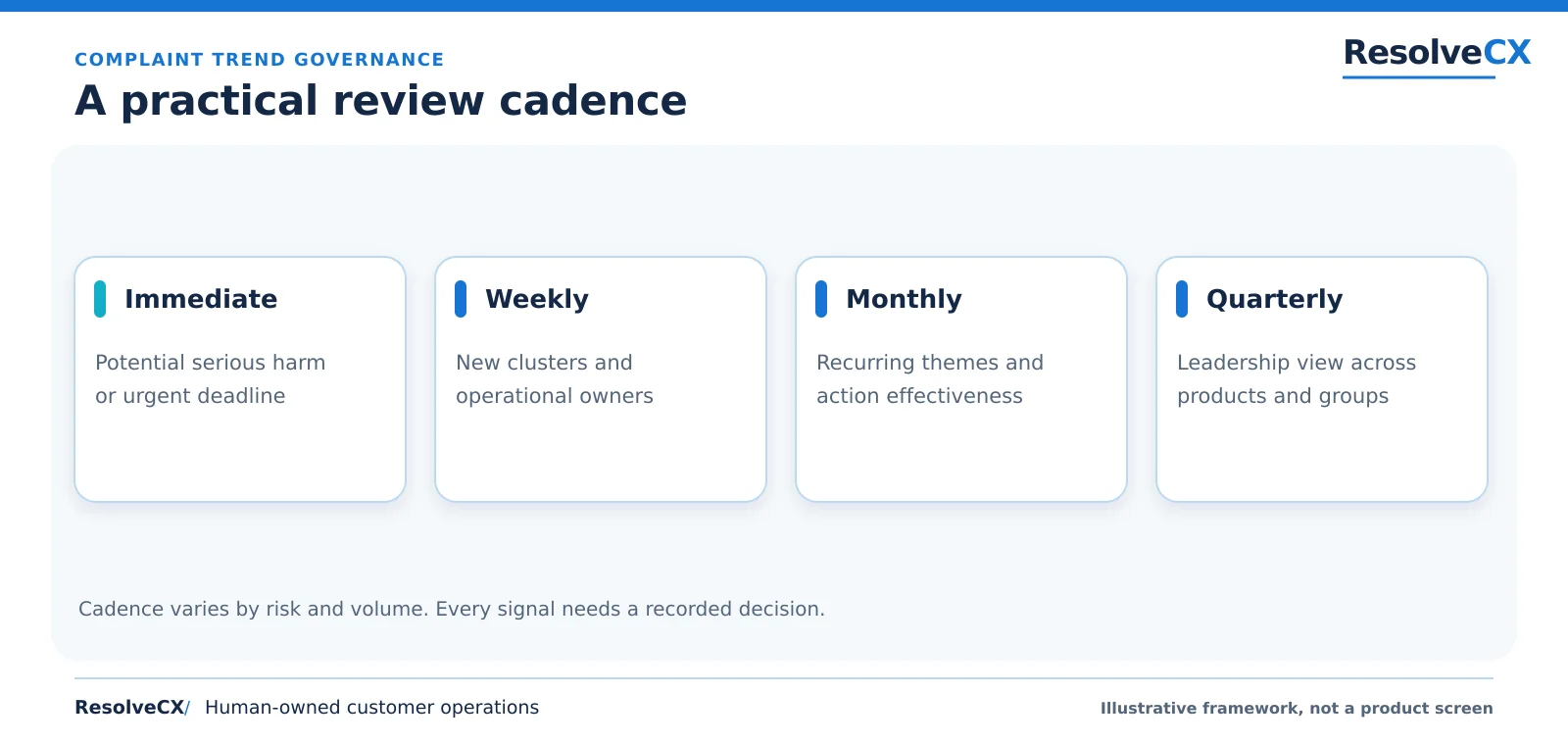
A practical review cadence varies by risk and volume. Every signal needs a recorded decision; urgent harm does not wait for a scheduled review.
Review urgent harm signals as they arise. Use a weekly operational review for new clusters and deadlines, with a monthly cross-functional review for persistent themes, root-cause actions, and effectiveness. A quarterly leadership view can examine wider patterns across products and customer groups. The exact cadence depends on complaint volume, risk, and available evidence.
Name the forum and decision owner. An analyst can prepare the view, but a service leader or designated owner must accept the finding, commission investigation, and track action. Share enough case detail for informed review without exposing unnecessary personal data. Preserve why a signal was dismissed, monitored, or escalated; that record makes later reassessment possible.
Conclusion
Effective complaint trend analysis starts with comparable records, examines rates and harm together, validates patterns in source cases, and measures whether owned action reduced recurrence. Begin with one high-impact complaint category and a denominator. For a discussion of how ResolveCX supports reviewable complaint and problem workflows, contact the ResolveCX team.
Frequently Asked Questions
A trend is an observed pattern in comparable complaints. A root cause is an explanation established through investigation. Similar wording in several cases can suggest where to look but cannot, by itself, prove why the failure occurred.
Collect dates, issue categories, products or services, channels, affected customers, outcomes, owners, and links to original evidence. Add an exposure measure such as orders or active accounts when comparing rates. Use a stable counting rule and protect personal data.
Divide the number of relevant complaints by the number of relevant exposures, then multiply by a clear scale such as 1,000. State the period and denominator. Complaints per 1,000 invoices should not be compared directly with complaints per 1,000 customers.
No. More customers, easier reporting, a new channel, or changed coding may raise recorded volume. Check the rate, original cases, severity, and operational changes before drawing a conclusion.
Escalate potential serious harm, vulnerable-customer impact, missed obligations, or a credible systemic failure according to the organization's rules. A small cluster can justify immediate action; waiting for a statistically stable trend may be inappropriate.
Complaint analysis studies expressed dissatisfaction and the decisions, remedies, and records attached to it. Feedback analysis may include compliments, suggestions, survey answers, and other signals. Combine them carefully because their sources and denominators differ.
AI can suggest clusters and possible explanations. A responsible team tests those hypotheses against source records, operational evidence, and alternative causes. People approve consequential findings and actions.
Urgent signals need prompt assessment. Weekly operational and monthly cross-functional reviews are useful starting points, with cadence adjusted for risk and volume. Document thresholds, owners, and the next review date.
Assign an investigator, define affected scope and evidence, agree corrective action with the responsible team, and check recurrence after implementation. Keep individual customer responses on track while the broader investigation proceeds.
It can reveal issues worth exploring, but it is rarely a representative sample. Compare reporting rules, market exposure, company size, product mix, and publication limitations before drawing firm-level conclusions.
ResolveCX Team are practitioners and product specialists in complaint governance, escalation management, and regulated CX operations. Our articles draw on real implementation experience across financial services, healthcare, and telecommunications.