The Cost of Poor Complaint Handling: A Practical Business Case
Build a finance-ready complaint handling case from measured rework, repeat contacts and escalation. Separate cash, capacity and risk, then test the full cost of change.
ResolveCX Team10 November 202616 min read7 views
Key Takeaways
1Separate original failure and legitimate remedies from necessary handling and avoidable work.
2Trace every estimate to evidence, an accountable owner and finance-approved rates.
3Reconcile overlaps before valuing improvements, and keep released capacity separate from cash savings.
4Compare hypothetical scenarios against full annual and first-year costs, including a process-only alternative.
5Use a measured pilot with human review, outcome checks and explicit stop conditions.
The cost of poor complaint handling is the extra work and exposure created when a complaint loses ownership, evidence, momentum or a fair decision. A defensible business case measures that incremental burden, compares it with the full cost of change, and tests whether outcomes improve. It does not assume every dissatisfied customer leaves. Explore ResolveCX for an example of connected complaint, case and escalation governance. Start with your own cases and finance-approved assumptions; a borrowed industry average cannot tell you what your process wastes.
What counts as poor complaint handling cost?
Separate three things. The original service failure may require a repair, replacement or legitimate refund. Normal complaint handling includes intake, investigation and a considered response. Poor handling creates avoidable additions: lost evidence, repeated calls, duplicated investigation, unnecessary escalation and preventable delays. Charge each activity to the right cause. Otherwise, a proposal may claim savings from costs the proposed change cannot remove.
Cost layer
Example
Treatment in the case
Original failure
Defective item and warranted replacement
Include only if prevention work can reduce the underlying failure
Necessary handling
Investigator checks facts and responds
Baseline cost, not automatically waste
Avoidable handling
Two teams reconstruct the same timeline
Candidate improvement, subject to measurement
The American Society for Quality includes complaints and returns among external failure costs in its cost-of-poor-quality framework. That classification helps quality teams, but it does not mean every service complaint stems from a defective product. Define the scope of the cost model before mixing product, service and complaint-process costs.
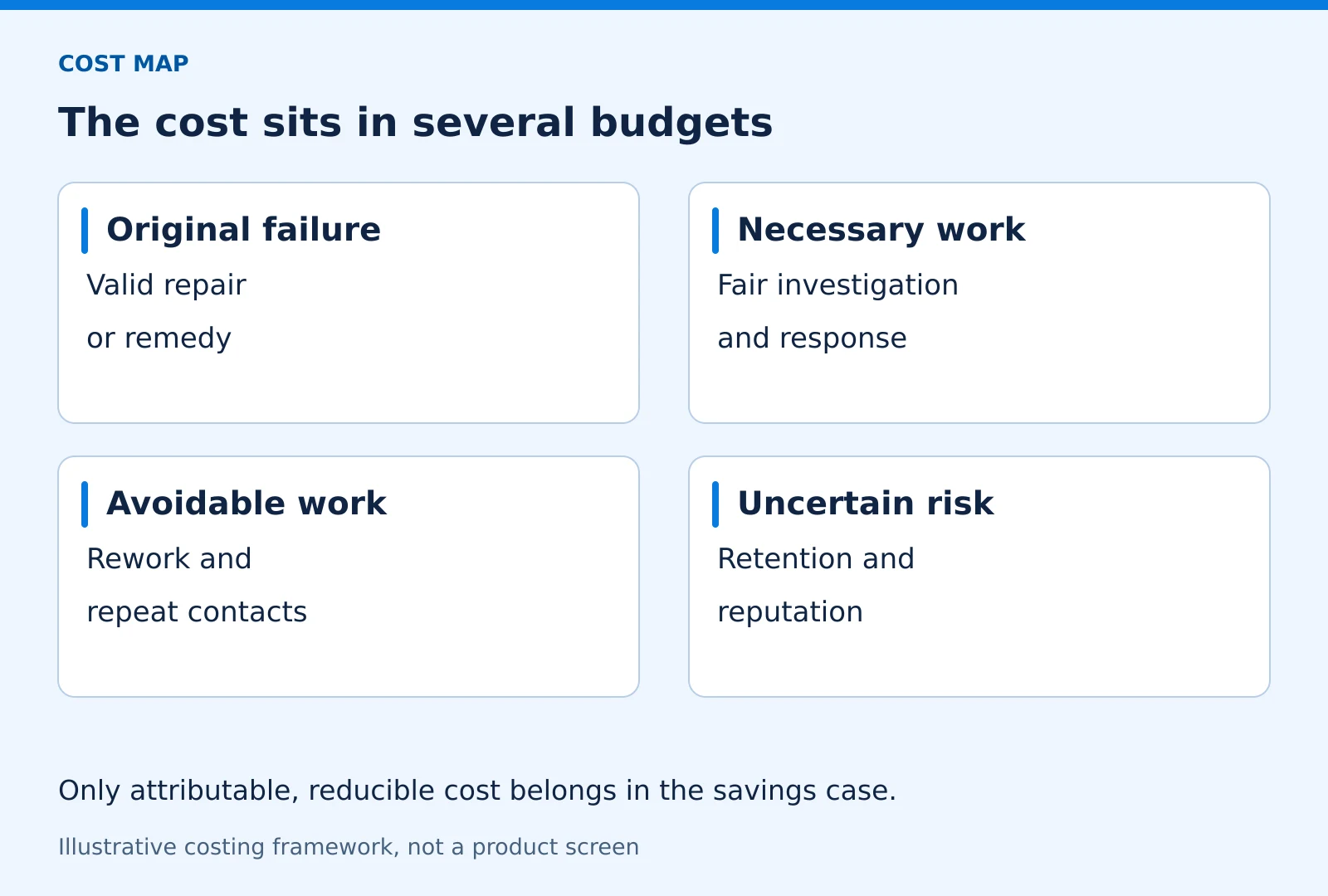
Original failure: valid repair or remedy. Necessary work: fair investigation and response. Avoidable work: rework and repeat contacts. Uncertain risk: retention and reputation. Only attributable, reducible cost belongs in the savings case.
COST MAP
Original failure
Valid repair
or remedy
Necessary work
Fair investigation
and response
Avoidable work
Rework and
repeat contacts
Uncertain risk
Retention and
reputation
Only attributable, reducible cost belongs in the savings case.
Illustrative costing framework, not a product screen
The cost sits in several budgets
Original failure: valid repair or remedy. Necessary work: fair investigation and response. Avoidable work: rework and repeat contacts. Uncertain risk: retention and reputation. Only attributable, reducible cost belongs in the savings case.
COST MAP
Original failure
Valid repair
or remedy
Necessary work
Fair investigation
and response
Avoidable work
Rework and
repeat contacts
Uncertain risk
Retention and
reputation
Only attributable, reducible cost belongs in the savings case.
Illustrative costing framework, not a product screen
Figure 1. The cost sits in several budgets.
Where does the cost appear?
The cost of poor complaint handling spans contact-center time, investigation, redress and retention work. Follow each activity to the response while separating measured spending from uncertain downstream risk.
Rework and evidence retrieval
Handlers search inboxes, request the same files twice or rewrite a chronology after ownership changes. Sample time spent on these tasks separately from necessary investigation. If evidence collection remains essential under the new process, do not count it as a saving. The realistic opportunity is less reconstruction, fewer failed handoffs and a more reviewable case.
Repeat contacts and prolonged cases
A customer may call because the promised update did not arrive, because the next owner is unknown or because an answer ignored part of the complaint. Count the incremental contacts and the minutes needed to handle them. Record whether the contact reflects a handling failure or a legitimate new fact. Longer cycle time alone is not a cash cost; it becomes costly when it drives additional work or demonstrable harm.
Escalation, redress and external review
Escalation can be appropriate. Count only avoidable escalation activity, such as a supervisor rebuilding a file that should have been complete. Redress that is fairly owed for the original issue is not a saving from faster processing. Additional compensation caused by a preventable handling error may be relevant if finance can identify it. External case fees apply only where the organization and referral meet the relevant scheme's rules.
Retention and reputation exposure
Poor handling can weaken trust, but a complaint does not prove churn causation. Use a cohort analysis or a controlled customer study before translating retention differences into margin. Reviews, social posts and satisfaction scores are risk indicators until a monetary effect is supported. The business case can still report these outcomes, clearly separated from booked savings.
Which costs can you measure reliably?
Build the cost of poor complaint handling from units that a finance partner can inspect. APQC's process-cost measures include labor, systems, overhead, outsourced and other costs, but some combine orders, inquiries and complaints. Use their categories as a completeness check, not their broad measure as a complaint-only price.
The linked APQC measure is per business entity full-time equivalent and combines orders, inquiries and complaints. It is not cost per complaint.
Ledger item
Unit and source
Attribution check
Duplicate evidence search
Minutes sampled per complaint; case audit
Was the search avoidable rather than required?
Repeat contact
Extra contacts and handle time; telephony or CRM
Was the contact caused by a missed update?
Supervisor escalation
Incremental minutes; roster and case record
Was escalation avoidable under policy?
External fee
Fee actually charged; finance ledger
Did this case generate a payable fee?
Incremental redress
Difference linked to handling error; approval record
Would it have been paid for the original failure anyway?
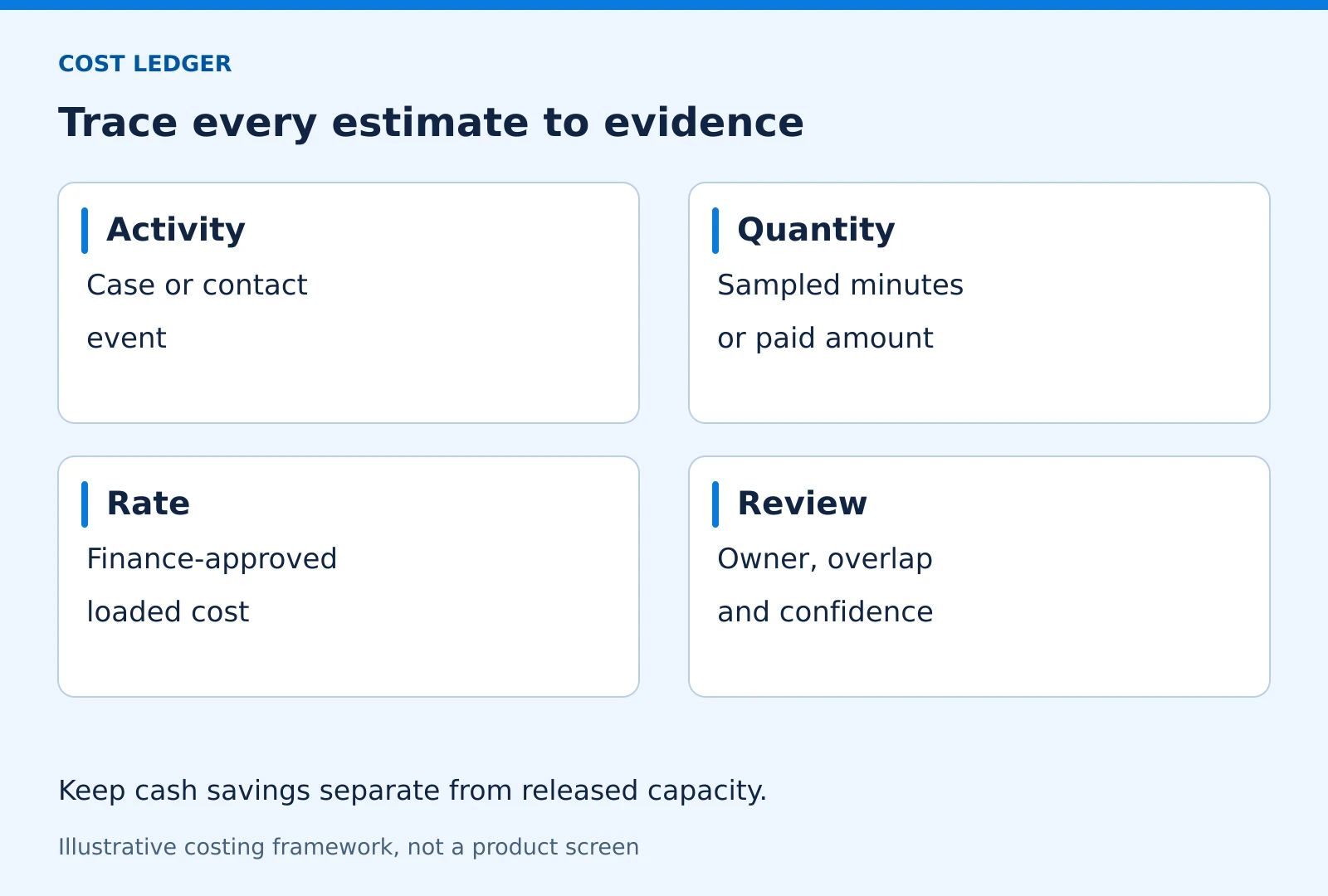
Activity: case or contact event. Quantity: sampled minutes or paid amount. Rate: finance-approved loaded cost. Review: owner, overlap and confidence. Keep cash savings separate from released capacity.
COST LEDGER
Activity
Case or contact
event
Quantity
Sampled minutes
or paid amount
Rate
Finance-approved
loaded cost
Review
Owner, overlap
and confidence
Keep cash savings separate from released capacity.
Illustrative costing framework, not a product screen
Trace every estimate to evidence
Activity: case or contact event. Quantity: sampled minutes or paid amount. Rate: finance-approved loaded cost. Review: owner, overlap and confidence. Keep cash savings separate from released capacity.
COST LEDGER
Activity
Case or contact
event
Quantity
Sampled minutes
or paid amount
Rate
Finance-approved
loaded cost
Review
Owner, overlap
and confidence
Keep cash savings separate from released capacity.
Illustrative costing framework, not a product screen
Figure 2. Trace every estimate to evidence.
Assign one owner to each data source. The complaint manager validates case classification; operations supplies time and volume; finance confirms loaded rates and paid amounts; compliance checks regulatory interpretation. Trace each estimate to a sample, extract or assumption.
How do you establish the baseline?
The cost of poor complaint handling needs a representative starting period. A month with a major outage may overstate ordinary demand; a quiet period may understate seasonal complaints. Segment by issue type, severity and channel because a simple delivery query and an investigated financial dispute have different activity patterns.
Reconcile complaint counts across inboxes, telephony, CRM and case records.
Select a documented sample from each major complaint segment.
Time intake, evidence search, investigation, follow-up and response separately.
Identify repeat contacts, transfers, reopenings and overdue updates.
Match actual redress, fees and outsourced costs where records allow.
Agree fully loaded rates, exclusions and sample limitations with finance.
Record a range when a value cannot be observed precisely.
If case data is incomplete, sample two high-volume types prospectively. Record gaps and avoid precise savings claims from unverified benchmarks.
How do you stop the model counting the same cost twice?
Double counting is a common reason a complaint business case loses credibility. If the labor system already records all handler hours, adding a separate repeat-contact labor estimate may duplicate the same expense. Decide whether the model uses an activity-based ledger or total labor capacity, then reconcile the two rather than summing both.
Potential overlap
Primary entry
Exclusion rule
Repeat calls and handler hours
Incremental repeat-contact minutes
Remove those minutes from any general rework allowance
Refund and service recovery
Actual redress paid
Do not also book the same amount as retained revenue
Escalation and supervisor time
Incremental supervisor activity
Exclude it from average case handling time
Several complaints from one account
Customer-level retention analysis
Do not assign the full lost margin to every case
The cost of poor complaint handling should also distinguish money saved from capacity released. If existing staff use freed hours to investigate more carefully, that is valuable capacity, but it is not a payroll saving unless budgets or overtime actually fall. State the benefit category in the board paper.
What does an illustrative calculation look like?
Consider a hypothetical organization receiving 12,000 complaints annually. A sampled ledger finds eight avoidable evidence-search minutes on each case, 2,400 repeat contacts caused by missed updates at 12 minutes each, and 600 avoidable escalations requiring 45 incremental supervisor minutes. Finance approves loaded hourly rates of $42 for handlers and $55 for supervisors. These are example inputs, not industry benchmarks or ResolveCX results.
Annual addressable activity cost: $112,110 before validated overlap adjustments.
Assume the activity samples are mutually exclusive and a proposed program costs $45,000 annually. For this example, that annual amount includes recurring configuration support and maintenance, but not one-time implementation. At 25% reduction, the modeled gross annual activity value is $28,028, below program cost. At 50%, it is $56,055. At 75%, it is $84,083. These scenarios test sensitivity; none establishes that the change will deliver that reduction. Include implementation spending and timing when comparing first-year value.
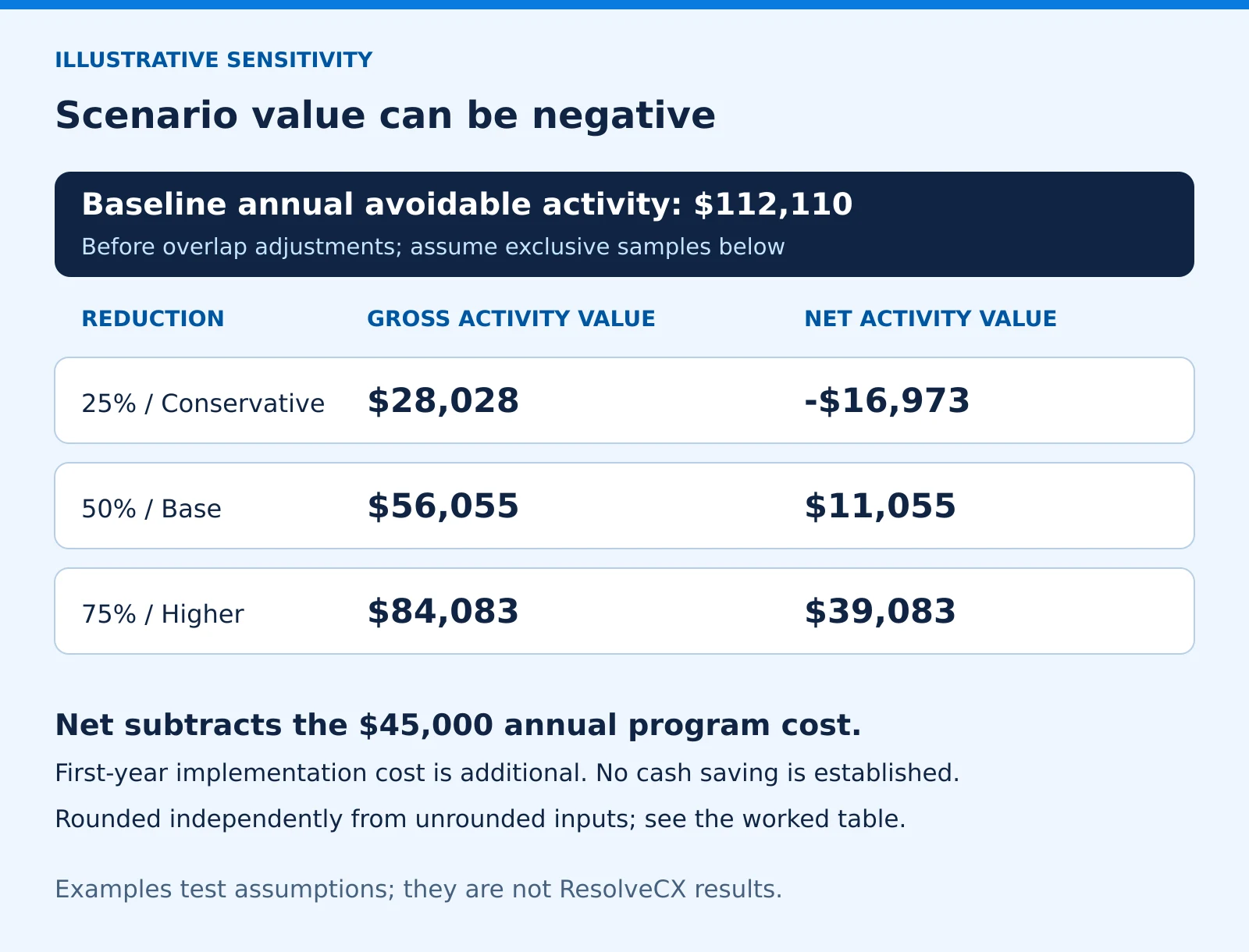
Hypothetical baseline: $112,110 in annual avoidable activity before overlap adjustments. At 25% reduction, gross activity value is $28,028; at 50%, $56,055; at 75%, $84,083. Subtract $45,000 annual program cost for net activity values of -$16,973, $11,055 and $39,083, rounded independently. First-year implementation is additional. These are not cash savings or ResolveCX results.
ILLUSTRATIVE SENSITIVITY
Baseline annual avoidable activity: $112,110
Before overlap adjustments; assume exclusive samples below
REDUCTION
GROSS ACTIVITY VALUE
NET ACTIVITY VALUE
25% / Conservative
$28,028
-$16,973
50% / Base
$56,055
$11,055
75% / Higher
$84,083
$39,083
Net subtracts the $45,000 annual program cost.
First-year implementation cost is additional. No cash saving is established.
Rounded independently from unrounded inputs; see the worked table.
Examples test assumptions; they are not ResolveCX results.
Scenario value can be negative
Hypothetical baseline: $112,110 in annual avoidable activity before overlap adjustments. At 25% reduction, gross activity value is $28,028; at 50%, $56,055; at 75%, $84,083. Subtract $45,000 annual program cost for net activity values of -$16,973, $11,055 and $39,083, rounded independently. First-year implementation is additional. These are not cash savings or ResolveCX results.
ILLUSTRATIVE SENSITIVITY
Baseline annual avoidable activity: $112,110
Before overlap adjustments; assume exclusive samples below
REDUCTION
GROSS ACTIVITY VALUE
NET ACTIVITY VALUE
25% / Conservative
$28,028
-$16,973
50% / Base
$56,055
$11,055
75% / Higher
$84,083
$39,083
Net subtracts the $45,000 annual program cost.
First-year implementation cost is additional. No cash saving is established.
Rounded independently from unrounded inputs; see the worked table.
Examples test assumptions; they are not ResolveCX results.
Figure 3. Scenario value can be negative.
Hypothetical reduction
Gross annual activity value
Net annual activity value after $45,000 program cost
25%
$28,028
-$16,973
50%
$56,055
$11,055
75%
$84,083
$39,083
Amounts are calculated from unrounded inputs and rounded independently to the nearest dollar, with half dollars rounded away from zero. The exact 25% gross value is $28,027.50 and its net value is -$16,972.50. The exact 75% gross value is $84,082.50 and its net value is $39,082.50. This explains any $1 difference when subtracting displayed rounded figures.
These are net activity values, not established monetary ROI. The full baseline represents 2,080 handler hours and 450 supervisor hours, or 2,530 hours. A uniform 25%, 50% or 75% reduction would release 632.5, 1,265 or 1,897.5 hours respectively. Real cash savings require evidenced reductions in spending, such as paid overtime.
First-year net activity value equals the gross value actually achieved during the first year minus the first-year operating cost minus one-time implementation cost. For example, with a hypothetical $20,000 implementation cost and a full year of benefits and $45,000 operating cost, the three first-year net activity values would be -$36,973, -$8,945 and $19,083. A delayed rollout reduces the benefit period. The $20,000 is an additional illustration, not a quote or a cost already included in the $45,000.
For the cost of poor complaint handling, the core equation is: net annual value equals evidenced avoidable cost reduction plus defensible incremental benefit minus full annual program cost. Divide net value by program cost only when the numerator represents comparable monetary benefits. If the case releases time rather than cash, present its hours separately. A negative first-year case may justify a pilot for a serious, documented governance risk. Keep exposure separate from realizable savings, and test assumptions against measured case outcomes.
Which benefits belong in the proposal?
The cost of poor complaint handling can fall when teams stop reconstructing history, customers receive timely updates and decisions move to the right owner. A structured record may also make review easier and reveal recurring causes. Test these mechanisms; software alone does not deliver them. See ResolveCX complaint management for how intake, investigation, response and learning can be organized around an owned record.
Separate four benefit types. Measured cash savings may include paid overtime avoided. Redeployed capacity is time available for higher-value work. Risk reduction covers a lower likelihood or impact of a specific failure, with assumptions disclosed. Strategic value includes customer confidence and product improvement, which should not be silently converted into revenue. Research on complaint-management ROI identifies cost reduction, organizational learning, reputation, customer focus and social benefits as distinct themes.
In UK financial services, actual redress and relevant Financial Ombudsman Service case fees can be measured, subject to scheme rules. The FCA's Complaints data: 2026 H1, published October 22, 2026, reports 1.85 million complaints received between January and June 2026 and £240 million in redress. These are sector totals, not a complaint-handling waste estimate or a per-case forecast. The Ombudsman's Case fees page lists a maximum respondent fee of £680 and a £2,000 case fee allowance for the financial year. Its final Plans and Budget 2026/27 confirms those amounts for 2026/27, not every earlier or future period. Some professionally represented cases attract a reduced £500 respondent fee; chargeability, referral, outcome and allowance rules matter. Respondents are normally charged when an investigated case closes, while the largest businesses are billed quarterly in advance from April 1, 2026. Use actual payable fees for the applicable period, not £680 multiplied by all complaints.
Retail teams may trace returns, delivery disputes and repeated product faults, while avoiding the assumption that every return is a poorly handled complaint. Telecom and contact-center teams can examine repeat calls, missed callbacks and escalated service issues. Healthcare organizations need to consider sensitive evidence, investigation and safety-related handoffs; reducing that work to a revenue number would misrepresent the decision. US and UAE operators should apply their own policies and current requirements rather than import a UK regulatory fee.
This is an educational costing guide, not legal, regulatory or clinical advice. Have qualified reviewers confirm jurisdiction-specific assumptions. Source checks do not establish product capabilities.
What must the investment cost include?
A business case for the cost of poor complaint handling needs the full change cost: software subscription, configuration, integration, migration, security and privacy review, training, ongoing administration, maintenance and the time of operational owners. Include the cost of reviewing AI suggestions and managing exceptions. If the organization can remove the failure with a clearer ownership rule or better training in its existing system, compare that lower-cost option on the same baseline.
The cost of poor complaint handling does not itself prove a specialist platform is required. Software becomes more plausible when complaints cross channels and departments, deadlines are hard to govern, evidence is repeatedly reconstructed or corrective action lacks follow-through. A contained process issue with reliable records may need a procedure change first.
When does prevention add measurable value?
A closed complaint does not prove the underlying cause is gone. Group repeated issues by a stable cause definition, assign corrective work and compare recurrence before and after implementation while accounting for volume changes. If a warehouse error, billing defect or policy ambiguity continues to generate complaints, prevention may reduce the original failure cost as well as handling demand. Keep those two savings streams separate.
Explore ResolveCX problem management for an approach to linking customer signals to human-led investigation, owned corrective action and effectiveness review. AI can surface patterns or summaries, but people evaluate causes and approve changes. A suspected trend is not evidence that a corrective action worked.
What should a board-ready case contain?
The cost of poor complaint handling becomes a decision when the document shows evidence, options and conditions for review. Keep the executive summary to one page, with a supporting cost ledger. Name the complaint leader, finance partner, operational owners and person authorized to approve the investment.
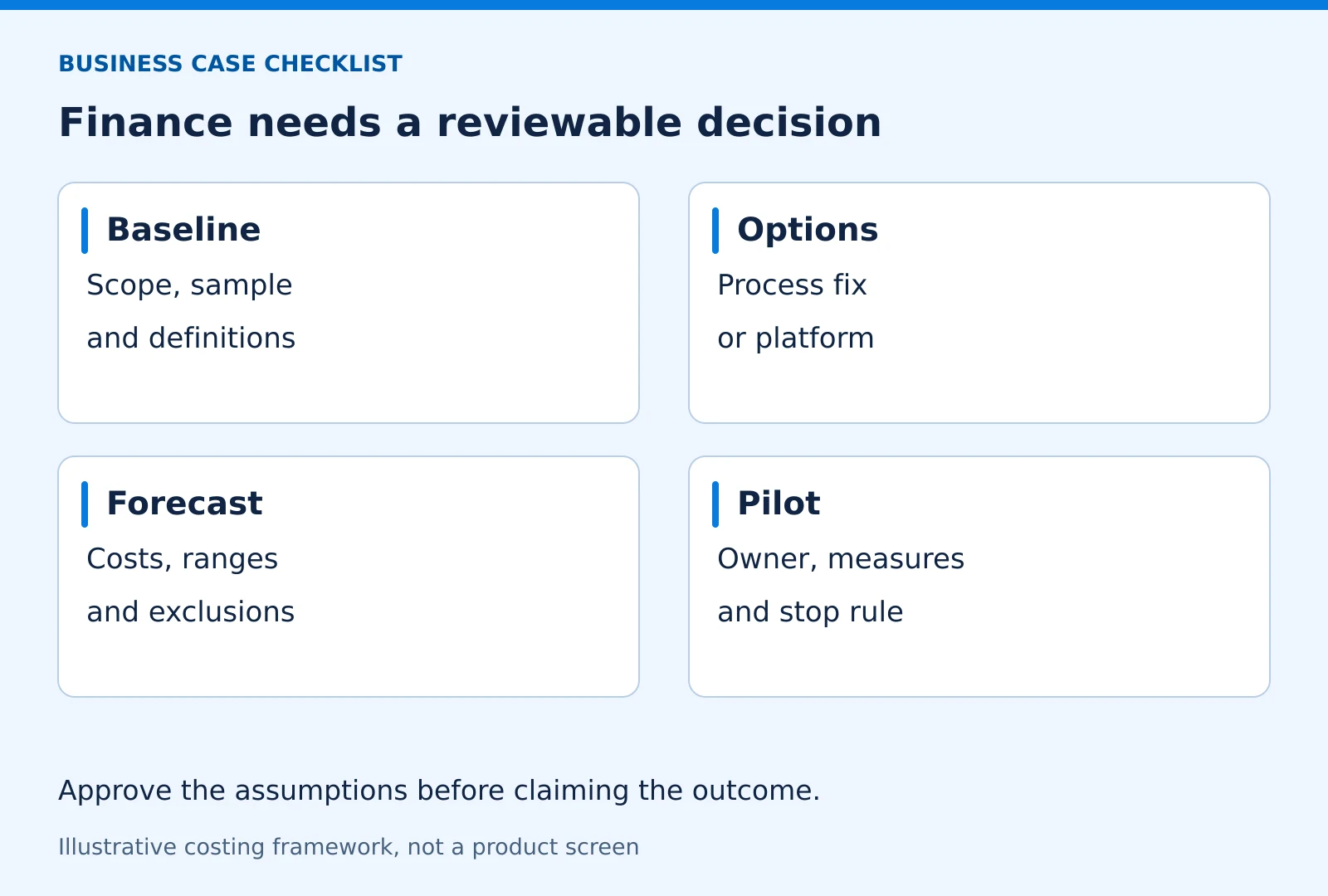
Baseline: scope, sample and definitions. Options: process fix or platform. Forecast: costs, ranges and exclusions. Pilot: owner, measures and stop rule. Approve the assumptions before claiming the outcome.
BUSINESS CASE CHECKLIST
Baseline
Scope, sample
and definitions
Options
Process fix
or platform
Forecast
Costs, ranges
and exclusions
Pilot
Owner, measures
and stop rule
Approve the assumptions before claiming the outcome.
Illustrative costing framework, not a product screen
Finance needs a reviewable decision
Baseline: scope, sample and definitions. Options: process fix or platform. Forecast: costs, ranges and exclusions. Pilot: owner, measures and stop rule. Approve the assumptions before claiming the outcome.
BUSINESS CASE CHECKLIST
Baseline
Scope, sample
and definitions
Options
Process fix
or platform
Forecast
Costs, ranges
and exclusions
Pilot
Owner, measures
and stop rule
Approve the assumptions before claiming the outcome.
Illustrative costing framework, not a product screen
Figure 4. Finance needs a reviewable decision.
The decision requested, scope and alternative options.
Baseline period, sample, definitions and excluded cases.
Measured cost, estimated exposure and nonfinancial outcomes separately.
Three improvement scenarios and the variables that change them.
Full implementation and annual operating costs.
Pilot success criteria, measurement owner and review date.
Conditions that would stop or redesign the proposal.
Measure assignment time, repeat-contact rate, evidence-search time, avoidable escalation, overdue updates, decision quality and recurrence. Use a pilot to test whether improvements hold without discouraging customers from complaining or rushing a case to closure. Retain human review for contested outcomes and approvals.
Conclusion
Calculate the cost of poor complaint handling from observed activities, not a universal churn claim. Remove overlaps, include the full change cost and test a conservative scenario against a process-only alternative. Then run a limited pilot with finance-approved measures and an accountable owner. Discuss your complaint workflow with ResolveCX if the evidence points to a need for connected ownership, decisions and prevention.
Frequently Asked Questions
It is the incremental work and exposure caused by avoidable delays, lost context, repeat contacts, inconsistent decisions or failed follow-up. Separate it from necessary investigation and the original service failure.
Divide measured handling costs for a defined complaint segment by its completed case count. Include labor and allocated expenses consistently, then report avoidable additions separately.
Consider documented rework, repeat contact, avoidable escalation, paid external fees and incremental redress. Treat churn and reputation as uncertain unless supported by customer-level evidence.
Only the portion attributable to a handling failure may be avoidable through handling improvement. A fair remedy owed for the original issue belongs to another cost category.
Count contacts caused by missed updates or unclear ownership and multiply their measured handle time by an approved loaded rate. Exclude the same minutes elsewhere.
Yes, if a defensible analysis estimates the incremental effect of handling quality on retention and converts it to contribution margin. Otherwise, show churn as exposure.
Maintain one primary ledger entry per activity, document overlaps and reconcile totals with finance. Distinguish released capacity, reduced cash spending and risk reduction.
Use complaint counts by type, sampled activity times, repeat contacts, escalation records, paid amounts, loaded rates and case outcomes. Mark gaps and sample limits.
When attributable monetary benefits exceed the full implementation and operating cost over the agreed period. Test conservative scenarios and verify results after rollout.
Choose the simpler remedy when it meets ownership, evidence and outcome requirements. A platform case strengthens when fragmentation or governance needs persist across teams.
ResolveCX Team are practitioners and product specialists in complaint governance, escalation management, and regulated CX operations. Our articles draw on real implementation experience across financial services, healthcare, and telecommunications.