Escalation Engineering — Make Escalations Predictable, Fast, and Auditable
Escalation management is often discussed as a CX concern. In reality, it is a risk, governance, and architecture problem.
Late or blind escalations are one of the fastest ways to erode brand trust. They rarely fail loudly at first. More often, they fail quietly—through missed handoffs, inconsistent decisions, undocumented approvals, and timelines no one can fully reconstruct later.
By the time the failure becomes visible, it usually isn't through a CSAT score. It surfaces through:
- A regulatory inquiry
- A legal request
- A public complaint
- A compensation dispute
- A customer who escalates externally because internal escalation failed them
At that point, the damage is already done.
Most escalation failures don't happen because teams don't care or don't try hard enough. They happen because the underlying systems were never designed to govern escalation lifecycles.
Traditional ticketing tools are built to move work quickly. Escalations require something different: persistent ownership, enforceable timelines, and defensible evidence across teams.
When escalation management software is treated as an afterthought, organizations pay the price in:
- Brand reputation damage
- Repeated rework and operational cost
- Audit stress and compliance exposure
- Poor customer recovery after high-risk issues
Escalation management is not a CX nicety. It is enterprise protection.
Why Escalation Management Breaks in Most Organizations
If escalation management feels fragile or inconsistent inside your organization, you're not alone. Across regulated and high-volume environments, the same failure patterns repeat regardless of industry, tooling stack, or team maturity.
Escalations reset ownership instead of enforcing it
In many environments, escalating a case simply means moving it to another queue or team. Accountability quietly resets in the process. No single owner remains responsible for the outcome across the full escalation path.
Queues own work. People own decisions.
When escalation ownership is implicit instead of explicit, gaps appear—and customers feel them immediately.
SLAs pause, restart, or silently disappear
Escalation SLAs often look well-defined on paper. In practice, they fragment as cases move between teams, tools, or approval layers. Timers reset. Breaches go unrecorded. Responsibility becomes ambiguous.
From the outside, it looks like delay. From the inside, it feels like confusion.
Evidence is reconstructed after the fact
In many escalation workflows, evidence lives everywhere except where it should:
- Comments
- Inboxes
- Spreadsheets
- Chat threads
- Verbal approvals
When auditors, regulators, or legal teams ask what happened, teams scramble to reconstruct a story that should already exist.
According to PwC's global risk research, more than half of customer-handling compliance failures are tied to documentation gaps and unclear decision accountability, not incorrect decisions. The work was done—it just couldn't be proven.
Decisions are implied, not recorded
Escalations involve judgment calls. Approvals. Trade-offs. Policy interpretation. Yet most systems never require teams to capture why a decision was made—only that it was.
That creates long-term risk. Decisions without rationale are indefensible months later, even if they were correct at the time.
This isn't inefficiency—it's latent enterprise risk.
McKinsey has consistently shown that complex service operations lose 25–40% of productive capacity to rework and coordination overhead. Escalation breakdowns are a major contributor—not because teams underperform, but because systems fail to enforce continuity.
What Escalation Management Actually Means
Before escalation management can be fixed, it needs to be defined properly.
Escalation management is not:
- Ticket reassignment
- A priority flag
- An email chain
- An SLA reset
True escalation management is:
A governed, time-bound resolution path with explicit ownership, enforceable SLAs, and defensible evidence—across teams.
That definition matters, because most tools and processes only support fragments of it.
Escalation management must ensure:
- Ownership never disappears as work crosses functions
- Timelines reflect real responsibility, not system artifacts
- Evidence is captured at the moment decisions are made
- Similar cases produce consistent outcomes
Anything less is motion, not governance.
This is where Escalation Engineering comes in.
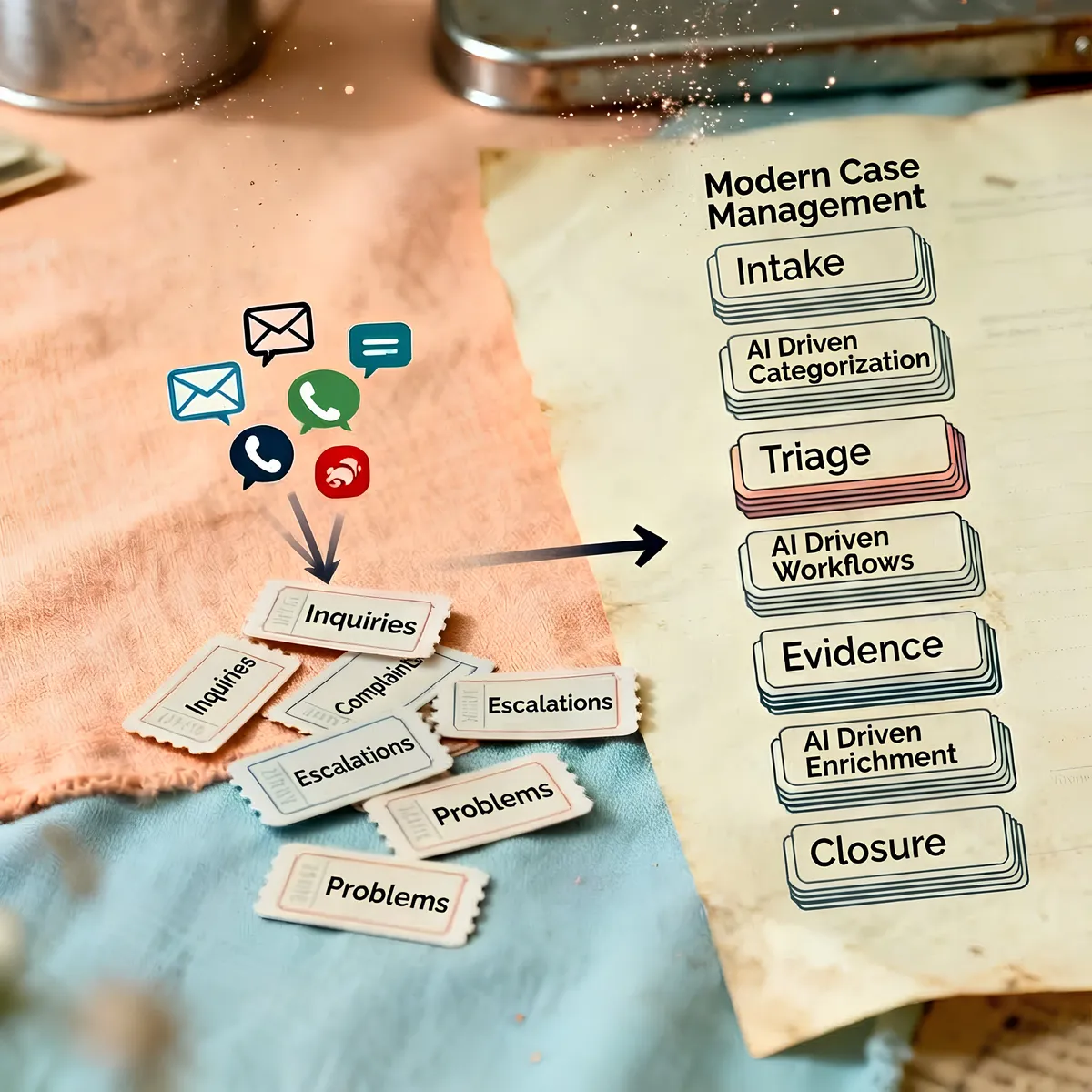
Escalation Engineering is the discipline of designing escalation paths intentionally—with rules, checkpoints, ownership transitions, and evidence requirements built into the system itself. It treats escalations as governed stages in a case lifecycle, not as interruptions in a queue.
When escalation management is engineered properly:
- Teams stop relying on heroics
- Supervisors investigate less and resolve more
- Customers experience continuity instead of contradiction
- Organizations regain confidence in their outcomes
The Structural Limits of Ticket-Based Escalation Management
It's important to be clear: escalation failures are not the result of bad configuration or weak discipline. They are the result of design intent mismatch.
Ticketing systems were created to manage transactions. Escalations are not transactions—they are narratives.
Structurally, ticket-based escalation management breaks down because:
- Tickets are transactional objects. They capture events and actions, not the evolving resolution story.
- Timelines fragment across tools. Context spreads across comments, attachments, linked records, and external systems.
- There is no persistent narrative. Each reassignment or duplication creates another partial version of the truth.
- Ownership belongs to queues, not outcomes. Responsibility shifts invisibly as work moves.
- Evidence capture is optional, not enforced. Critical rationale is implied, not required.
Forrester research shows that more than 65% of complex service issues require cross-functional involvement. Yet ticketing tools treat each interaction as a discrete object. The math doesn't work.
This isn't a failure of people or process. It's the system behaving exactly as it was designed to.
And no amount of automation or AI layered on top of fragmented escalation architecture fixes this. In fact, it often amplifies risk by accelerating decisions on incomplete context.
This is why escalation management cannot be "configured" into ticketing systems. It has to be designed—deliberately—into the operating model.
Escalation Risk = Brand Risk + Compliance Risk
Escalations are not just operational events. In regulated and high-stakes environments, they are records of accountability.
When escalation management breaks down, the impact rarely shows up immediately in CX dashboards. It appears later where the consequences are far more expensive.
Poorly governed escalations directly increase:
- Regulatory exposure — incomplete records, unclear ownership, and missing rationale
- Public complaints — customers escalate externally when internal escalation fails
- Compensation leakage — inconsistent outcomes lead to over-correction and goodwill payouts
- Reputation damage — contradictory responses erode trust far beyond the individual case
This risk is especially pronounced in regulated industries.
In financial services, customer complaints are routinely reviewed months after resolution. Regulators don't ask whether a case was closed—they ask who decided what, when, and based on which evidence. When escalation records are fragmented, even correct decisions become indefensible.
In telecom, escalations often cross network operations, billing, and CX. Without a single governed case timeline, customers receive conflicting explanations, SLAs quietly reset, and repeat complaints multiply—frequently ending up with regulators or ombudsman offices.
In healthcare, escalations involving patient safety or service quality demand precise traceability. When evidence is scattered across systems or reconstructed after the fact, the risk isn't just compliance failure—it's loss of institutional credibility.
PwC's Global Risk Survey consistently shows that more than half of compliance failures tied to customer handling stem from documentation gaps and unclear accountability, not malicious intent or incorrect judgments. The work happened. The proof didn't.
This is why experienced leaders don't fear escalations themselves. They fear indefensible escalations.
What Strong Escalation Management Looks Like in Practice
Once organizations accept that escalation failure is architectural, the path forward becomes clearer.
Strong escalation management does not rely on hero agents, manual follow-ups, or tribal knowledge. It is designed into the operating model through a case-first approach.
Case-first escalation management treats escalations as governed stages in a single resolution lifecycle—not as exceptions layered onto tickets.
At a minimum, effective escalation management requires:
- A single authoritative case timeline
- Explicit ownership transitions
- SLA continuity across teams
- Mandatory evidence at decision points
- Auditable handoffs
When these elements are present, escalation behavior changes naturally:
- Reopens decline
- Escalation bounce drops
- Outcomes become consistent
- Audit preparation shifts from panic to routine
This isn't theoretical. Organizations that operate on unified, case-centric escalation models consistently reduce repeat escalations and resolution delays because context stops fragmenting.
This is the foundation modern escalation governance requires.
ResolveCX Escalation Management Software
ResolveCX exists because this gap between escalation reality and escalation tooling has become impossible to ignore.
ResolveCX is a case-first escalation management platform designed to govern complex complaints and escalations—not just move them.
Instead of forcing escalations into ticket-centric workflows, ResolveCX structures them as governed stages within a single case lifecycle. That architectural shift enables outcomes that ticketing systems struggle to deliver.
Here's how that plays out in practice:
- Escalation Engine → clear paths and enforced timers → fewer SLA breaches
- Guided resolution workflows → consistent handling → reduced brand risk
- Evidence capture by design → audit readiness → lower compliance cost
- Ownership enforcement → fewer bounce-backs → faster resolution
ResolveCX does not replace contact center platforms. CCaaS systems handle conversations. ResolveCX governs resolution.
That distinction is what allows escalation outcomes to become predictable, explainable, and auditable—even under pressure.
Escalation Management for Regulated and High-Volume Teams
For regulated and high-volume organizations, escalation management is not optional. It is a control mechanism.
ResolveCX is designed specifically for teams that live with:
- Regulatory scrutiny
- High complaint volumes
- Cross-functional resolution paths
- Zero tolerance for undocumented decisions
This includes financial services, insurance, telecom, healthcare, utilities, and large-scale BPOs.
Across these environments, the pain points are remarkably consistent:
- Audit panic when escalation histories must be reconstructed
- Repeat complaints because root causes are never fully resolved
- Inconsistent outcomes across similar cases
- Escalation chaos as issues bounce between teams without clear ownership
ResolveCX addresses these issues by structuring escalation management around outcomes, not activity.
Teams see measurable improvements in:
- Time to Resolution (TTR) through enforced ownership and guided workflows
- Reopen rates as context and decisions remain intact
- SLA breach rates via persistent timers and proactive escalation
- Customer recovery through consistent, defensible handling of high-risk cases
For compliance, risk, CX, and operations leaders, this translates into something far more valuable than speed: Confidence.
Confidence that escalations are handled correctly. Confidence that outcomes are consistent. Confidence that decisions can be explained—months later—without scrambling.
Escalation Management for CCaaS Partners and System Integrators
For CCaaS partners and system integrators, escalation management represents both a gap and an opportunity.
Contact center platforms are excellent at routing conversations, handling channels, and optimizing agent workflows. What they do not provide—and were never designed to provide—is escalation governance across complex, cross-functional resolution paths.
That gap increasingly shows up during implementations, audits, and executive reviews.
ResolveCX is designed to sit on top of CCaaS platforms as an attachable escalation governance layer. It does not compete with routing, IVR, or workforce optimization. It complements them by governing what happens after the conversation.
For partners, this creates clear advantages:
- Differentiation beyond routing and IVR in a commoditized CCaaS market
- Attach revenue through a high-margin escalation and complaint governance layer
- Ongoing services and managed operations post go-live, instead of disengagement once routing is done
- Stronger enterprise positioning when customers ask about audits, complaints, and escalation accountability
Most importantly, ResolveCX allows partners to stay relevant where CCaaS platforms fall short—without building custom escalation logic themselves.
The positioning remains simple and consistent: CCaaS handles conversations. ResolveCX governs outcomes.
AI in Escalation Management (With Guardrails)
AI has a role to play in escalation management—but only when applied responsibly.
Escalations are high-risk by nature. They involve judgment, policy interpretation, and accountability. Automating decisions without governance increases exposure rather than reducing it.
ResolveCX applies AI where it adds value, while enforcing guardrails where accuracy and defensibility matter most.
That means:
- AI assists, not decides — humans remain accountable for outcomes
- Predictive escalation risk surfaces cases likely to escalate before they do
- Deterministic validation ensures AI outputs are checked against rules and policy constraints
- Human-in-the-loop controls apply to approvals, high-impact decisions, and sensitive cases
This approach aligns with a simple principle: AI should accelerate good decisions—not automate bad ones.
By embedding intelligence inside a governed, case-first architecture, ResolveCX enables proactive escalation management without sacrificing auditability, consistency, or trust.
Business Outcomes You Should Expect
When escalation management is designed architecturally—not patched procedurally—outcomes change in measurable ways.
Organizations operating with governed, case-first escalation management typically see:
- Reduced escalation volume as root causes surface earlier
- Lower reopen rates because context and decisions persist
- Faster resolution times through clear ownership and enforced timelines
- Audit readiness by default, not by preparation
- Stronger brand protection through consistent, defensible handling
- Better cost control as rework and compensation leakage decline
- Improved retention and topline growth through effective customer recovery
The exact impact varies by industry, volume, and maturity. But mature teams routinely see:
- 30–50% reductions in rework tied to escalations
- Meaningful declines in SLA breaches
- Measurable improvements in customer recovery after high-risk cases
The common thread is not speed alone. It is resolution confidence—internally and externally.
Escalation Management Is an Architecture Decision
Escalations don't fail because teams don't care. They fail because systems were never designed to govern them.
You cannot process-fix architectural gaps. You cannot train your way out of fragmented ownership. You cannot automate accountability into tools that don't preserve context.
Escalations need governance—not heroics.
Case-first systems change escalation behavior by design. Ownership becomes explicit. Timelines persist. Evidence accumulates naturally. Outcomes become explainable.
That is what modern escalation management requires.
If escalation outcomes matter to your brand, your compliance posture, and your customers, the question is no longer whether to change—but how deliberately.
Start with a 2-week prototype. Run a unified CX audit. Adopt an escalation rulebook your teams—and regulators—can trust.
Because in high-stakes environments, escalation governance isn't optional. It's protection.
About ResolveCX Team
The ResolveCX team consists of case management experts, CX architects, and enterprise solution specialists with decades of combined experience building governed resolution systems for regulated industries.
Key Takeaways
- Escalation management is not a CX nicety — it's a risk, governance, and architecture problem.
- Most escalation failures aren't caused by people or process, but by systems that were never designed to govern cross-team resolution.
- Ticket-based escalation breaks down structurally: ownership resets, SLAs disappear, evidence fragments, and decisions become indefensible.
- Escalation risk quickly becomes brand and compliance risk, especially in regulated industries like finance, telecom, and healthcare.
- Strong escalation management requires a case-first model with one authoritative timeline, explicit ownership, SLA continuity, and mandatory evidence capture.
- AI can help only with guardrails — assisting humans, predicting risk, and enforcing rules, not making unchecked decisions.
- Organizations that engineer escalation governance see fewer reopens, lower escalation volume, faster resolution, stronger audit readiness, and better customer recovery.
- Escalation management is ultimately an architecture decision. You can't fix structural gaps with training, process tweaks, or heroics.
References
- [1]Gartner — Service Management, Customer Experience & Governance research
- [2]Forrester — Customer service, case management, and cross-functional resolution studies
- [3]McKinsey & Company — Service operations, rework, and coordination cost research
- [4]PwC — Global Risk Survey and compliance documentation findings
- [5]Harvard Business Review — Customer trust, complaint handling, and reputation impact studies
- [6]CX Network — Escalation management and complaint handling benchmarks