How to Choose Customer Service Case Management Software
Map your customer workflows, agree buyer priorities and test vendors with the same cases before choosing case management software.
ResolveCX Team27 October 202615 min read2 views
Key Takeaways
1Choose ticketing for predictable requests and case management when evidence, decisions and cross-team ownership need coordination.
2Map case types, closure criteria, owners, handoffs and decision authority before vendor demonstrations.
3Apply mandatory gates before using the suggested 100% weighted scorecard.
4Use identical routine, complex and exception scenarios, including reopening, reports and export.
5Test AI oversight and confirm privacy, implementation and full ownership costs with the responsible stakeholders.
The right platform should make responsibility, evidence, decisions and outcomes visible throughout a complex customer issue. Product selection starts with your operating model.
This guide explains how to choose customer service case management software using a practical workflow assessment, weighted scorecard and scripted demonstration. Explore ResolveCX's approach to governed customer resolution as a reference point for connecting case ownership, evidence and human decisions without treating AI as the final authority. 7
Do You Need Case Management Software or a Ticketing System?
The examples in this guide are evaluation scenarios, not customer results. The capability checklist describes what buyers should test, not a promise that every platform or ResolveCX provides each control.
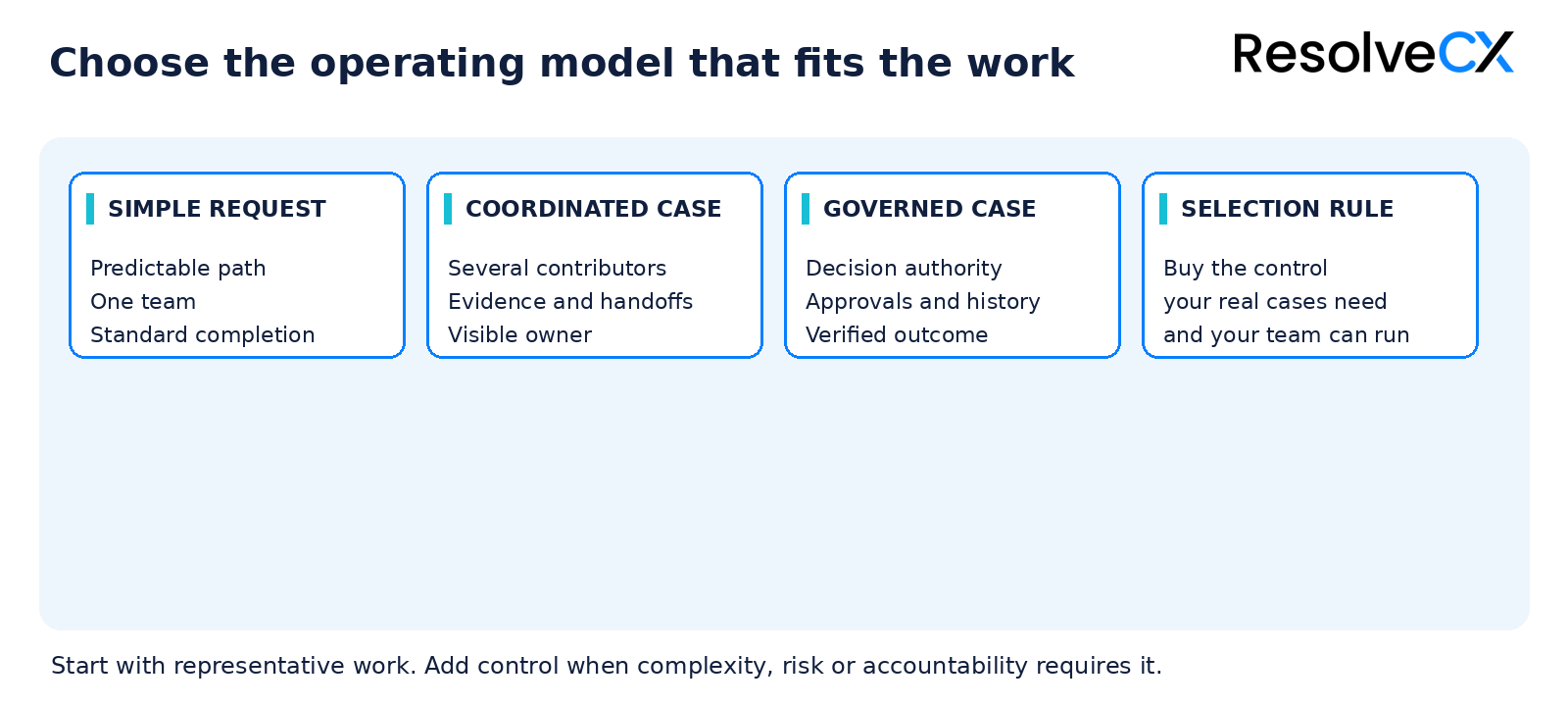
A ticketing system is often sufficient when requests are short, repeatable and owned by one team. Password resets, delivery-status questions and simple account updates may need categorization, routing, a response and closure, but little investigation or formal decision control.
Case management becomes useful when an issue develops across interactions, teams and decisions. Examples include disputed charges, service failures, complex complaints, vulnerable-customer concerns and cases requiring specialist review. The record must preserve what was reported, who owns the outcome, what evidence was considered, which authority approved an action and why the case closed.
Decision factor
Ticketing may be sufficient
Case management is more suitable
Request pattern
Predictable and repeatable
Variable or exception-driven
Ownership
One queue or team
One accountable owner with contributors
Evidence
Limited interaction history
Documents, findings and linked records
Decisions
Standard agent action
Review, rationale or approval required
Escalation
Priority-based routing
Authority, risk or deadline intervention
Completion
Reply or task completed
Outcome verified against closure criteria
Figure 1. Match platform complexity to the work that must be governed.
Vendor-authored introductions from Microsoft, ServiceNow and Salesforce provide background on case records and workflows. They describe their own products and are not independent comparative evidence or rankings. 456
Map Your Workflow Before Comparing Vendors
Organizations learning how to choose customer service case management software should document their current work before attending demonstrations. A vendor cannot prove fit if the buying team has not agreed what the system must support.
Define case types and outcomes
List the customer issues that require coordinated handling. For each case type, define the intended outcome, required information and conditions for closure. Keep complaints, incidents and recurring problems related but distinct: a complaint records customer dissatisfaction, an incident records an operational failure, and problem management addresses an underlying recurring cause.
Identify stages, owners and handoffs
Map intake, assessment, assignment, investigation, decision, action, communication, closure and any follow-up. Name the accountable role at every stage. Specify what happens when the intended owner is absent, the receiving team rejects a transfer or work waits for the customer, supplier or internal reviewer.
Define evidence and decision requirements
Record which source interactions, documents, findings, policies and approvals must remain attached to the case. Decide which actions an agent can complete, which require specialist input and which require authorized approval. A status label should represent completed work rather than substitute for it.
Establish measurable requirements
Translate operational needs into observable tests. “Flexible routing” is vague. “Route a billing dispute to the correct team using product, market and customer impact, then preserve the reason for assignment” is testable. Separate mandatory requirements from preferences before vendors influence the scoring model.
Which Capabilities Matter Most?
Omnichannel intake and duplicate control
Check how email, forms, messaging, phone notes and other approved channels create or update cases. The platform should preserve the original concern, source and receipt time. Test whether it detects possible duplicates without merging unrelated issues that happen to involve the same customer.
Configurable case records and relationships
The data model should support case types, required fields, products, accounts, interactions, tasks, incidents, complaints and related improvement work. Confirm that configuration can vary by case type without producing an unmanageable set of fields and statuses.
Ownership, routing and workload
Require one owner for the case while contributors own tasks. Evaluate queue rules, skill or authority routing, workload visibility, transfer acceptance, absence coverage and fallback ownership. A copied message or queue location does not prove that responsibility was accepted.
Evidence, documents and history
Users should be able to find the original customer account, communications, attachments, findings, decisions and corrections. Check version handling, restricted material, attribution and timestamps. Summaries should guide orientation while source records remain available for verification.
Deadlines, SLAs and entitlements
Test multiple clocks, warning points, pauses and exceptions. Ask how the system distinguishes an internal waiting state from an external commitment. Verify entitlement rules and escalation behavior using your policies rather than accepting a generic timer demonstration.
Escalations, decisions and approvals
An escalation needs a reason, destination, requested action and accepted responsibility. Reviewers should be able to approve, amend, reject or request more information, with rationale retained. Routine work should not require unnecessary approval, while significant actions should not bypass authority controls.
Evaluate templates, accessibility, approved language, outbound review and customer-facing status. Knowledge suggestions should use current authorized material and allow the handler to assess relevance. Test how communication works when the case involves confidential internal findings.
Reporting, root cause and prevention
The platform should report volume, age, ownership gaps, waiting time, overdue actions, reopened work, outcomes and record quality. It should also help teams examine recurring themes without declaring correlation to be a proven cause. Confirm whether reported numbers can be traced back to underlying cases.
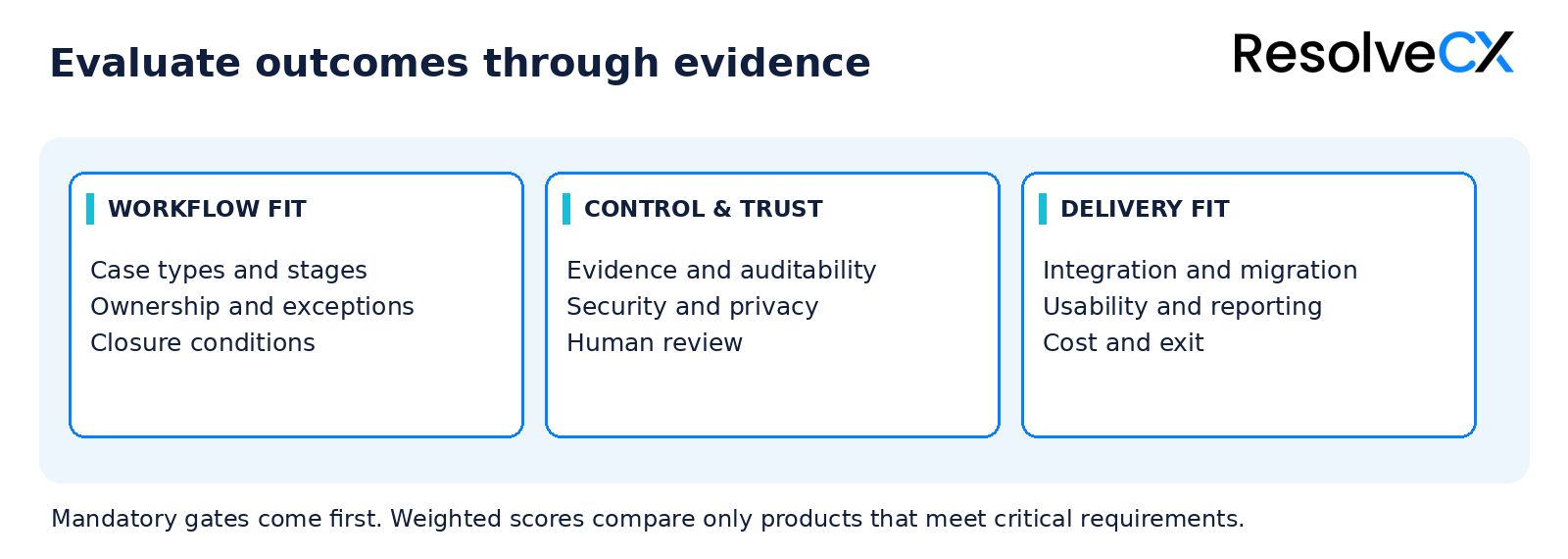
Figure 2. Score operational fit, controls and delivery evidence.
How Should You Evaluate AI Capabilities?
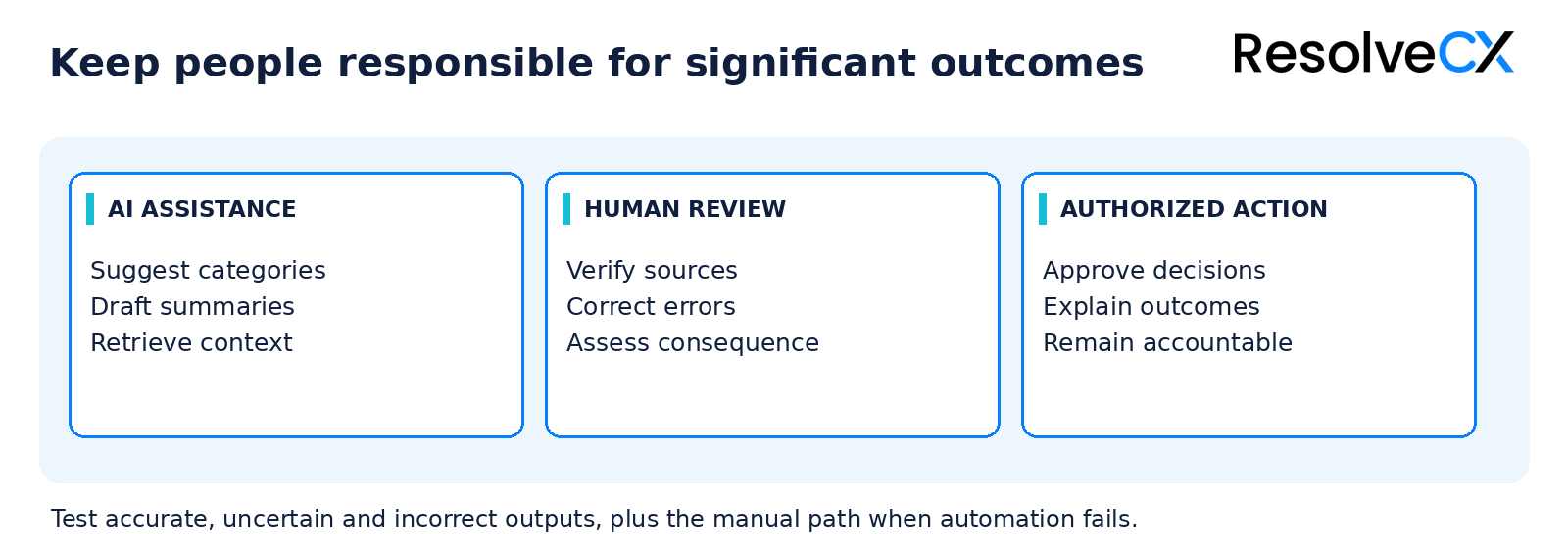
AI can assist classification, summarization, knowledge retrieval and suggested next actions. Buyers should judge the quality of the assistance and the controls around its use. A polished response is not enough if reviewers cannot inspect sources, correct errors or identify where generated material entered the record.
Ask vendors to demonstrate an accurate result, an uncertain result and a wrong result. Check whether a user can override a suggestion, whether the correction is recorded and whether automation failure creates visible work. Define which actions may run automatically and which findings, remedies or approvals remain with authorized people.
Review what data reaches each model or provider, whether customer information is used for training, where processing occurs, how long inputs and outputs are retained and how model changes are communicated. Confirm contractual statements with privacy, security and legal stakeholders. NIST's AI Risk Management Framework provides a voluntary structure for governing, mapping, measuring and managing AI risks, while ICO guidance discusses AI governance, fairness and safeguards around automated decisions. The ICO marks this guidance as under review following the Data (Use and Access) Act; confirm current requirements with qualified stakeholders. 12
Figure 3. AI supports the workflow while authorized people govern outcomes.
Build a Weighted Evaluation Scorecard
A useful scorecard reflects your risks and operating priorities. First apply mandatory gates: a vendor that fails a critical security, data-location, accessibility or integration requirement should not compensate by scoring highly on attractive optional features.
The question of how to choose customer service case management software becomes measurable through an agreed scorecard. The following weights are suggested buyer priorities, not research findings or a universal standard. They total 100%.
Evaluation area
Suggested weight
Evidence required
Workflow and case lifecycle
20%
Complete representative case
Ownership and escalation
15%
Transfer and exception test
Evidence and auditability
15%
Inspectable history and export
Security and privacy
15%
Documentation and stakeholder review
Integrations and portability
10%
Connector, API or export test
Reporting and prevention
10%
Buyer-defined report from test data
Usability and administration
10%
Timed user and configuration tasks
AI assistance and oversight
5%
Correct, uncertain and failed outputs
Use a consistent evidence scale:
0: absent: the requirement is not supported.
1: asserted: the vendor states that it is supported.
2: shown: the capability appears in a standard demonstration.
3: proven: the vendor completes your scripted scenario.
4: validated: your team completes the test with representative roles and data.
Run Scripted Demonstrations with Realistic Cases
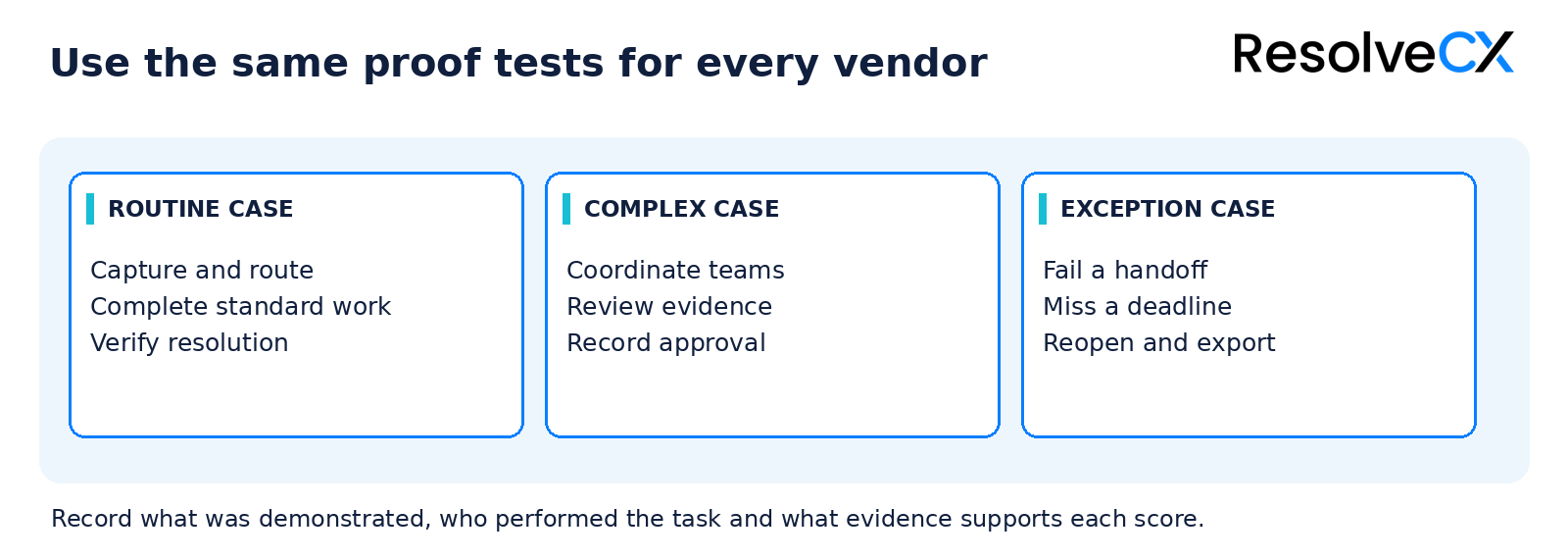
Learning how to choose customer service case management software requires giving every shortlisted vendor the same scenarios, roles, starting data and success conditions.
Select a routine case that should move quickly through intake, assignment and resolution.
Select a complex case requiring evidence from several teams, an approval and a customer update.
Select an exception involving an unavailable owner, missed deadline, incorrect AI suggestion or failed integration.
Reopen a closed case using new information and verify that the earlier record remains understandable.
Produce a manager report and trace one result back to the source cases.
Export the case, attachments, history and relationships in a usable form.
Include frontline handlers, team leaders, case owners, compliance or risk representatives, administrators, security specialists and integration owners. Each participant should score only the areas they can judge. Collect observations immediately after the same task so presentation style does not outweigh evidence.
Figure 4. Use routine, complex and exception cases to test every vendor.
Evaluate Security, Privacy and Audit Controls
Ask specific questions rather than whether a platform is “secure.” Review role-based access, privileged administration, authentication, single sign-on, encryption, audit logging, backups, recovery, vulnerability management, incident notification and supplier oversight. Test whether sensitive fields and attachments can be restricted without hiding all useful case context.
Map personal data through collection, processing, sharing, retention, deletion and export. Confirm processing locations, subprocessors and contractual responsibilities. Requirements vary by jurisdiction and sector. UK buyers should assess UK GDPR and ICO guidance; UAE buyers should assess the scope and exclusions of the UAE Personal Data Protection Law, relevant free-zone regimes and applicable sector rules; US organizations should identify relevant federal, state and industry obligations. 23
Distinguish a legal requirement from a vendor capability. An audit log may support governance, but its existence does not prove appropriate access, retention or review. Certifications can contribute evidence about a control environment; they do not guarantee that your configured workflow complies with every obligation.
Calculate the Full Cost of Ownership
Subscription licenses, usage charges and minimum commitments.
Implementation, process design and project management.
Data cleansing, migration and validation.
Integrations, API limits and connector licenses.
Security review, testing and assurance work.
Training, adoption and administrator capacity.
Reporting, storage, retention and AI consumption.
Support tiers, environments and release management.
Contract changes, renewal increases and data extraction.
Assess Implementation and Vendor Fit
Ask who owns discovery, configuration, integration, migration, testing, training and post-launch support. Require named acceptance criteria and a remediation process. Clarify which changes your administrators can make, which require professional services and how releases affect configured workflows.
Review reference customers with similar case complexity, regulatory exposure and operating scale. Ask about difficult deployments and limitations as well as successful outcomes. Evaluate support coverage, escalation routes, product documentation, roadmap communication and the supplier's financial and operational resilience.
Plan a controlled pilot with representative cases and users. Measure routing accuracy, record completeness, handoff acceptance, overdue work, reporting consistency and user effort. Do not scale until material failures have owners, corrective actions and retest evidence.
Common Selection Mistakes
Starting with vendor demonstrations before defining requirements.
Treating every feature as equally valuable.
Testing only a clean, straightforward case.
Ignoring waiting states, rejected transfers and reopening.
Letting the vendor's terminology replace internal definitions.
Assuming automation will fix unclear ownership.
Buying AI without review, correction and fallback controls.
Accepting dashboard totals without source-case traceability.
Excluding frontline users and operational administrators.
Ignoring migration, data export and contract exit.
When a Full Case Management Platform May Be Unnecessary
A shared inbox or ticketing platform may be the better choice when requests follow one predictable path, one team owns resolution, little evidence is collected and standard responses close most work. Adding case stages, approvals and governance controls can slow simple service if the operating risk does not justify them.
Some organizations need both models. Routine contacts can remain tickets while complex complaints, disputes or investigations become cases under defined conversion rules. The customer should not have to understand the internal distinction, but employees should know which record governs ownership and completion.
How ResolveCX Supports Structured Case Operations
ResolveCX's approved case-management approach connects one accountable owner, supporting material, reviewer findings and final actions. Confirm access, history and retention against the proposed configuration. AI may suggest a category, summary or route from authorized case context where configured; a person checks the sources and remains responsible for the final decision. 78
During evaluation, verify the exact configuration, permissions, integrations, migration scope, retention arrangements and service responsibilities required for your operating model. ResolveCX supports governance processes but does not guarantee legal or regulatory compliance.
Conclusion
The practical answer to how to choose customer service case management software is to map real work, establish mandatory controls and make vendors prove outcomes through identical scenarios. Weight the capabilities that affect ownership, evidence, decisions and customer outcomes. Test exceptions, data portability and operating cost before contract signature.
It is a platform for coordinating customer issues that require structured ownership, multiple activities, evidence, decisions and a verified outcome. It connects interactions and work around one case record.
Ticketing organizes requests and responses, usually through a predictable queue. Case management provides deeper lifecycle control for variable work involving investigation, cross-team coordination, approvals, evidence or complex escalation.
Prioritize workflow fit, visible ownership, evidence history, escalation, approvals, deadlines, reporting, security, integrations and data portability. Add AI only where its contribution and controls can be tested.
Define requirements before demonstrations, apply mandatory gates, use agreed weights and give every vendor identical scenarios. Record evidence for each score instead of relying on presentation quality.
Test a routine case, a complex multi-team case and an exception. Include incorrect data, failed handoffs, waiting states, reporting, reopening, permissions and export so the team sees operational behavior.
Test accurate, uncertain and incorrect outputs. Verify sources, correction, override, logging, data use, monitoring and manual fallback. People should retain appropriate authority over significant findings, remedies and approvals.
No. Software can support access control, consistent workflows, retention and audit records. Compliance depends on applicable requirements, configuration, policies, contracts and operating practices reviewed by qualified stakeholders.
Buyers often overlook migration, integration, training, administration, storage, AI usage, additional environments, assurance work, premium support and exit costs. Model internal effort as well as vendor charges.
Include customer-service leaders, frontline users, case owners, operations, IT, security, privacy, compliance, procurement, finance and administrators. Involve specialists according to the data and decisions involved.
There is no reliable universal duration. Timing depends on workflow complexity, data quality, integrations, security review, configuration, migration, testing and organizational readiness. Require a phased plan with acceptance criteria.
ResolveCX Team are practitioners and product specialists in complaint governance, escalation management, and regulated CX operations. Our articles draw on real implementation experience across financial services, healthcare, and telecommunications.