Complaint Quality Assurance: A Practical Guide for Complaint Teams
A service-complaint QA guide to sampling, evidence-based scoring, calibration, coaching, root-cause testing, and verified improvement.
ResolveCX Product Management Team23 November 202617 min read
Key Takeaways
1Operational QA evaluates handling quality; it does not replace case decisions or independent internal audit.
2On the SPSO scale, 1 is best practice, 2 good practice and 3 substandard practice. Lower is better.
3Keep representative sampling separate from targeted risk reviews and avoid universal quotas.
4Calibrate independent reviews against the same evidence and scorecard, then record the rationale.
5Assign coaching and process actions to owners, then test later cases for effectiveness.
Complaint quality assurance is the structured review of how complaints are handled against defined standards. Teams select cases, examine the evidence and decisions, score consistent indicators, discuss disagreements and use the findings to improve handling. This guide focuses on service complaints, particularly UK regulated environments, rather than pharmaceutical product-quality investigations. The Scottish Public Services Ombudsman (SPSO) quality assurance tool provides a practical reference for that approach. 1
A good QA program does not stop at a pass mark. It asks whether the customer was heard, the investigation was fair, the explanation was clear, appropriate adjustments were considered and any action was completed. The result is a coaching and governance process, not merely a supervisor checking boxes.
For teams building consistent complaint records and ownership, the starting point is a defined complaint process and accessible evidence. Explore how ResolveCX approaches complaint governance before designing complaint quality assurance reviews.
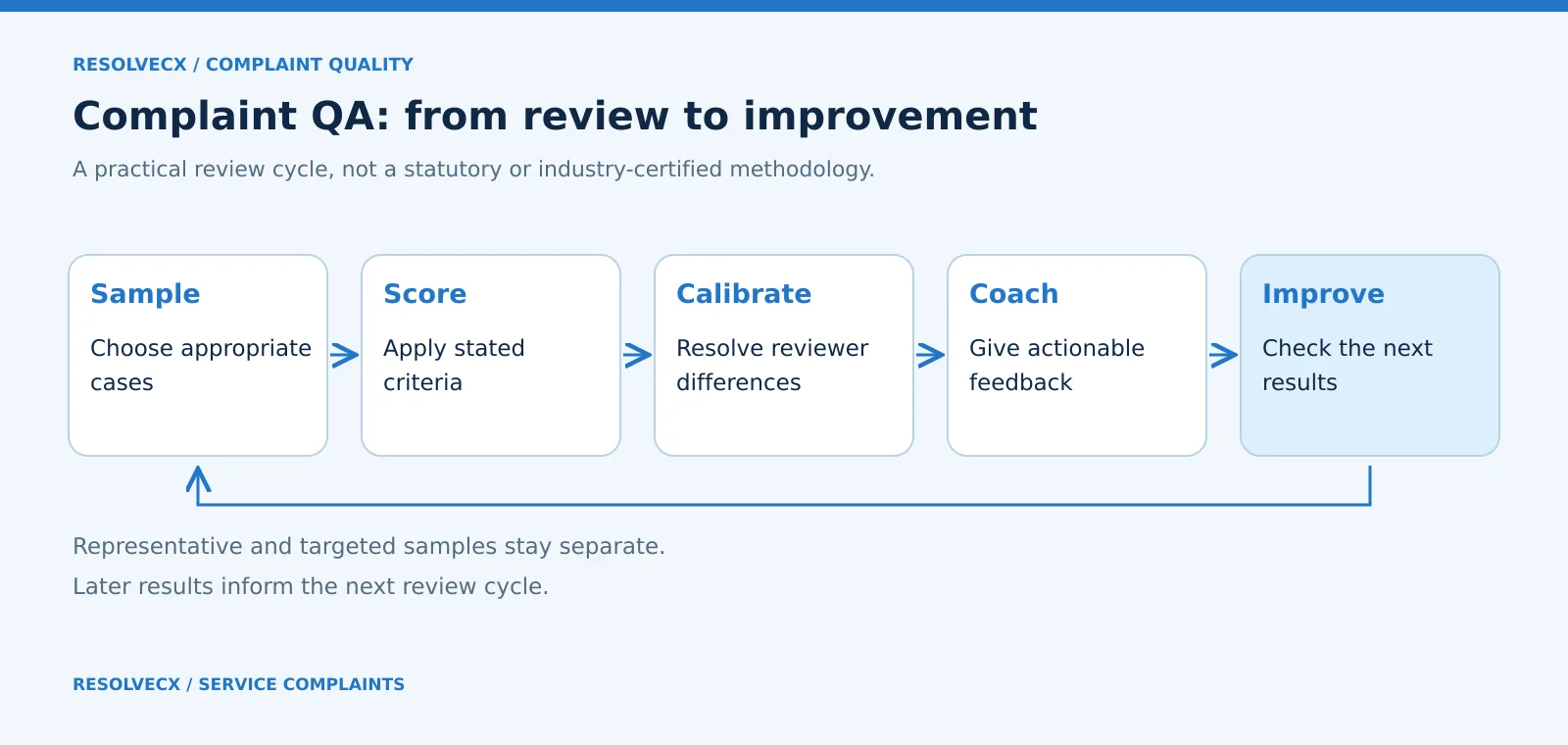
Figure 1. Connect case selection to a later check of results.
Figure 1 text equivalent. Sample appropriate cases, score stated criteria, calibrate reviewer differences, coach with actionable feedback, and improve by checking later results. Keep representative and targeted sample streams separate. Later results inform the next review cycle. This is a practical method, not a statutory or certified methodology.
Complaint quality assurance, or complaint QA, checks whether completed or in-progress handling meets agreed quality standards. It is different from resolving the complaint itself: the handler makes case decisions; the QA reviewer evaluates how those decisions were reached, explained and recorded. A useful review separates a missed administrative step from a problem that could affect fairness or the outcome.
QA should also be distinguished from independent internal audit. Operational quality review is commonly managed within the handling function or a dedicated quality team. Compliance or second-line oversight may challenge its design, while internal audit provides independent third-line assurance. The exact allocation depends on an organization's governance model; QA is not automatically a second-line activity in every firm.
Activity
Primary question
Typical output
Complaint handling
Was this case investigated and resolved fairly?
Decision, response and remedies
Complaint QA
Was the handling process and outcome quality sound?
Evidence-based review and coaching
Internal audit
Are governance and controls effective and independently assured?
Independent assurance findings
QA reviewers need access to a clear policy, applicable complaint rules and the case record. In regulated services, rules such as Financial Conduct Authority (FCA) DISP may affect the review criteria. ISO 9001 concerns organizational quality management systems; it is not a complaint QA scoring method and does not replace applicable complaints regulations. This guide does not assess certification or reproduce the paid standard. For a broader definition of the process itself, see ResolveCX's article on what is complaint management.
The Six Stages QA Should Check
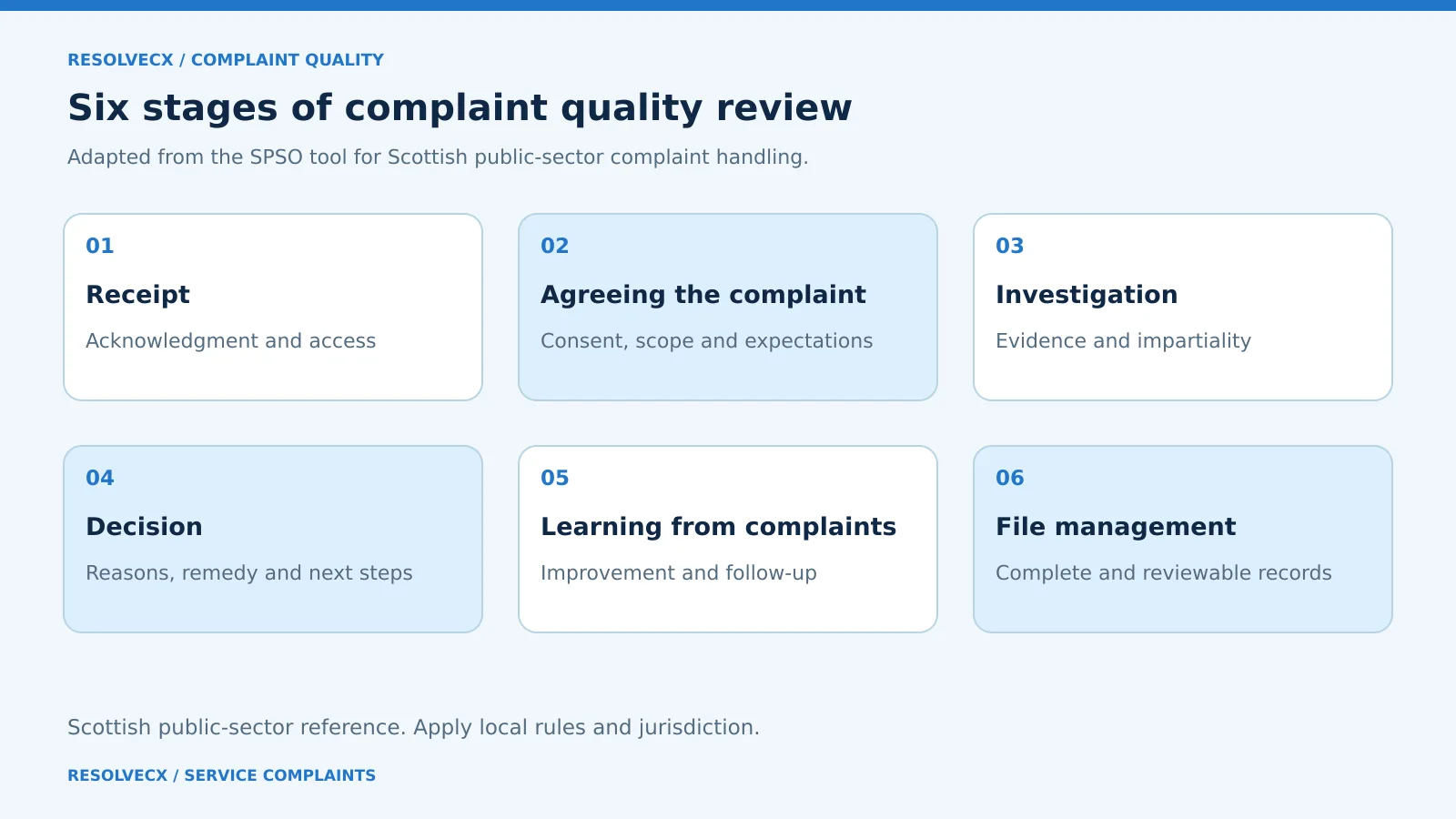
A practical complaint quality assurance framework should check every meaningful stage, not just the final response. The SPSO Complaints Process Quality Assurance Tool groups its indicators into six stages: receipt, agreeing the complaint, investigation, decision, learning from complaints and file management. These categories are a valuable design reference. They come from Scottish public-sector Model Complaints Handling Procedures, not from FCA DISP. 1
Review stage
What a reviewer should test
Receipt
Was the complaint captured, acknowledged and made accessible?
Agreeing the complaint
Were issues, consent, desired outcomes and expectations clarified?
Investigation
Was evidence relevant, balanced and sufficient to support findings?
Decision
Were reasons, tone, outcome, remedy and next steps clear?
Learning from complaints
Were identified failures, actions and follow-up recorded?
File management
Could another reviewer reconstruct the case from its record?
Figure 2. Review all six SPSO stages, using the rules that apply to the organization.
Figure 2 text equivalent. Receipt checks acknowledgment and access. Agreeing the complaint checks consent, scope, expectations and desired outcomes. Investigation checks balanced evidence and impartiality. Decision checks reasons, remedy and next steps. Learning from complaints checks improvement and follow-up. File management checks a complete, reviewable record. SPSO provides a Scottish public-sector reference, not FCA time limits.
A missed accessibility requirement can be more serious than a formatting error. Reviewers should look for reasonable adjustments, vulnerable customer needs and clear explanations, not only timing. For relevant CQC-regulated health and social-care activities in England, Regulation 16 concerns receiving and acting on complaints, while Regulation 17 addresses good governance. These are sector-specific requirements, not a generic QA score. 34
For FCA-regulated complaint handling, DISP 1.6.2R generally requires a final response or the prescribed written response by the end of eight weeks after receipt, subject to scope and applicable exceptions. For applicable payment-services (PSD) and electronic-money (EMD) complaints, DISP 1.6.2AR generally requires a final response within 15 business days. In exceptional situations where reasons beyond the respondent's control prevent that response, a holding response within 15 business days must explain the delay and give a final-response deadline no later than 35 business days after receipt. A QA reviewer must apply the correct clock to the relevant complaint, not borrow SPSO timeframes or presume all cases follow the same rule. These are response routes, not permission to leave a complaint inactive. 2
How to Design a Complaint QA Scorecard
A complaint quality assurance scorecard is a set of case-review indicators with clearly defined evidence requirements and practice levels. The SPSO tool describes each indicator at three levels: best practice (1), good practice (2) and substandard practice (3). Under that model, a lower number is better. Do not convert the values to a percentage or label “3” a strong result without explaining the scale. 1
Useful criteria describe observable behavior. “Investigation is good” is too vague. A stronger criterion is: “The decision addresses each agreed issue and identifies the evidence supporting it.” Include both process quality and substantive fairness. A handler may acknowledge promptly yet reach an unsupported conclusion; those are different findings.
Indicator
Evidence a reviewer looks for
Review question
Scope agreed
Complaint record, customer correspondence
Were all issues and expected outcomes understood?
Balanced investigation
Records, interviews, relevant standards
Were contrary facts considered?
Decision explanation
Final response and decision notes
Can the customer see why each issue was decided?
Remedy follow-up
Action owner, completion evidence
Was the promised action carried out?
Accessibility
Adjustments and communication choices
Were individual needs addressed appropriately?
Scoring weights and automatic failure thresholds should be governance decisions, not copied from a generic article. If a serious fairness or regulatory issue appears, establish an escalation rule regardless of the aggregate score. Keep enough narrative space for the reviewer to explain evidence, uncertainty and what needs to change.
Scorecards become more reliable when teams pilot them on real anonymized cases, test whether criteria are understandable, and refine descriptions before wide use. That pilot should not be mistaken for proof that a particular numerical target works across all case types.
Sampling: How Many Cases and Which Ones?
Complaint quality assurance sampling should provide enough relevant case evidence to identify weaknesses and compare handling fairly. There is no universally defensible sample percentage. The SPSO tool offers 10% of cases closed in the previous quarter as an example, split by team or stage where useful. It is not an FCA requirement or a recommended universal quota. 1
Start by defining the population: complaints received or closed during a period, teams involved and case types included. Make selections transparent. Combine a broadly representative sample with targeted reviews of higher-risk situations, such as potential detriment, repeat complaints, unusual delays, vulnerable customer needs or reopened cases. Keep the two streams separately identified: a risk-weighted selection cannot support the same population-wide conclusions as an appropriately designed random sample.
New starters may receive closer or full review as part of onboarding. Aptean's vendor commentary discusses adapting QA to staff development and training needs; it does not create a regulatory obligation for full review. Closer onboarding review is a developmental control, not evidence that every established handler needs every case reviewed forever. Increase review when quality deteriorates, rules change, a major issue emerges or the case mix materially shifts. 5
Document selection dates, exclusions and reasons for extra scrutiny. If a team handles very few complaints, a small percentage can miss important categories, so supplement the sample with professional judgment. Avoid declaring statistical confidence without a proper sampling design and enough data.
Calibration: Getting Reviewers to Agree
In complaint quality assurance, calibration is the practice of having reviewers independently assess the same complaint cases, compare their reasoning and agree how the documented criteria apply. It reduces scoring drift and makes feedback more consistent, without requiring reviewers to agree that every judgment is certain.
The SPSO guidance suggests peer-review sampling of a small set of files, for example four cases each quarter, reviewed individually before discussion. This is an illustration of peer comparison, not a universal schedule for every complaint operation. 1
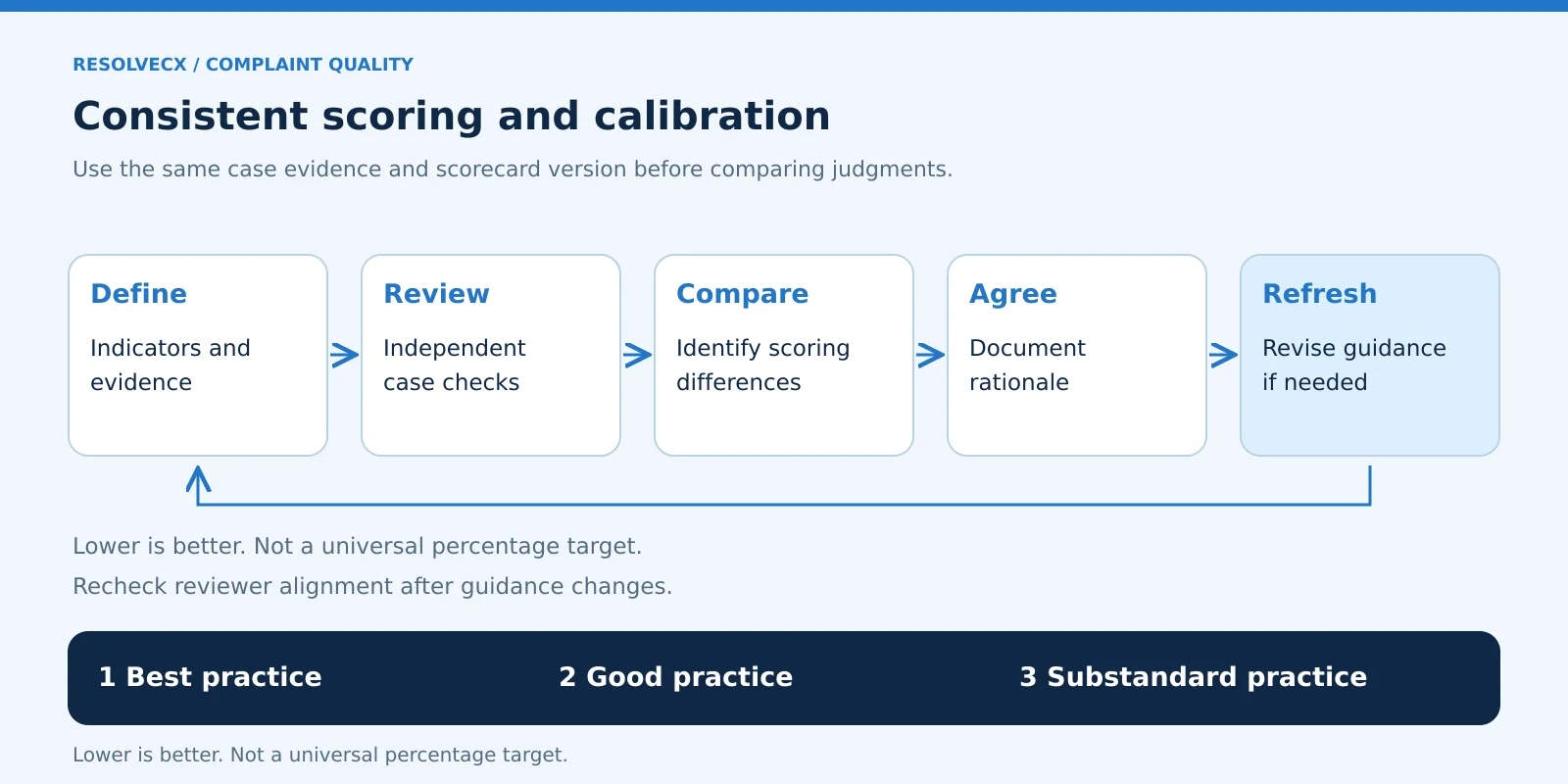
Figure 3. Lower is better on the SPSO scale. Calibrate the evidence, not a percentage target.
Figure 3 text equivalent. Define indicators and evidence, review the same cases independently, compare indicator differences, agree and document the rationale, then refresh guidance if needed. Recheck alignment in later reviews. The SPSO practice scale is 1 best practice, 2 good practice, 3 substandard practice. Lower is better. These are ordered descriptions, not universal percentage targets.
A practical calibration meeting begins with a case record and the same version of the scorecard for each reviewer. Reviewers record scores and supporting evidence independently, then compare differences by indicator. Where scores diverge, identify the specific missing fact, ambiguous standard or inconsistent interpretation. Record the agreed rationale, resolve material risk issues promptly and update reviewer guidance if the disagreement exposes a recurring ambiguity.
Avoid achieving artificial agreement by asking junior reviewers to copy the most senior person. The purpose is defensible consistency. Record unresolved differences for an owner to adjudicate and revisit difficult indicators later to see whether guidance actually improved alignment.
Feedback and Coaching: Turning Scores into Improvement
Effective complaint quality assurance feedback connects a specific observation to a handling standard and a next action. “Improve your tone” is vague; explaining that a response omitted the customer's key concern, then showing how to address it without prejudging the case, is actionable.
Give the handler an opportunity to explain the context and correct incomplete records. Distinguish knowledge gaps from system barriers: a colleague cannot consistently meet an expectation if necessary evidence or permissions are unavailable. Coaching may involve an example response, guided practice, supervision or a change to instructions, depending on the cause.
Keep a short coaching record: the finding, agreed action, support needed, owner and review date. Follow up with another relevant case rather than assuming that attendance at a training session fixed the problem. Use QA results for learning as well as accountability. If scoring becomes punitive and opaque, reviewers may lose access to the candid explanations needed to improve a process.
The SPSO tool explicitly connects reviews to feedback for complaint handlers, while Aptean discusses staff development and training needs. A strong team turns those principles into a repeatable feedback conversation, not a collection of isolated scores. 5
From Scores to Fixes: Root Cause Analysis
Repeated QA failures justify investigation of the underlying condition, but repeated symptoms do not automatically prove a single root cause. Start with the failure mode: missing evidence, weak decision reasoning, inaccurate time clocks or incomplete remedies. Then compare affected cases, teams, systems and time periods before deciding what explains the pattern.
For example, several incomplete final responses may reflect training, but they may also reflect a template that does not prompt for each agreed issue. A team should examine the decision record, source material and response workflow before choosing a fix. ComplianceQuest's vendor commentary identifies investigation and root cause analysis as part of complaint handling. This is general operational advice, not regulatory authority; testing plausible causes in QA findings helps address why quality defects recur. 6
Assign the corrective action, expected evidence and an effectiveness review. A revised checklist is not itself proof of improvement. Review later cases for the same failure, and distinguish the corrective action being completed from the quality outcome actually changing. Life-sciences quality management may use formal corrective and preventive action (CAPA); this service-complaints guide does not impose pharmaceutical QMS terminology on other sectors.
QA Reporting and MI: What Managers Need to See
Complaint quality assurance findings become management information (MI) when reviewers aggregate defensible evidence, show relevant patterns and identify decisions for accountable leaders. A report consisting only of average QA scores misses recurring issues, review coverage, severe exceptions and whether actions worked.
Management view
What to include
Decision supported
Review coverage
Cases reviewed, selection basis, teams and stages
Is coverage adequate for the risk?
Quality findings
Indicator-level outcomes and material exceptions
Which controls require attention?
Calibration
Disagreements and criteria clarified
Where is interpretation inconsistent?
Improvement
Actions, owner, due date and later evidence
Did the corrective change work?
Relevant supporting measures may include first response time, closure cycle time, repeat complaints and escalation accuracy. Define each measure, its denominator and its limitations before interpreting changes. These are operational examples, not standardized complaint QA targets for UK service teams. Quality review should also consider fair outcomes and customer detriment, which a single speed metric cannot establish.
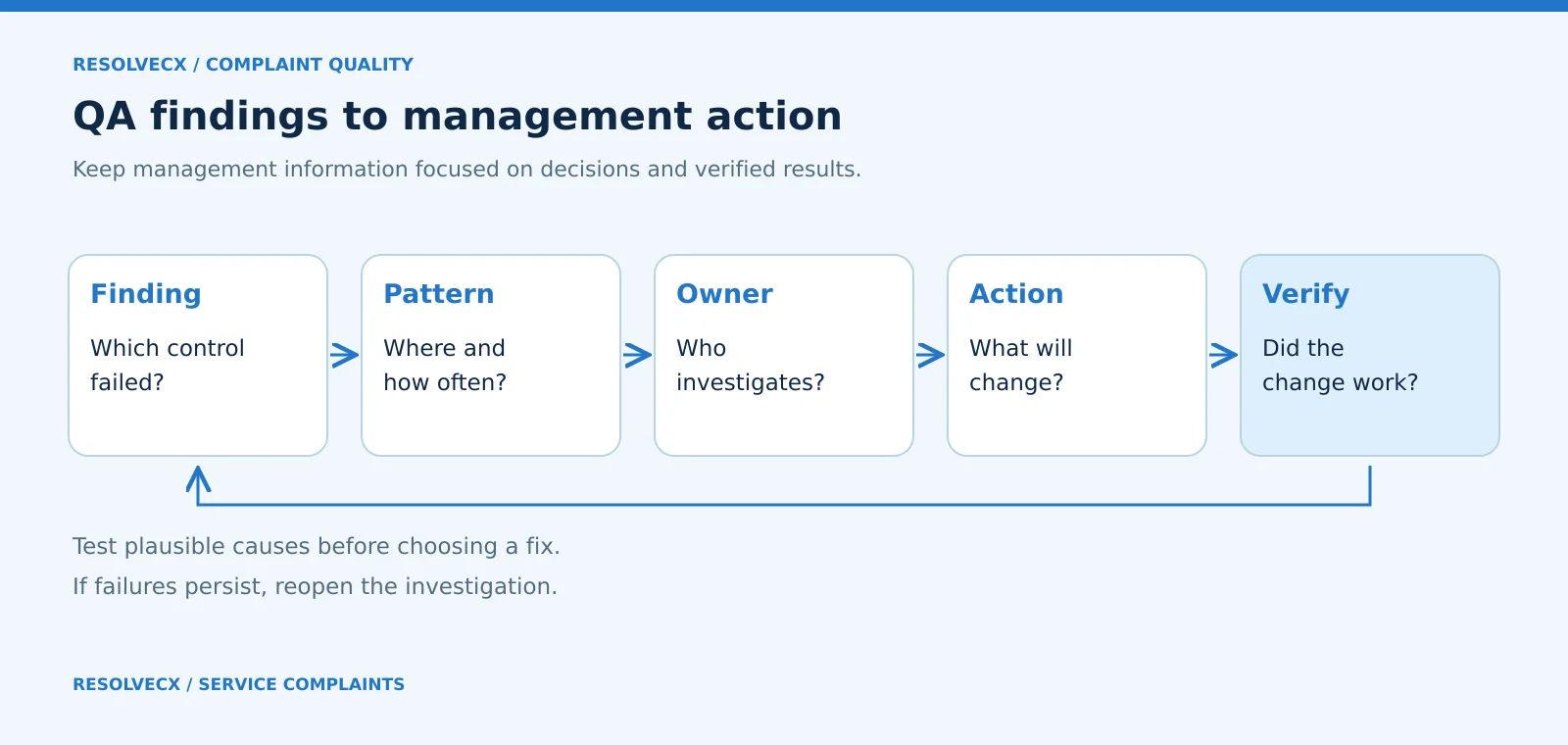
Figure 4. Completing an action is not proof that handling improved.
Figure 4 text equivalent. Identify which control failed, compare where and how often the pattern appears, assign an investigation owner, decide what action will change, and verify whether it worked in later cases. Test plausible causes before choosing a fix. If the failure persists, reopen the investigation rather than count action completion as success.
Complaint quality assurance should support informed operational decisions, not only quality scores. A regular QA discussion should ask three questions: what has changed, which risks need action and how will the next review test the response? The SPSO method links sampling findings and patterns back to management intelligence. Where complaint trends need deeper interpretation, ResolveCX separately explains complaint trend analysis. Structured records and evidence links matter more than visually polished charts without clear underlying definitions. 1
Common Complaint QA Mistakes
Sampling only the easiest cases creates a misleading impression of quality. A sample shaped exclusively by risk triggers is useful for detecting problems but must not be described as representative of the whole operation. Be clear about both.
Scoring without calibration makes comparisons unfair. Coaching without an action owner leaves learning unfinished. A perfect-looking aggregate score may hide a serious weak decision, an accessibility failure or an undelivered remedy.
Do not mistake complaint severity tiers for handler-quality scores, or use the SPSO public-sector timeframes as FCA rules. Equally, QA review is not a substitute for independent internal audit. Most importantly, avoid turning a practical service-complaint quality program into a pharma GMP or medical-device compliance article simply because the search results contain those terms.
Frequently Asked Questions
It is a structured check of complaint handling against defined standards, using case evidence, consistent indicators, reviewer discussion and improvement actions. It evaluates the quality of handling rather than replacing the case decision.
There is no universal percentage. The SPSO tool gives 10% of recently closed cases as one illustrative approach; teams should select a method that reflects case volumes, risk, coverage and their ability to interpret findings.
It should test scope, accessibility, investigation fairness, decision clarity, remedies, learning and record completeness. Criteria should be observable and supported by case evidence.
Reviewers independently score the same case, compare evidence and resolve differences using common criteria. The agreed reasoning is recorded so future reviews are more consistent.
QA assesses case-handling quality and guides improvement. Internal audit independently evaluates broader governance, risk and controls; its independence and remit are distinct.
Group recurring issues, investigate plausible causes, assign coaching or process changes and test later cases. Management should verify effectiveness rather than counting completed actions as proof of better outcomes.
Make Quality Review Part of Better Complaint Handling
Complaint quality assurance works when sampling, scoring, calibration, coaching, root-cause review and management action form one connected process. The aim is fairer handling and evidence-backed improvements, not simply a higher score. For the records, ownership and reviewability that support this work, consider ResolveCX complaint management software and its structured approach to complaint workflows. This article describes an operating method. It does not imply that ResolveCX ships a QA scoring or calibration module.
2. FCA Handbook, DISP 1.6 Complaints Time Limit Rules. UK financial-services rules, subject to scope and exceptions. Inspected as of November 22, 2026; the page states a June 1, 2026 update and a separate future version. See DISP 1.6.2R and 1.6.2AR. Confirm applicability and any special complaint arrangements before using a timetable. Checked November 22, 2026.
4. Care Quality Commission, Regulation 17: Good governance. Applies to relevant CQC-regulated health and social-care activities in England. Covers governance, assurance, records, feedback and improvement, not a universal complaint QA grade. Checked November 22, 2026.
6. ComplianceQuest, Complaint Management. Vendor commentary and product marketing, including product-quality and medical-device contexts. Investigation and root-cause discussion can inform general practice; its regulatory and product claims are not adopted here. Checked November 22, 2026.
About ResolveCX Product Management Team
The ResolveCX Product Management Team writes about accountable customer operations, case ownership and governed complaint workflows. Examples in this guide are illustrative, not legal advice.