
Case Management
How to Choose Customer Service Case Management Software
Map your customer workflows, agree buyer priorities and test vendors with the same cases before choosing case management software.
ResolveCX Team
15 min read
110

A practical guide to complaint reporting, from case evidence and KPI definitions to board MI, accountable action and regulator-specific returns.

Key Takeaways
Complaint management reporting is the structured recording, checking and presentation of complaint information so teams can monitor handling performance, identify risks and make accountable decisions. A useful report shows more than how many complaints arrived: it explains outcomes, unresolved work, evidence gaps and actions still needed. For regulated firms, internal management information and formal regulatory returns must also be distinguished.
Consider a complaints manager who sees fewer new complaints this month but more overdue cases, repeated contacts and unresolved redress. A volume-only chart looks positive; a governance report exposes an operational problem. That is the difference between collecting statistics and making complaint data useful.
Explore how ResolveCX approaches accountable complaint and case governance.
Complaint management reporting converts complaint records into structured views for operations, risk teams and leadership. It includes the collection of reliable case fields, consistent aggregation, interpretation of exceptions and communication of what needs attention. ISO 10002:2018 describes a complaints-handling process that includes analysis, evaluation, review and improvement; it does not prescribe one universal dashboard or management pack. 1
Complaint handling concerns receipt, investigation, decisions, responses and remedies for a particular complaint. Reporting examines how that work is progressing across cases and whether outcomes are supported by evidence. A complaint record can be complete without the management picture being informative; conversely, a polished chart can conceal poorly documented decisions.
Reporting presents defined measures and their limitations; trend analysis investigates changes and possible drivers. Teams should describe a rise in billing complaints before attributing that rise to a system defect. The companion complaint trend analysis guide covers segmentation, normalization and root-cause testing in depth.
Management information, or MI, is decision-ready information. Raw counts become MI when leaders understand the population, relevant comparison, risk, responsibility and required decision. A key performance indicator is a measure tied to a management objective or target rather than simply any available number.
Reporting connects today's exceptions to a review of recurring weaknesses. Record the decision, assign an action owner and verify the result before describing an intervention as preventive.
Complaints can reveal operational friction, confusing communication, conduct risk and potential unfair customer outcomes. A single serious complaint may merit immediate review even when the category's volume is low. Leaders should combine complaint evidence with other controls and outcomes monitoring; complaints alone neither prove nor disprove a systemic failure.
At minimum, define the complaint identifier, received date, relevant product or service, channel, category, current stage, assigned owner and applicable deadline. Record key contact history, evidence collected, investigation steps, decisions and approval rationale. Capture the response type, upheld status where relevant, any redress offered, and whether the agreed remedy was actually completed. Use access controls for sensitive or vulnerable-customer information.
Aggregate records by a stable taxonomy. Separate complaints received in the period from older cases still open at the cutoff. Compare category, branch or team only where reporting populations are meaningful; an apparent hotspot may simply serve more customers. Preserve the ability to drill from a reported figure to the underlying case population and the extraction rules used.
| View | Minimum useful content | Decision supported |
|---|---|---|
| Case detail | History, owner, evidence, decision, remedy | Is this complaint handled and evidenced? |
| Portfolio overview | Volume, categories, outcomes, backlog | Where are delays or risk concentrated? |
| Action record | Finding, owner, due date, evidence | Did management respond and verify? |
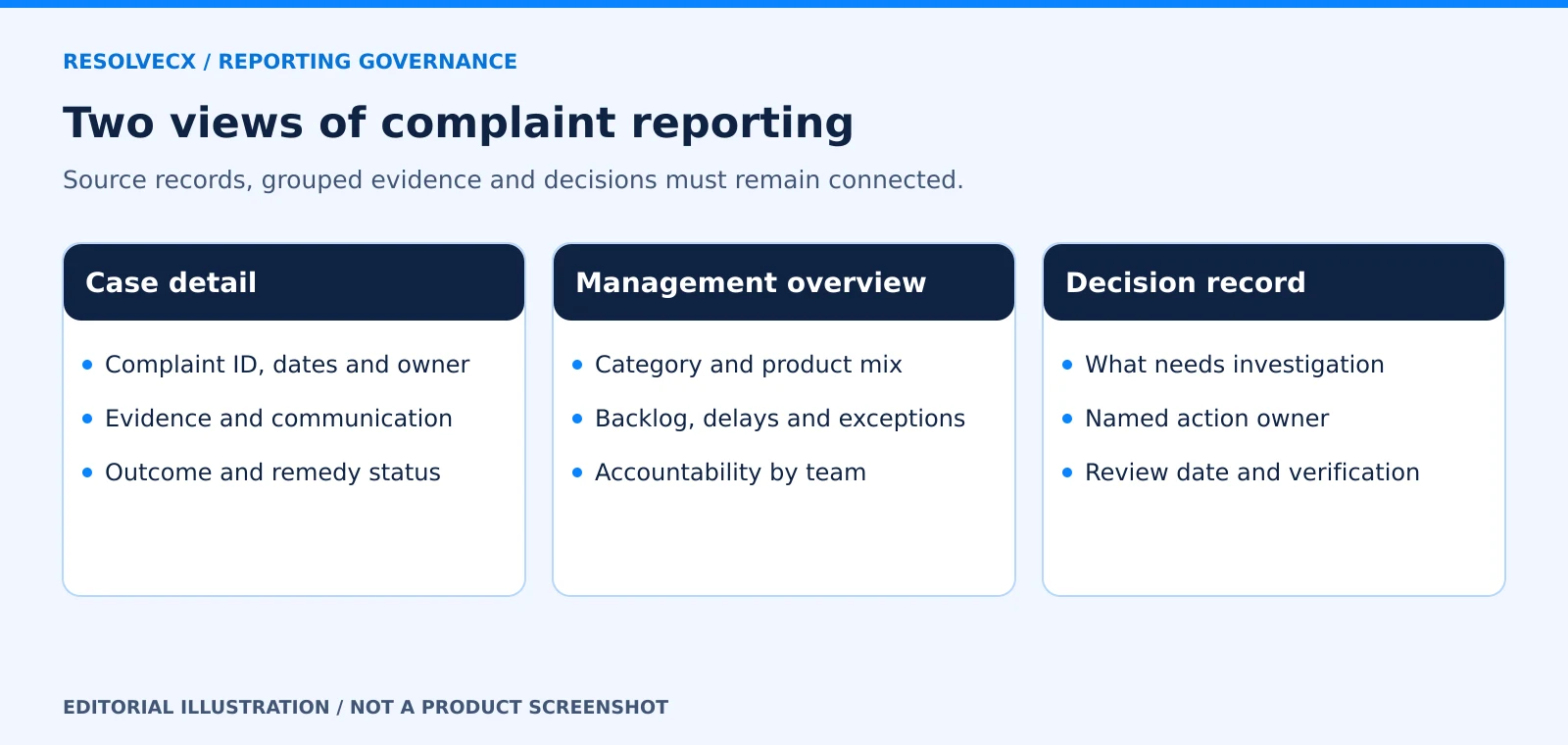
Figure 1. Source records, grouped evidence and decisions must remain connected. Editorial illustration, not a ResolveCX product screenshot.
Text equivalent: Case detail: Complaint ID, dates and owner; Evidence and communication; Outcome and remedy status. Management overview: Category and product mix; Backlog, delays and exceptions; Accountability by team. Decision record: What needs investigation; Named action owner; Review date and verification.
Reliable fields support period-to-period comparisons, reconciliations, evidence reviews and regulator-specific reporting where required. When teams use inconsistent received dates or redefine categories without documenting changes, even correct calculations become misleading. Report the definition version and extraction date alongside material conclusions.
Complaint management reporting KPIs should measure timeliness, outcomes, workload and control quality rather than volume alone. Every metric needs a clearly defined cohort, reporting period, clock and treatment of exclusions. Distinguish an operational target from a regulatory time limit; an internal SLA is not automatically a legal obligation.
Track time to acknowledgment, time spent at each handling stage and time to the defined resolution event. Include a view of complaints approaching deadlines, not only those already late. State whether elapsed time ends at final response, closure or verified completion of an agreed remedy; these milestones can occur on different dates.
Report upheld, partially upheld and not upheld using the organization's documented decision rules and applicable regulatory definitions. Define the denominator, for example eligible decided complaints in a period, before publishing an uphold rate. A lower complaint volume alongside more upheld outcomes should prompt examination, not an automatic success claim.
Record repeat complaints and reopened cases separately. A reopening can signal premature closure, missing evidence or a new issue; investigate samples before drawing conclusions. Customer satisfaction can add context but may be biased toward customers who respond to surveys. Escalation rates likewise need interpretation: appropriate escalation can protect customers.
| KPI | Definition to publish | Interpretation caution |
|---|---|---|
| New complaints | Received during defined period | Separate from carryover backlog |
| Open backlog | Still open at reporting cutoff | Include age and deadline exposure |
| Response timeliness | Eligible cases meeting applicable clock | Specify exceptions and start point |
| Resolution time | Receipt to stated endpoint | Final response differs from remedy |
| Uphold rate | Defined upheld outcomes / eligible decisions | Partial uphold treatment varies |
| Reopen rate | Reopened cases / defined closed cohort | Check duplicate issue classification |
| Evidence completeness | Cases meeting required record criteria | Audit sampling and missing data |
A complaints MI pack is a periodic, decision-focused summary of performance, emerging risk, customer outcomes and management action. Boards and executives do not need a complete ticket export. They need to understand what changed, whether existing controls are adequate, what remains unresolved and which decisions require oversight.
Start with an executive narrative that distinguishes facts, risks and hypotheses. Add complaint volume and meaningful exposure-based rates; movement in timely responses; backlog aging; uphold and redress outcomes; high-impact exceptions; and whether vulnerable customers face different handling risks. Show the status of important investigations and corrective actions, including overdue decisions and accountable owners.
| Reader | Most useful view | Typical action |
|---|---|---|
| Frontline/team lead | Open cases, deadlines, unowned work | Reassign or unblock a case |
| Complaint manager | Stage delays, outcomes, evidence gaps | Improve handling controls |
| Risk and compliance | Exceptions, conduct signals, remedies | Challenge or escalate risks |
| Executive/board | Material trends, decisions, residual risk | Set priorities and require assurance |
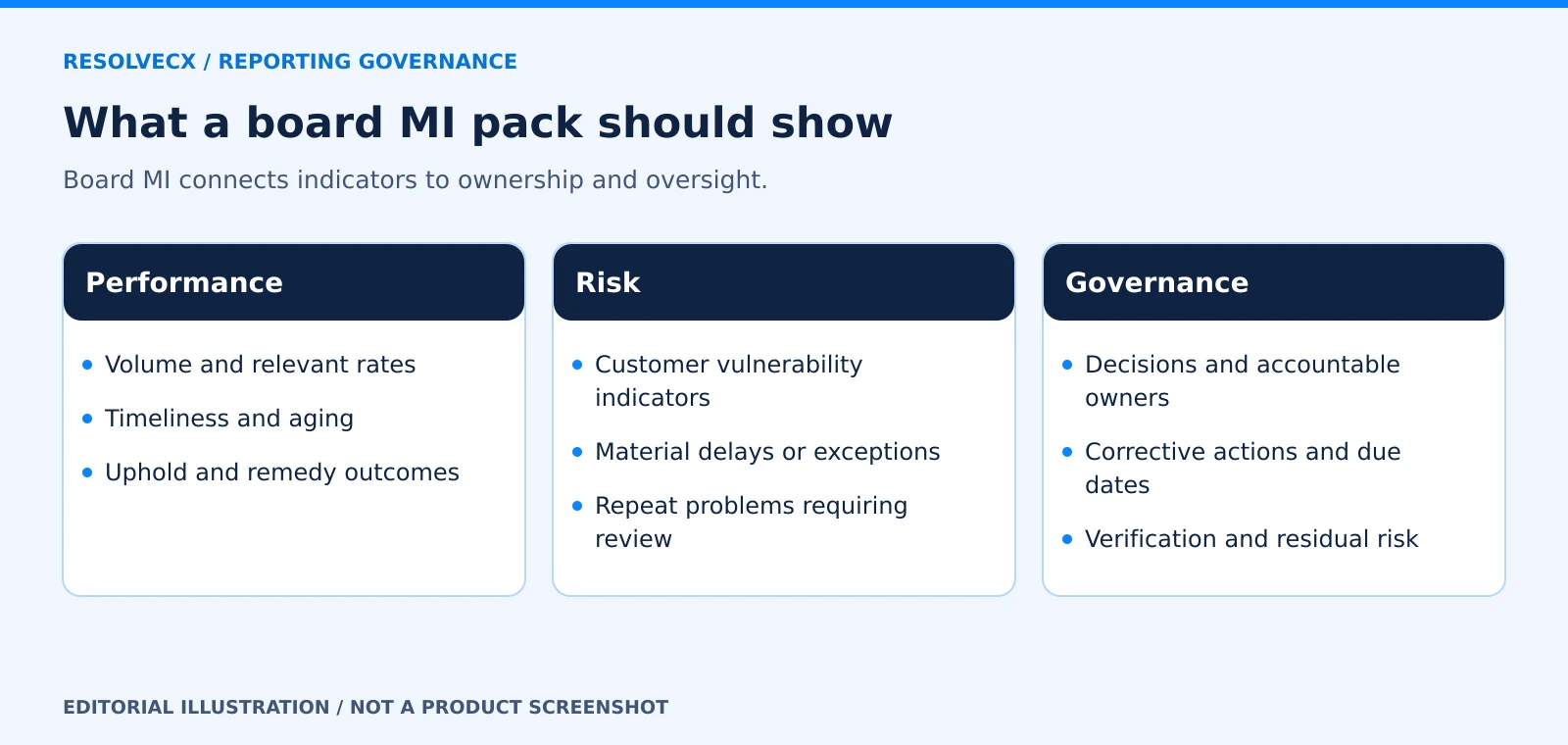
Figure 2. Board MI connects indicators to ownership and oversight. Editorial illustration, not a ResolveCX product screenshot.
Text equivalent: Performance: Volume and relevant rates; Timeliness and aging; Uphold and remedy outcomes. Risk: Customer vulnerability indicators; Material delays or exceptions; Repeat problems requiring review. Governance: Decisions and accountable owners; Corrective actions and due dates; Verification and residual risk.
Operational teams may need frequent updated views; management reviews usually follow a scheduled cadence; board or committee packs should match governance cycles and materiality. There is no universal reporting frequency for every organization. A one-page summary can link to drill-down evidence while preserving the version reviewed at the meeting.
Under a three-lines approach, first-line operations own complaint handling and corrective work, risk or compliance functions provide challenge, and internal audit may independently assess control design and operation. The division depends on the organization. UK Consumer Duty monitoring adds a customer-outcome lens for firms within scope; complaint metrics alone are insufficient evidence of good outcomes.
Explore complaint management software as a structured foundation for ownership, evidence and review.
FCA complaints reporting is a regulatory obligation for affected UK firms, separate from internal complaint management reporting. Relevant rules sit in the FCA Handbook, particularly DISP, with requirements that depend on the firm's permissions, activity and complaint type. Firms should check the rules effective for their reporting period rather than rely on a generic checklist.
For complaints within the ordinary DISP 1.6.2R rule, a firm must send a written response by the end of eight weeks after receipt: either a final response or the specified response explaining the delay and expected timing, with the required Financial Ombudsman Service information. This is not a universal eight-week final-response requirement. Subject to the applicable rules and exceptions, EMD and PSD complaints under DISP 1.6.2AR require a final response by the end of 15 business days after the day of receipt. Only in exceptional circumstances, for reasons beyond the firm's control, may it send a holding response within that 15-business-day period, explaining the delay and deadline, followed by a final response within 35 business days after the day of receipt. A mixed complaint's EMD or PSD part follows the specific provisions. Check applicability and any relevant special rules rather than assigning one clock to every complaint. 3
A final response is a formal regulatory concept; it should not be conflated with early summary resolution or internal case closure. Record the receipt date, relevant complaint classification, response milestone and applicable clock so management reporting and regulatory submissions can be reconciled. Customers may refer qualifying unresolved disputes to the Financial Ombudsman Service subject to its jurisdiction and rules.
The FCA states that COM001, a unified complaints return under PS25/19, starts on January 1, 2027 for affected firms. It replaces five existing returns: DISP 1 Annex 1, Consumer Credit Return (CCR), Funeral Plans (FP), Claims Management Companies (CMCs), and Electronic Money and Payment Services Return (PSR). Reporting moves to fixed six-month calendar periods, with the first covering January 1 to June 30, 2027. Relevant return sections depend on regulated permissions. The upfront nil-return option is not simply a zero-new-complaints shortcut: the future DISP reporting rule describes no complaints received during the period and none outstanding. Group reporting is removed in favor of individual legal entity reporting. Confirm the applicable rule version and scope for the firm. 2 4 5
Source inspection on November 22, 2026 found that the FCA reporting page, updated November 13, still described the COM001 technical schema and validation rules as subject to change. It had removed the earlier data reference guides and explicitly said not to rely on them when developing reporting systems. Its data-capture flow diagram is not a reporting template or technical specification. This does not change the policy or reporting requirements. Collect the required data points from January 1, 2027, and check the latest FCA page, final technical guides and applicable Handbook version before building submission logic. The FCA also notes subsequent targeted-support and Deferred Payment Credit updates, so the original PS alone is not a complete implementation specification. This technical source inspection is not professional compliance sign-off. 2 5
| Output | Audience | Purpose |
|---|---|---|
| Operational dashboard | Complaint handlers | Manage current work and due cases |
| MI pack | Managers, executives, board | Oversee risks, outcomes and actions |
| COM001 return | FCA for affected firms | Submit prescribed complaint data |
| US consumer complaints | US financial-services context | Separate CFPB process and rules |
A regulatory return has prescribed fields and submission controls. A board pack may discuss root-cause hypotheses, vulnerabilities, customer outcomes and remediation that are not represented in the return. Neither output replaces the other. US financial institutions may have separate Consumer Financial Protection Bureau processes; CFPB timelines and US retention rules should never be presented as FCA or UK requirements.
Read the FCA-focused complaint governance overview for UK regulatory context.
A complaint management dashboard should help handlers see the current status of work and help supervisors identify immediate exceptions. It is not a substitute for periodic governance reports that explain outcomes, decisions, unresolved risks and follow-up. Update frequency must reflect the actual data pipeline; a chart labeled real time can still be delayed or incomplete.
Useful views include open complaints by owner and stage, work nearing deadline, overdue cases, new arrivals, pending actions, evidence gaps and remedy completion. Enable filters for team or service and a controlled route back to the case record. Display the last-refresh time and explain whether records were excluded or corrected after extraction.
An operational view supports intervention in current work. A periodic MI pack preserves a defined cutoff, explains movement since the prior period and records decisions. Reconcile late corrections rather than allowing a refreshed dashboard to silently replace the evidence a committee reviewed.
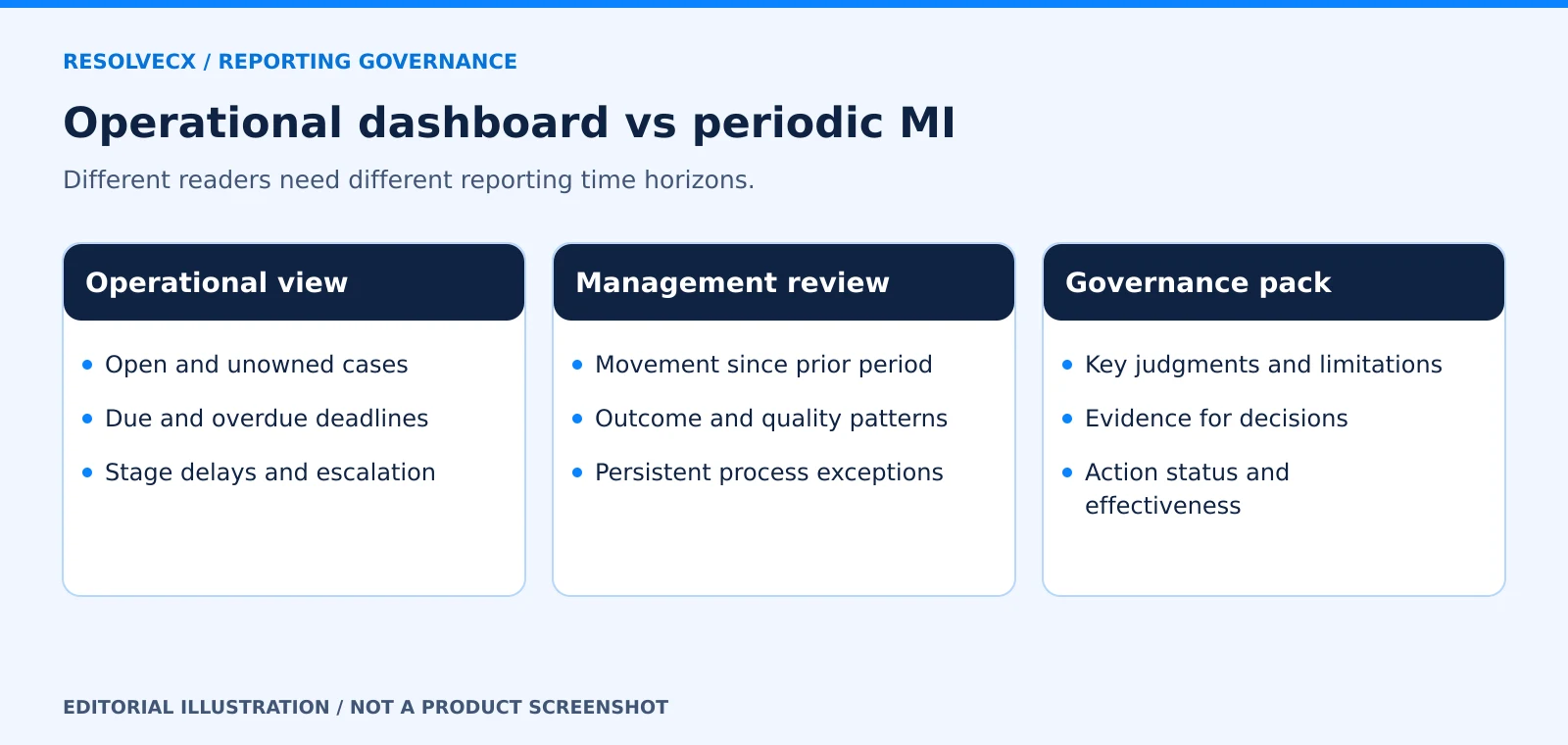
Figure 3. Different readers need different reporting time horizons. Editorial illustration, not a ResolveCX product screenshot.
Text equivalent: Operational view: Open and unowned cases; Due and overdue deadlines; Stage delays and escalation. Management review: Movement since prior period; Outcome and quality patterns; Persistent process exceptions. Governance pack: Key judgments and limitations; Evidence for decisions; Action status and effectiveness.
For complaint management reporting, use a short narrative, a compact KPI table, a restrained trend chart where comparisons are meaningful and an action register. Visual categories should remain consistent between periods. State limitations plainly: missing data, revised case classifications or changing exposure can make an apparent improvement unreliable. Avoid charts that convert an untested correlation into a declared root cause.
Daily views are useful for deadlines and ownership; weekly reviews can examine exceptions and capacity; monthly packs can review outcomes and corrective actions; less frequent reports can support senior governance. Annual summaries may be appropriate where required or useful, but do not assume the same schedule suits every firm or regulator. Each output needs a named producer, reviewer and escalation route.
Illustrative management narrative: billing complaints appear to be increasing. The complaint manager first validates category coding and relevant exposure, then requests a focused billing-process review. A named operational owner reports findings, controls proposed and verification criteria at the next meeting. The report records the decision without claiming that a cause has already been established.
The most damaging complaint management reporting mistakes are often errors of interpretation and ownership rather than missing charts. Teams may report figures without definitions, hide overdue work inside averages or present action recommendations without accountable follow-up. Each weakness makes the report less useful even when the underlying software calculates correctly.
For each material exception, record the decision required, the accountable owner, the due date and the evidence needed at review. A recommendation without an accepted owner or a follow-up date does not show that management acted.
Spreadsheet workflows can be effective at modest scale, but version conflicts, uncontrolled manual edits, inconsistent formulas and missing audit trails create risks. Document reconciliations and reviewers, regardless of the technology. A falling number of complaints may reflect reduced access to complaint channels, misclassification or changes in business volume rather than better handling.
Repeated complaints in one location can justify investigation, not an automatic training diagnosis. Confirm process evidence, exposure and alternative explanations before stating a cause. The final report should show corrective-action status and whether the chosen control reduced the underlying failure mode.
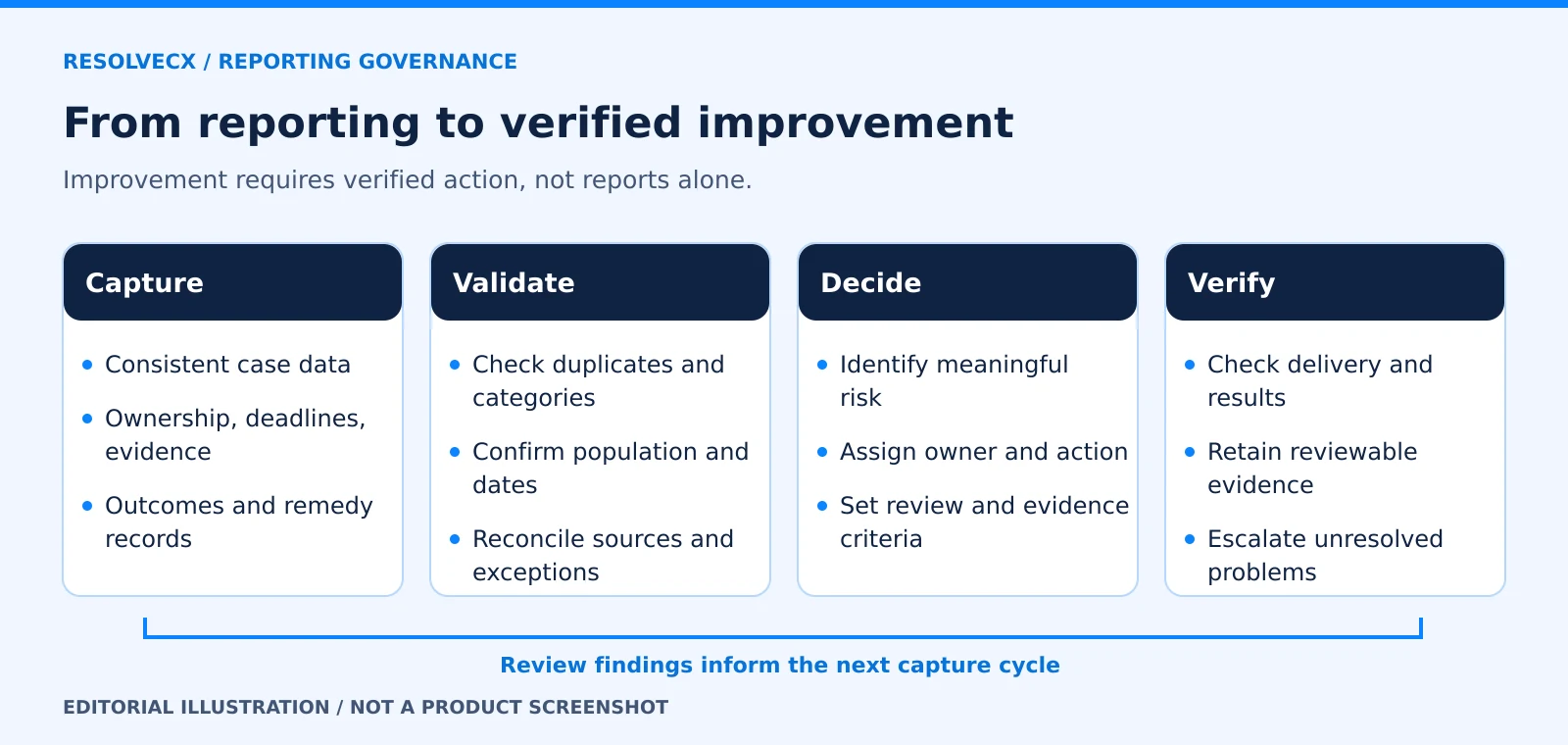
Figure 4. Improvement requires verified action, not reports alone. Editorial illustration, not a ResolveCX product screenshot.
Text equivalent: Capture: Consistent case data; Ownership, deadlines, evidence; Outcomes and remedy records. Validate: Check duplicates and categories; Confirm population and dates; Reconcile sources and exceptions. Decide: Identify meaningful risk; Assign owner and action; Set review and evidence criteria. Verify: Check delivery and results; Retain reviewable evidence; Escalate unresolved problems.
For complaint management reporting, record when source data was extracted, who approved calculation definitions, and whether corrections changed previously reviewed totals. That evidence helps management explain changes without overstating certainty or improvement.
Complaint management reporting organizes complaint records into reliable operational and governance information. It tracks handling, outcomes, risks and actions so named owners can respond and leaders can review effectiveness.
Include the reporting period, defined complaint population, ownership, deadlines, outcomes, material exceptions and corrective actions. Support portfolio summaries with traceable case records, evidence and any limits on data quality.
Common measures include complaint volume, open backlog, response and resolution timeliness, uphold outcomes, reopened complaints and remedy completion. Define every denominator and clock; a lower number is not automatically better.
A complaints management information pack is a periodic summary for leaders and oversight functions. It combines meaningful metrics with material risks, management decisions, action owners and evidence that past interventions were reviewed.
Affected UK firms must follow their applicable FCA DISP reporting rules and regulatory returns. COM001 begins in January 2027 for affected firms, but submission scope and details depend on permissions and the rules effective for the reporting period.
Real-time complaint reporting presents operational changes as source systems update, subject to actual refresh delays. It helps teams manage live queues and deadlines, while periodic MI reporting adds governance interpretation and accountable follow-up.
Complaint management reporting is most valuable when case evidence becomes actionable oversight. Keep internal MI distinct from applicable regulatory returns, and verify that assigned improvements produced the intended result. A well-designed report makes responsibility visible rather than hiding problems inside averages.
Explore ResolveCX complaint management software and its governance approach.
1. ISO 10002:2018: Guidelines for complaints handling. International guidance, not a universal dashboard specification. The official abstract is a limited source, not a licensed full-standard assessment.
2. FCA: Reporting complaints and COM001 changes. Source inspected November 22, 2026; page updated November 13, 2026. Includes the January 2027 transition and withdrawn-guide warning.
3. FCA Handbook: DISP 1.6 Complaints time limit rules. Source inspected November 22, 2026 in the current version, last updated June 1, 2026. Check applicability and special provisions.
4. FCA: PS25/19, Improving the complaints reporting process. Read with the FCA's updated policy page and current or future Handbook requirements, not as a frozen technical specification.
5. FCA Handbook: DISP 1, Treating complainants fairly. Use the timeline for the relevant reporting period. Future DISP 1.10 reporting provisions were inspected separately from current handling rules; engineering inspection is not legal advice.
About ResolveCX Team
The ResolveCX team writes about complaint management and accountable customer operations.
Contact the TeamMap your customer workflows, agree buyer priorities and test vendors with the same cases before choosing case management software.

Learn how AI-powered resolution governance helps teams detect escalation risk, preserve case context, connect recurring complaints to root causes, and intervene before customers leave.

Missed messages, parallel replies and stalled transfers are often workflow failures. Diagnose seven common problems, repair the process and choose the support model your team needs.