Supporting Vulnerable Customers: A Practical Guide for Regulated Firms
A practical UK financial-services guide to identifying support needs, offering usable choices, handling information proportionately, and checking outcomes.
ResolveCX Product Management Team23 November 202618 min read
Key Takeaways
1Vulnerability is a changing spectrum, not a diagnosis or demographic customer type.
2Use the four FCA drivers to consider barriers, then ask about individual support needs.
3FG21/1 guidance and Consumer Duty rules have distinct scope and application.
4Assess Article 6 and, for special-category data, a separate Article 9 condition before processing.
5People verify context, agree support, and monitor whether the adjustment actually helped.
A vulnerable customer is someone especially susceptible to harm because of personal circumstances, particularly when a firm does not act with appropriate care. The Financial Conduct Authority (FCA) treats vulnerability as a changing spectrum rather than a permanent label. Supporting vulnerable customers means understanding the customer's needs, adapting the interaction and checking the outcome. This guide explains the UK financial-services approach. Explore ResolveCX's approach to accountable customer resolution where a support need becomes part of an owned case.
What is a vulnerable customer?
The FCA's FG21/1 guidance defines vulnerability by susceptibility to harm and the care a firm provides. It does not create fixed customer types. Bereavement may call for extra time; a health condition may require an accessible format. Another person may need neither. Ask what is difficult in this interaction and what adjustment would help. 1
Vulnerability is a spectrum, not a label
Circumstances can be temporary, long term, overlapping or changing. A customer may understand a product yet struggle with its digital journey. Disability and protected characteristics can overlap with vulnerability, but are distinct. Do not infer vulnerability or a diagnosis from age, sentiment, account value, geography, an account segment, or an AI score. Supporting vulnerable customers starts with a useful record of a relevant need and agreed support rather than assigning a personality judgment.
FG21/1 applies where the FCA Principles apply to firms supplying products or services to retail customers who are natural persons, including some unincorporated businesses and charities. It does not extend that natural-person scope to incorporated businesses simply because their staff have support needs. The Consumer Duty has its own retail-market application rules, sector-specific customer definitions, and exclusions; not every regulated firm, activity, or business customer is covered identically. Check the applicable rules and the firm's role in the distribution chain. This article addresses service support and outcomes. A formal complaint, safeguarding concern, or clinical matter needs its own appropriate process; a support adjustment does not decide a complaint, establish safeguarding safety, or provide clinical advice. 14
What are the four drivers of vulnerability?
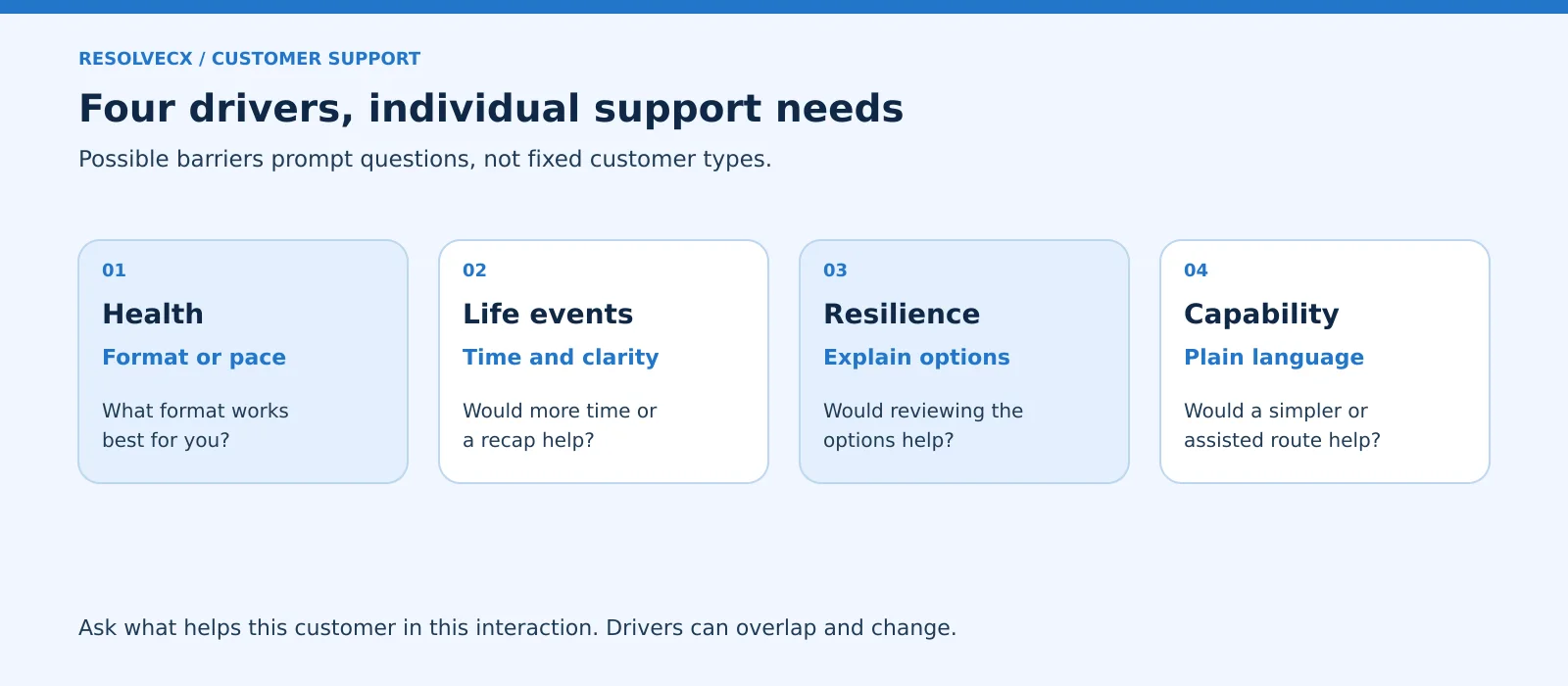
The FCA groups characteristics of vulnerability under health, life events, resilience and capability. These drivers help a firm consider possible barriers; they do not prove a particular customer's status or prescribe a single remedy. Several may overlap. Assess the effect on this customer's interaction.
FCA driver
Illustrative circumstance
Possible service need
Health
A physical or mental health condition affects interaction
A suitable format, channel or pace
Life events
Bereavement, job loss or relationship breakdown
Clear next steps and time to respond
Resilience
Limited ability to withstand financial or emotional shocks
Careful explanation of consequences and options
Capability
Limited financial knowledge, confidence, literacy or digital skills
Plain language and an alternative to a digital-only journey
Bereavement may overlap with reduced resilience; low digital confidence does not imply poor product understanding. Check the actual barrier. Supporting vulnerable customers starts with the customer's experience of a specific journey, not a broad demographic assumption.
Figure 1. The four FCA drivers prompt questions about individual support needs.
Figure 1 text equivalent: Health: consider format or pace and ask what format works best. Life events: consider time and clarity and ask whether more time or a recap would help. Resilience: explain options and ask whether reviewing them would help. Capability: use plain language and ask whether a simpler or assisted route would help. These are possible questions, not prescribed remedies. Ask what helps this customer in this interaction; drivers can overlap and change. None establishes a diagnosis or determines a support need.
How can firms identify support needs without making assumptions?
Identification combines what customers disclose with relevant signs in their interaction. A customer may struggle with a document or form, request repeated explanations or mention a life event. None establishes a diagnosis. A handler can ask an open, respectful question such as what would make the next step easier, then confirm any agreed adjustment. Written messages and third-party contacts can reveal needs too, subject to verification of authority and confidentiality.
Disclosure cannot be the only route. Stigma or concern about product decisions may inhibit disclosure. The FCA says firms should take steps to encourage disclosure where there are clear indicators and respond to needs they can recognize. A signal prompts consideration, not a diagnosis or machine verdict. 14
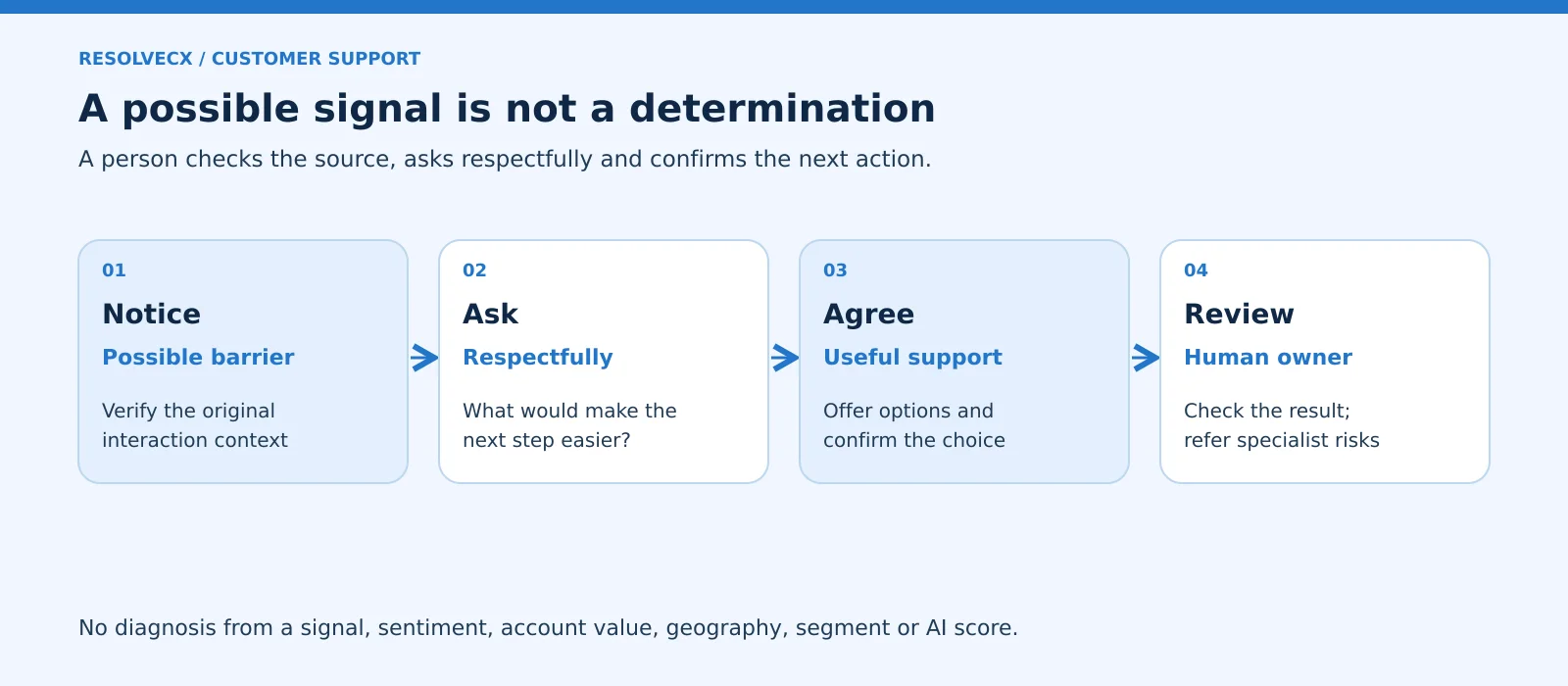
Use a simple sequence: notice an interaction barrier; ask what the customer needs; offer a suitable option; confirm the choice; and check later whether it helped. If details are withheld, explain available channels. Refer specialist risks while retaining a customer contact. Recording principles appear below; do not create a speculative label during triage.
Before changing a customer's route based on an automated suggestion, check the underlying interaction and ask whether the proposed support matches what the customer wants. Record who reviewed the suggestion, the source, the accepted or rejected action and the reason. Test false positives and missed needs: an inaccurate flag can restrict choices, while an ignored barrier can leave the customer without usable service. Escalate sensitive cases promptly to a trained person. This is a governance control, not a claim that AI can identify vulnerability reliably.
What do FG21/1 and the Consumer Duty expect?
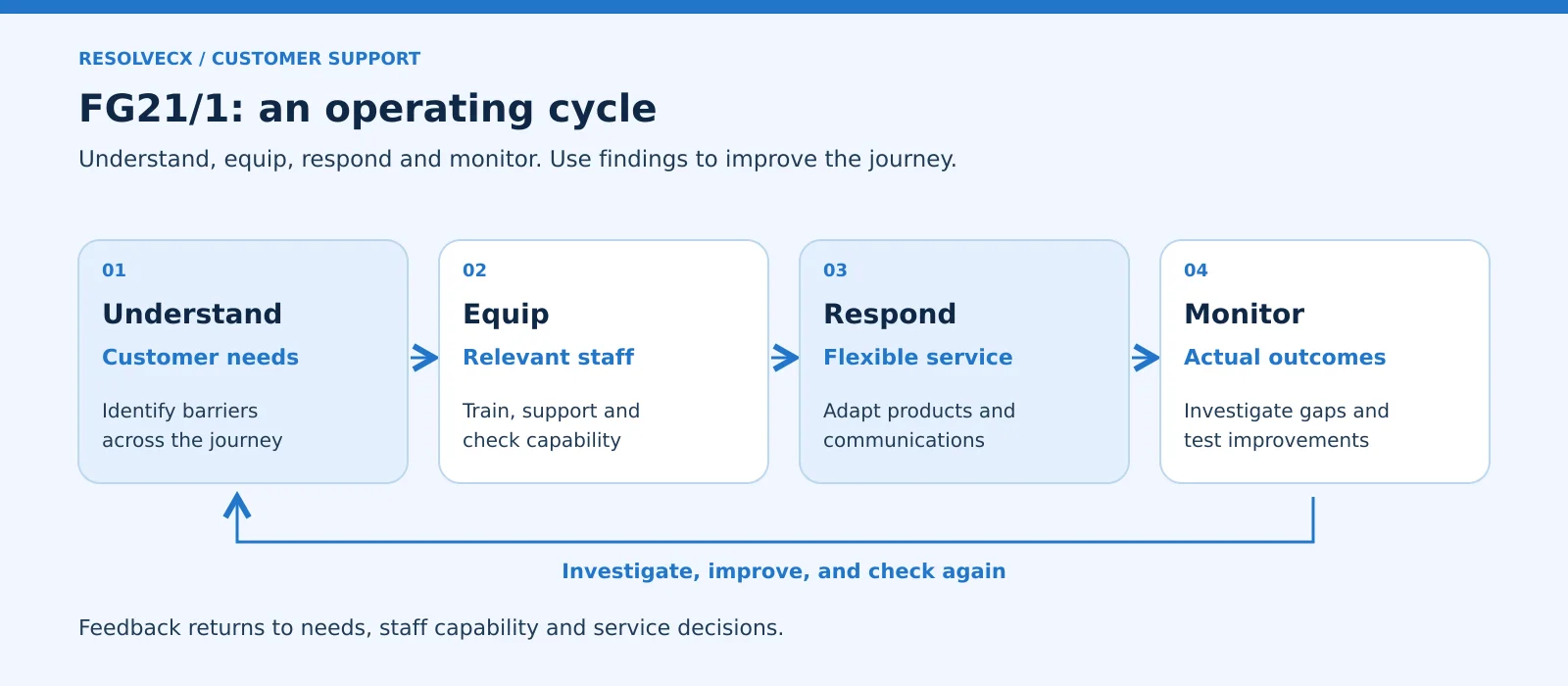
FG21/1 asks firms to understand the needs of their target market and customer base, equip staff to recognize and respond, adapt products and services and communications, and monitor whether needs are met. Published in February 2021, the guidance has a summary-page note added on July 22, 2026. That note directs readers to current Consumer Duty expectations because some referenced publications predate the Duty; it is not a new edition of FG21/1. Controls depend on the service and risk. 1
Understand needs. Identify how characteristics of vulnerability could create disadvantage across a journey.
Build staff capability. Train relevant frontline, design, operational and management teams, and support their judgment.
Respond flexibly. Test products, communications and service channels against identified needs.
The Consumer Duty came into force on July 31, 2023 for open products and services and on July 31, 2024 for closed products and services within its scope. Its four outcomes concern products and services, price and value, consumer understanding, and consumer support. Consult the FCA's Consumer Duty information for firms for timing and application, rather than treating all regulated activities or business customers alike. Distinguish binding rules and Principles from guidance examples and internal policy. Firms are not bound to adopt every specific action described in FG21/1, but must meet applicable Principles and rules. 14
In its March 2025 findings, the FCA described good outcome monitoring as defining what success looks like, using quality data, escalating poor outcomes and evaluating corrective action. Complaints, customer feedback, quality assurance and journey reviews can supply management information (MI). Complaints inform learning; this guide does not prescribe their procedure. Review ResolveCX complaint management for a separate, owned workflow when a customer expresses dissatisfaction. 2
Figure 2. Monitoring feeds evidence back into needs, staff capability, and service decisions.
Figure 2 text equivalent: First, understand customer needs and barriers across the journey. Second, equip relevant staff through training, practical support, and capability checks. Third, respond flexibly through product, service, and communication changes. Fourth, monitor actual outcomes, investigate gaps, and test improvements. Feed the findings back into needs, staff capability, and service decisions. This is a continuing cycle, not a one-time checklist.
How should firms support vulnerable customers in practice?
Supporting vulnerable customers requires a choice of help matched to the person and situation. Explain next steps plainly, allow time and offer an accessible channel. Check understanding without repeated disclosure. Document the agreed adjustment so the next authorized handler can honor it. A single standard script or digital-only route may not work for every customer.
Adapt the service, not the customer's identity
A customer who cannot navigate a form may need a telephone or assisted route. Someone facing a stressful life event may need an appointment at a suitable time and a written recap. An adjustment should address the actual barrier and remain proportionate to the service. Do not silently remove options or choose a product for the customer. Verify the support worked.
Representation and difficult moments
Family members, caregivers or other representatives may help, but authority to discuss account details must be checked. Verify a power of attorney and access under the firm's process. Bereavement journeys can involve multiple contacts and documents, so clear ownership and a consistent explanation can reduce avoidable repetition. Refer a need beyond the firm's remit to an appropriate specialist or external support source, without presenting signposting as a completed service outcome.
The FCA examined power-of-attorney and bereavement journeys in retail banks and building societies during its multi-firm work. Authorised staff need relevant context across the journey. Review adjustments as circumstances change. 2
How should staff discuss a sensitive support need?
A good conversation explains why information is sought, listens without diagnosis and asks what practical assistance the customer wants. Speak clearly, allow time and involve a specialist when appropriate.
TEXAS and IDEA have different purposes
TEXAS is a conversation aid: Thank, Explain, eXplicit consent, Ask, Signpost. It helps staff respond to a disclosure, explain use, gather relevant information, and offer support. FG21/1 paragraph 3.18 also describes an alternative X step, checks about objections, depending on the processing basis. Paragraph 3.20 and the FCA FAQs make clear that consent is not always appropriate. The government debt toolkit's consent-based version reflects its processing context, not a universal lawful basis. Follow the firm's approved privacy position; a conversational check does not itself establish lawful processing. 145
IDEA appears in a UK government debt-management toolkit as a method for asking about a customer's situation when more detail is needed to choose effective action: Impact, Duration, Experiences, and Assistance. That is a contextual resource, not a general FCA mandate or an instruction for support staff to diagnose a condition. Ask only proportionate questions within approved processes and training. 5
Aid
Best use
Limitation
TEXAS
Handle a voluntary disclosure and agree support
Follow the firm's lawful-processing policy
IDEA
Explore barriers when more detail is needed in a debt-management setting
Not a universal FCA script
Plain, open question
Offer help without requiring sensitive disclosure
May require specialist follow-up
Figure 3. A possible barrier leads to a respectful question and a human support decision.
Figure 3 text equivalent: Notice a possible barrier, then verify the original interaction context. Ask respectfully what would make the next step easier. Offer suitable options, confirm the customer's choice, and agree useful support without requiring a diagnosis. A human owner reviews the decision and checks whether it worked, referring specialist risks when needed. Do not infer vulnerability or a diagnosis from a signal, age, sentiment, account value, geography, segment, or AI score. Support decisions remain with people.
How should firms record vulnerability-related information?
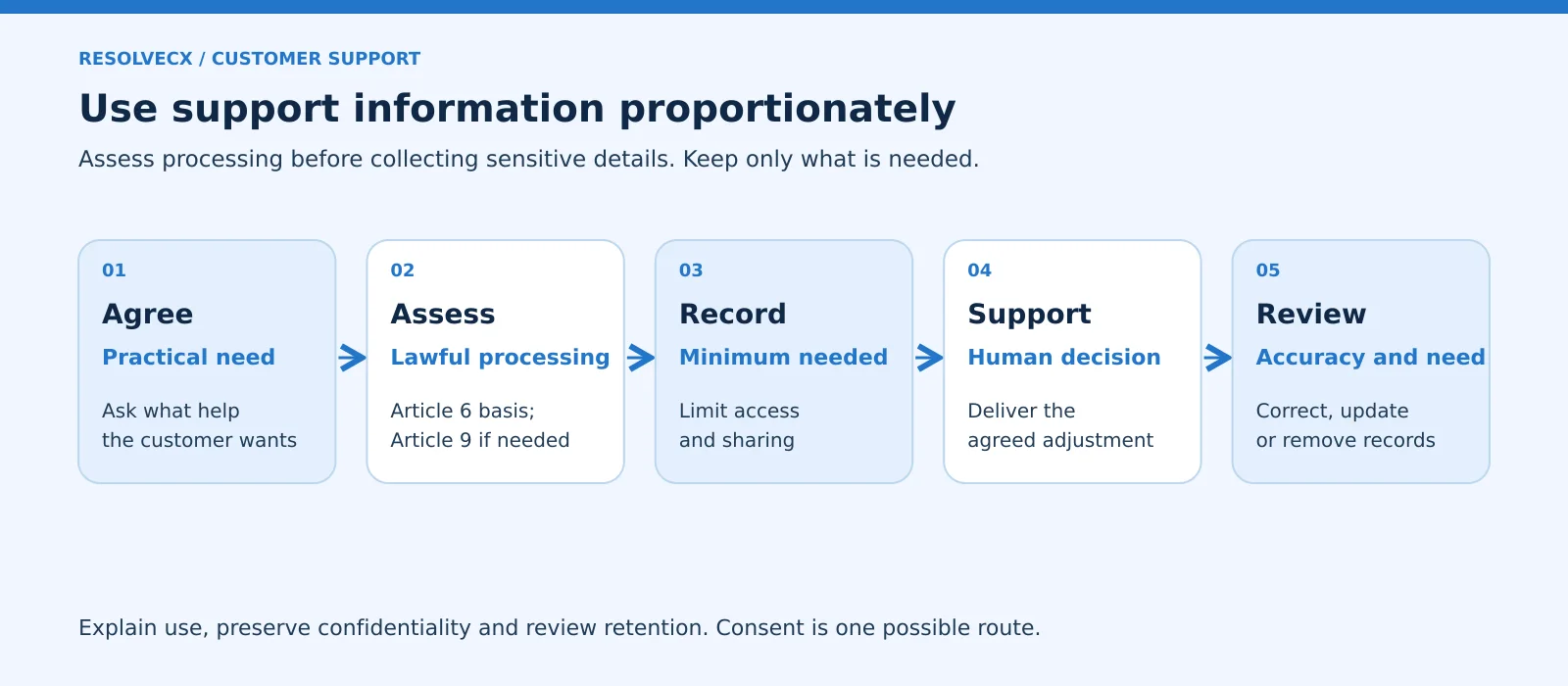
Record what is necessary to deliver the agreed support: the customer's stated need, preferred channel, adjustment, review point and the source of the information. Avoid conjecture, unnecessary diagnosis and a permanent label for a temporary situation. Restrict access to people who need the information, tell the customer how it will be used and correct it when circumstances change. A bare flag helps little; unrestricted notes expose too much.
The joint FCA and Information Commissioner's Office (ICO) statement published on March 27, 2026 explains that data protection law does not prevent firms from delivering good outcomes, but processing must be lawful, fair, transparent, accurate, minimized, and secure. A firm needs an Article 6 UK GDPR lawful basis for personal data. If it processes special-category information such as health data, it also needs a separate Article 9 condition, identified before processing begins. Explicit consent is one possible route, not an automatic requirement for every support record. Depending on the condition, additional Data Protection Act 2018 conditions, safeguards, or an appropriate policy document may be required. Complete a data protection impact assessment (DPIA) for processing likely to be high risk. Legal, privacy, and security teams should assess the actual purpose and processing. The ICO special-category guidance was updated in October 2026; use its current requirements rather than relying solely on older examples. 36
Data sharing across a distribution chain requires purpose, lawful basis, transparency, accuracy, and appropriate access controls. Use anonymized or aggregate monitoring where suitable; pseudonymized information can still be personal data. Review retention and remove or update information that is no longer accurate or necessary. AI-generated context must be checked against its authorized source before it influences a human decision. See ResolveCX's human-reviewed customer context and configured segmentation: where configured, it may suggest context or a segment; a person checks the source and decides the next step. It does not determine vulnerability, establish a diagnosis, or prove that particular controls are deployed for a customer. 3
Figure 4 text equivalent: Agree the practical support need without demanding sensitive detail. Before collecting or using sensitive information, assess the purpose and Article 6 lawful basis; if special-category data is involved, assess a separate Article 9 condition. Record only what is necessary for the agreed support and limit access and sharing to authorized purposes and people. A human makes the support decision and delivers the adjustment. Review accuracy, continuing need, and retention; correct, update, or remove information as appropriate. Explain use to the customer, preserve confidentiality, and remember that explicit consent is one possible route, not a universal basis.
How should staff training and outcomes monitoring work?
Supporting vulnerable customers requires training that gives staff confidence to notice barriers, ask about needs and make a useful adjustment. Frontline teams need listening and referral skills; designers and managers need outcomes awareness. Specialists should support difficult cases. Test capability through case review and customer feedback rather than treating course completion as proof of good outcomes.
Outcomes monitoring asks whether the customer actually received usable support. Define an outcome, find gaps, investigate causes and test corrections. The FCA's 2025 review found that effective firms used quality data, clear escalation and leadership oversight. The 2026 FCA and ICO statement also emphasizes that monitoring personal information must comply with data protection law. 23
Measure
Useful question
Interpretation limit
Adjustment delivery
Did the agreed help reach the customer?
A logged flag does not prove delivery
Understanding
Could the customer use the information?
A sent message does not prove comprehension
Repeat contact
Was the customer asked to explain again?
Some follow-up is necessary
Complaint themes
Which support barriers recur?
Low counts may reflect poor access
Sampled case review
Did the action improve the outcome?
Review the original context
Assign an owner to each finding, decide what should change, and check the next sample. Include outsourced teams in oversight. Supporting vulnerable customers is an ongoing operating responsibility, not a one-time recognition exercise.
Which mistakes undermine support?
The most damaging mistakes confuse a proxy for a need or a recorded action for a customer outcome. Supporting vulnerable customers works better when teams can explain the individual barrier, the agreed response and the evidence that it helped.
Labeling instead of asking: age, account value or a sentiment score does not establish the person's needs. Ask about the difficulty in this journey.
Waiting for a disclosure: respond to clear interaction barriers without pressing for a diagnosis.
Offering one standard route: test whether the channel, format and pace are usable.
Recording everything or nothing: keep relevant factual support information under suitable access controls.
Counting activity as success: a training module, system flag or referral does not show that support worked.
Treating support as complaint closure: a person may need an adjustment and still have an unresolved complaint. Keep the complaint decision in its own accountable process.
Refer safeguarding concerns under the specialist procedure. Review whether the barrier affects others.
Conclusion
Supporting vulnerable customers means understanding the possible drivers, asking about actual needs, offering workable choices, using information fairly and checking the result. Start with one journey that frequently causes repeat contact, then review its support decisions and outcomes. To examine how your team keeps ownership and evidence connected, discuss a governed workflow with ResolveCX.
Frequently Asked Questions
Under FCA guidance, the term describes someone whose personal circumstances make them especially susceptible to harm, particularly where a firm does not act with appropriate care. It is a changing spectrum of risk. Ask what help the person needs in the current interaction rather than assigning a permanent label.
The FCA names health, life events, resilience and capability. The drivers help firms consider where barriers could arise. They are not four customer types, and one person can experience several at once.
Listen to what the customer says, notice a clear interaction barrier and ask what would make the next step easier. Do not infer a diagnosis from age, tone or a data signal. Confirm the need and suitable adjustment with the customer where possible.
FG21/1 calls for understanding needs, staff capability, flexible responses and outcomes monitoring. Firms subject to the Consumer Duty must deliver good outcomes to retail customers in scope. The right implementation depends on the firm's service, customers and risks.
TEXAS stands for Thank, Explain, eXplicit consent, Ask, and Signpost. It is a conversation aid for handling disclosure. FG21/1 also describes checks about objections as an alternative X step depending on the processing basis. Follow the firm's lawful-processing policy; neither version makes consent a universal legal requirement or replaces an Article 6 and, where needed, Article 9 assessment.
Record the relevant need and agreed support, with appropriate access, accuracy and review controls. Assess an Article 6 lawful basis and, where special-category data is processed, an Article 9 condition. Keep only what is necessary and explain the processing to the customer.
2. FCA, Delivering good outcomes for customers in vulnerable circumstances. March 2025 findings on governance, quality data, escalation, and evaluation. Includes specific power-of-attorney and bereavement work with retail banks and building societies, not a universal operating template. Verified November 22, 2026.
3. FCA and ICO, Joint statement on vulnerability-related data, 2026. Published March 27, 2026. Explains regulatory expectations on identifying needs, sharing information, and monitoring outcomes, alongside data protection requirements. It is not blanket permission to collect or share health data. Verified November 22, 2026.
4. FCA, Finalised Guidance on the fair treatment of vulnerable customers FAQs. The official Finalised Guidance FAQs clarify natural-person scope, support information, and why consent is not the only processing basis. Historical guidance should be read alongside current Consumer Duty and ICO material. Verified November 22, 2026.
5. GOV.UK, Debt Management Vulnerability Toolkit. Contextual public-sector debt-management guidance. Distinguishes TEXAS disclosure handling from IDEA exploration; its consent-based script is not a mandate for all firms. Verified November 22, 2026.
6. ICO, Special category data guidance. Current ICO guidance, updated October 2026, distinguishes Article 6 lawful bases from Article 9 conditions and explains additional safeguards and DPIAs. Assess actual processing with qualified advisers. Verified November 22, 2026.
About ResolveCX Product Management Team
The ResolveCX Product Management Team writes about accountable customer operations, case ownership and governed escalation workflows. Examples in this guide are illustrative, not legal advice.