
UK-first complaint operations
Financial Services Complaint Management Software
ResolveCX helps financial services teams bring complaint ownership, investigation context and accountable resolution together. Explore configurable workflows, case evidence and human-reviewed AI for UK complaint operations.
For complaints, compliance, risk and technology teams evaluating software for banks, building societies, insurers, lenders, fintechs, payment providers and wealth managers.
Complaint journey
From first contact to accountable resolution
The regulatory framework
FCA complaint timelines depend on the route
Configure around your firm's validated rules, not a universal timer. Applicability depends on permissions, product and complaint type, including mixed complaints and temporary or sector-specific exceptions.
| Stage / route | Timing and response | Configuration consideration |
|---|---|---|
| Receipt and progress | Prompt written acknowledgement explaining the applicable response route; keep the complainant informed of progress. | Agree ownership and internal targets. There is no universal five-day acknowledgement rule. |
| Early resolution | Resolved by close of the third business day following receipt, with the complainant's acceptance: promptly send a summary resolution communication. | Record acceptance and resolution date, with the required FOS information. DISP 1.5 disapplies the time-limit rules where it applies. |
| General eight-week route | By the end of eight weeks after receipt, send a final response or a qualifying written response explaining the delay and expected response date, with FOS information. | Check applicability and exceptions. Eight weeks is not a universal final-response deadline. |
| EMD / PSD route | For e-money (EMD) and payment-services (PSD) complaints, send a final response by the end of 15 business days after the day of receipt. | Use the applicable business-day calendar, not a calendar-day timer. Check mixed complaints and relevant parts. |
| Exceptional EMD / PSD delay | Only where reasons beyond the respondent's control prevent the final response: send a holding response within 15 business days and a final response within 35 business days after the day of receipt. | The holding response must explain the reasons and specify the final-response deadline. This is not a routine extension. |
Firms remain responsible for the applicable calendar, receipt date, response content and FOS referral information. Explore the FCA complaint handling guide for detailed regulatory context.
Evidence and oversight
Keep decisions reviewable and actions owned
A useful complaint record explains what happened, why a decision was made and what comes next. Oversight should connect customer outcomes with action, not just count closed cases.
Evidence that explains the decision
Bring together the original complaint, correspondence, chronology, supporting files, rationale, approvals and any redress. Incomplete records can make a decision harder to explain; a structured file does not determine FOS outcomes.
AI assistance with accountable people
Check summaries and suggestions against original sources. Trained staff correct or override errors and own material responses. Possible vulnerability cues require contextual review, appropriate support and lawful, necessary data use.
Management information with a purpose
Define complaint taxonomy, age, outcomes, FOS referrals and redress consistently. Review customer cohorts and support needs alongside other evidence, then challenge recurring harm rather than rely only on closure rates.
Corrective action beyond case closure
Use recurring complaints to investigate a shared cause, including related service incidents. Agree an action owner, target date and effectiveness review. Root cause analysis is a starting point, not proof that harm has stopped.
Explore AI Classification, Case Summarization and Problem Management. The FCA's complaints and root cause review explains why management information, challenge and effectiveness matter.
The solution
Financial services complaint management, from intake to learning
Bring ownership and investigation context into one workflow. Configure the process around your operating model, with trained handlers and accountable reviewers making the decisions.
Capture and classify
Bring complaint context into a case. AI Classification assists categorisation and can feed configured team routing, with people reviewing exceptions.
Own the next action
Keep ownership, timelines and escalation paths connected. Configure the workflow around validated complaint routes and the firm's operating model.
Investigate with evidence
Keep source material and decision context together. Case Summarization helps handlers review available information and check for errors or omissions.
Review and respond
Use authorised review for material decisions, redress and customer responses. Keep the rationale and the version sent with the complaint context.
Close with context
Retain the outcome and follow-up work in the case context. Evaluate chronology, record access and export options against your firm's review needs.
Investigate recurring causes
Connect recurring issues to problem investigation and owned corrective actions. Managers decide priorities and assess whether changes are effective.
Buyer evaluation
Compare the operating model, not a feature checklist
Your CRM, helpdesk or spreadsheets may already support parts of the process. Compare the configured workflow, evidence and effort in your environment rather than assume every alternative has the same limitations.
| Need | Existing CRM, helpdesk or manual process | ResolveCX evaluation |
|---|---|---|
| Ownership and hand-offs | Check how assignments and decisions stay connected across inboxes and files. | Demonstrate named case ownership and configured escalation paths. |
| Timelines and exceptions | Check who maintains calendars, deadlines and policy changes. | Validate the applicable route, calendar and escalation configuration. |
| Evidence and review | Check how correspondence, rationale and sent responses are assembled. | Review available case history, source context and export options. |
| Learning from complaints | Check how repeated issues become owned investigations. | Demonstrate the link from a complaint to problem investigation and follow-up. |
Plan implementation around your firm
Start with complaint types, validated rules, ownership and review responsibilities. Scope configuration, migration of records and attachments, testing, training, administrator needs, ongoing support and launch criteria.
Confirm intake channels, CRM and contact-centre data flows, identity and connector requirements. Request current security and residency evidence, access controls, retention, deletion and export behaviour before agreeing scope, timing and cost.
Prepare for COM001 without assuming readiness
The FCA's consolidated complaints return replaces five existing returns from 1 January 2027. The first fixed period is 1 January to 30 June 2027, with permission-based sections, revised taxonomy and individual legal-entity reporting.
Collect required data from 1 January. The two vulnerability data points cover customers identified as being in vulnerable circumstances, regardless of disclosure method, and complaints relating to or caused by failure to consider or respond to vulnerability. Collect data lawfully.
Assess field mapping, available exports and submission responsibilities separately; operational reporting is not proof of RegData submission support.
FCA COM001 guidance and current specificationsExplore complaint management in context
Continue with the core product, detailed FCA context or the wider financial services platform.
Product Feature
Complaint Management
Explore cross-industry complaint ownership, investigation context and accountable resolution.
Regulatory Guide
FCA Complaint Handling Software
Read the regulation-specific guide to DISP, Consumer Duty and FOS preparation.
Industry
Financial Services
Explore the wider ResolveCX platform and financial services use cases.
Common questions
Financial Services Complaint Management: FAQs
What is financial services complaint management software?
Financial services complaint management software helps teams capture, assign, investigate and respond to complaints with clear ownership and case evidence. ResolveCX supports this operating model for UK-first buyer evaluation; firms determine applicable rules and remain responsible for decisions and compliance.
Which financial services teams should evaluate ResolveCX?
Complaint operations, compliance, risk and technology teams at banks, building societies, insurers, lenders, fintechs, payment providers and wealth managers can evaluate ResolveCX against their complaint types and operating model. These are intended audiences, not a claim of customer adoption or identical regulatory obligations.
How does ResolveCX support FCA DISP complaint handling?
ResolveCX supports named case ownership, configurable timelines and escalation paths, and investigation context. Firms validate the relevant DISP route, receipt date, business-day calendar, exceptions and response requirements before configuring workflows. Software does not guarantee compliance.
What are the three-day, eight-week and payment complaint timelines?
DISP requires prompt written acknowledgement and progress updates, subject to early resolution. If the complainant accepts resolution by close of the third business day following receipt, promptly send a summary resolution communication. The general route requires a final or qualifying written response by eight weeks. E-money and payment-services complaints normally require a final response within 15 business days after the day of receipt. Exceptional reasons beyond the respondent's control permit a holding response within 15 and a final response within 35 business days. Check applicable exceptions; five days is not a universal FCA acknowledgement rule.
Can ResolveCX help prepare a Financial Ombudsman Service case file?
ResolveCX helps organise complaint context and case records for review. A case file should explain the complaint, correspondence, chronology, evidence, decision rationale, approvals, redress and response sent. Evaluate available records and export options against the specific FOS request. The firm owns completeness and submission; software does not determine acceptance or the Ombudsman's decision.
How should complaint information support Consumer Duty monitoring?
Use complaint causes, age, outcomes, redress, FOS referrals and support needs alongside other evidence to investigate differences between customer groups. ResolveCX connects complaint context with investigation and follow-up work. Agree the required management information, data definitions and available reporting outputs during evaluation. Case closure alone does not establish a good outcome.
How should handlers review AI assistance and vulnerability signals?
AI Classification can assist categorisation and configured routing, and Case Summarization can help staff review case material. Trained handlers should check sources, correct or override errors and review material decisions and customer responses. A possible vulnerability signal is not a diagnosis or confirmed support need. People agree appropriate support, use information lawfully and monitor errors and missed signals.
Does ResolveCX replace our CRM, and which systems can it integrate with?
Evaluate ResolveCX alongside your existing CRM and service systems rather than assume a replacement. Scope intake channels, system ownership, identity, data flows and any API or connector requirements with the team. Confirm supported integrations and delivery responsibilities for your environment before committing; no universal banking-system connector coverage is promised.
What security, residency, retention and reporting requirements should we assess?
Request current evidence for hosting location, access roles, identity options, encryption, audit history, deletion, retention and export behaviour. Set retention using applicable obligations, not a generic software default. For COM001, assess permission-based fields, legal-entity mapping and the current FCA specifications separately from operational reporting. Do not assume a RegData integration or submission service.
How long does implementation and complaint-data migration take?
Timing depends on complaint types, configuration, connected systems and migration scope. Discovery should cover rule validation, data and attachment assessment, workflow testing, training, support arrangements and launch criteria. Agree delivery responsibilities, administrator needs, pricing and acceptance tests before setting a schedule.
Your complaint operating model
Bring your complaint workflow into focus
Bring your complaint types, ownership and review needs. Explore how ResolveCX can support accountable complaint operations for your firm.
Sources and editorial status
Content updated and primary sources checked on . Source checking is not qualified compliance review or regulatory approval. This revision awaits product and qualified compliance review.
- FCA consumer guidance: how to complain
- FCA DISP 1.6: complaint time limits
- FCA DISP 1.5: early resolution
- FCA DISP 1.9: complaint records
- FCA complaints and root cause analysis
- FCA FG21/1: fair treatment of vulnerable customers
- FCA Consumer Duty publications and resources
- FCA COM001 reporting guidance, updated 16 October 2026
- FCA PS25/19: consolidated complaints return
- Financial Ombudsman Service: resolving complaints
General information, not legal advice. Firms remain responsible for rule applicability, configuration, training, decisions and compliance. This UK-first overview does not establish regulatory coverage in other jurisdictions.
Keep exploring
Recommended insights
Relevant guides and real-world perspectives for the work you are doing now.
 Solution
FCA Complaint Handling Software
A destination for teams exploring complaint management in the context of FCA-related requirements.
Explore resourceGuideWhat Is Complaint Management?
The full lifecycle of a customer complaint, from intake and acknowledgement through investigation, resolution, and root-cause closure. What structured complaint management looks like versus reactive ticket handling.
Explore resource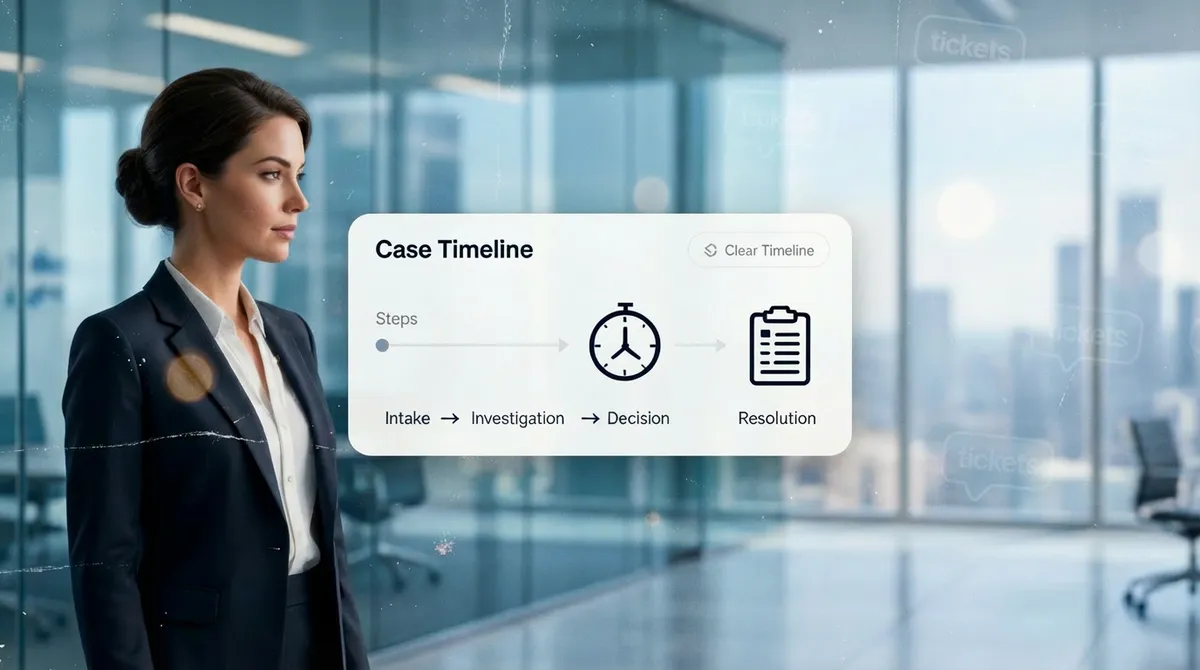 Guide
What Is Case Management?
An overview of case management, how a case differs from a ticket, and the role of context, ownership, and records in resolving customer issues.
Explore resourceFinancial Services Complaint Management
Explore the industry context and related customer operations workflows.
Explore resource