
AI Customer Churn Prediction Software for Proactive Retention
ResolveCX AI considers authorised past customer cases, SLA history including breaches, customer industry, sentiment and case nature, including complaints and escalations, to determine churn likelihood. The churn predictor score on the customer profile helps businesses find customers at risk of leaving. People review the context and own follow-up.
- CUSTOMER HISTORYPast customer cases, SLA history including breaches, customer industry, sentiment and case nature including complaints and escalations
- AI ASSESSES LIKELIHOODAI-determined customer churn likelihood shown as a churn predictor score on the customer profile
- HUMAN SOURCE REVIEWPerson reviews source cases, SLA history and supporting context
- HUMAN-OWNED FOLLOW-UPPerson owns any follow-up and decides what action is appropriate
The score helps businesses find customers at risk of leaving. Likelihood is not certainty; people review the sources and own follow-up. Illustrative only; availability depends on configuration.
Inputs
Customer-service signals considered together
Profile
Churn predictor score on the customer profile
Priority
Find customers at risk of leaving
Ownership
People decide and own follow-up
What it does
What Is AI Customer Churn Prediction Software?
AI customer churn prediction software assesses customer history to identify relationships that may be at risk of ending. ResolveCX uses authorised past cases, SLA history including breaches, customer industry, sentiment and case nature, including complaints and escalations, to determine churn likelihood. A churn predictor score appears on the customer profile. People review the service context and decide the appropriate follow-up; likelihood is not certainty.
The score represents an assessment, not an established percentage probability or a promise of retention. Confirm its output format, prediction horizon and refresh trigger during evaluation. ResolveCX customer retention prediction software supports relationship review within complaint and case handling, not a standalone CRM platform.
AI Workflow Builder can use churn risk as a decision input. Explore an illustrative follow-up branch; people configure the conditions and own relationship decisions.
How it works
Use authorised customer history
Begin with available past customer cases, SLA history including breaches, customer industry, sentiment and case nature, including complaints and escalations. Confirm source coverage and permissions.
Put the service context in order
A complaint operations lead checks case nature, repeated issues and unresolved work. Review industry and service commitments as context, not as proof of future customer intent.
AI determines churn likelihood
AI assesses the service signals together. The churn predictor score on the customer profile helps businesses find customers at risk of leaving. Likelihood is not certainty or a guaranteed retention outcome.
Review the service records
A customer-success manager checks current circumstances before prioritising attention. Reviewing source cases and SLA history is distinct from a verified model-explanation interface; confirm any displayed risk drivers during evaluation.
People own the follow-up
A relationship manager decides on outreach, retention offers or service recovery with the accountable team. AI does not independently contact customers or make final decisions. Regulated and sensitive decisions need appropriate specialist oversight.
Industry use cases
Illustrative Churn Prediction Scenarios
SaaS & Technology
Repeated support cases and missed SLA commitments can contribute to churn-likelihood assessment alongside industry, sentiment and case nature. An account owner reviews the unresolved work and decides on customer-success follow-up.
Telecommunications
Complaint cases, escalations and SLA breaches can inform churn likelihood alongside the customer's history, industry and sentiment. People decide follow-up; regulatory complaints remain with qualified specialists.
Financial Services
Post-complaint history, SLA performance, sentiment and escalations can inform churn likelihood in the customer's industry context. Authorised specialists own regulated decisions and any customer communications.
Manufacturing
Quality or delivery cases can inform churn likelihood alongside SLA history, industry and sentiment. The account owner reviews the service issues and determines appropriate follow-up without assuming retention is assured.
Why it matters
Churn Likelihood, Customer Health, Sentiment and Complaint Severity
These signals answer different questions. A service leader uses churn likelihood to prioritise relationship review alongside service ownership, without treating sentiment or complaint urgency as certainty about an individual customer.
| Signal and question | Typical output | Decision boundary |
|---|---|---|
| Churn likelihood: Could the relationship be at risk? | ResolveCX shows a churn predictor score on the customer profile to identify customers at risk of leaving. Its format and scale need implementation confirmation. | A person checks service context and owns follow-up and final decisions. Likelihood is not certainty. |
| Customer health: How is the overall relationship doing? | Typically a composite status or trend across selected relationship measures. This is a category distinction, not a ResolveCX health-scoring claim. | Broader commercial or usage measures are not confirmed ResolveCX churn inputs. |
| Sentiment: What tone appears in the interaction? | A contextual language cue that needs the original interaction and surrounding circumstances. | Tone alone does not establish intent to leave or diagnose a sensitive trait. |
| Complaint severity: How serious or urgent is the issue? | Typically a case priority or severity classification, rather than a relationship prediction. | Case-handling urgency is not churn certainty; specialists own regulated decisions. |
Related guide
Practical evaluation guide
Evaluating AI customer churn prediction with your team
Start with representative customer profiles and their churn predictor scores. Assess how past cases, SLA performance and breaches, customer industry, sentiment and case nature, including complaints and escalations, inform AI-determined churn likelihood. The score helps businesses find customers at risk of leaving. Confirm which authorised records are available rather than assuming complete coverage.
Illustrative review scenario
Repeated complaints and SLA breaches need context
Consider a customer with repeated complaints, an escalation and missed SLA commitments. AI considers that history alongside industry, sentiment and case nature to determine churn likelihood, shown as a churn predictor score on the customer profile. A reviewer uses the score to identify the relationship for attention, then checks whether the underlying issue is still open and what has changed before deciding on follow-up. This is an illustrative scenario, not customer proof or a validated accuracy claim; likelihood is not certainty or a guarantee of retention.
Questions to agree before use
- Which authorised sources, fields and history fit your workflow, and how are missing, stale or incorrect records handled?
- What do the score format, horizon, refresh trigger and score history mean, and can reviewers inspect drivers and source records?
- How are thresholds, false positives, missed risk, segment performance and ongoing monitoring evaluated?
- Which correction, challenge, access, audit and retention controls apply, and who owns follow-up and specialist oversight?
Use churn likelihood alongside complaint resolution and appropriate escalation. AI assesses likelihood; people own contact and final decisions. The assessment does not infer sensitive traits or authorise autonomous outreach. The following workflows explain surrounding service work, not additional confirmed model inputs. Ask to demonstrate any alerts, tasks, status changes or outcome recording before relying on them.
Questions About Customer Churn Prediction
AI customer churn prediction software assesses customer history to identify relationships that may be at risk of ending. ResolveCX determines churn likelihood from authorised service signals and presents a churn predictor score on the customer profile. People review the context, prioritise relationship attention and decide the appropriate follow-up. Likelihood is not certainty about a customer's next choice.
ResolveCX AI considers past customer cases, SLA history including breaches, customer industry, sentiment and case nature, including complaints and escalations. These inputs describe service experience, not proof of future intent. Available records depend on authorised access and implementation coverage. Related classification, segmentation, inbox and summary capabilities are not automatically confirmed inputs to the churn assessment.
The churn predictor score appears on the customer profile and represents AI-determined customer churn likelihood, helping businesses identify customers at risk of leaving. Likelihood is not certainty or a guarantee of retention. A numeric scale, percentage probability and prediction horizon are not established here; confirm the output definition and assessed event during evaluation before interpreting the score.
The update trigger and cadence need confirmation for your ResolveCX implementation. This feature description does not establish continuous, scheduled or event-triggered refresh. Ask when an assessment changes, which new or corrected records are included and how its age is shown. Confirm the prediction horizon separately so your team does not mistake an older assessment for a current forecast.
People should review the customer's service records and current circumstances before acting on churn likelihood. A displayed model explanation, contributing-risk-driver view or direct score-to-source links are not verified by this feature description. Ask to see the deployed review path during evaluation. Distinguish access to case history from an explanation of how the model produced a particular assessment.
Churn likelihood informs human-owned follow-up; it is not authorisation for autonomous outreach. The responsible team decides whether to contact the customer, offer service recovery or take no action. AI does not independently contact customers in the described churn workflow. Any proposed alerts, tasks, playbooks or automated actions require separate implementation confirmation, with regulated and sensitive decisions kept under appropriate specialist oversight.
Churn prediction asks whether a relationship may be at risk of ending; customer health scoring typically describes overall relationship condition through a composite status or trend. ResolveCX's confirmed churn inputs are service-history signals, not assumed billing or product-usage measures. Sentiment and complaint severity answer narrower interaction and handling questions. None of these signals removes the need for context and accountable decisions.
Complaints, SLA breaches and sentiment can provide context for churn-likelihood assessment, but do not establish that a customer will leave. ResolveCX considers them alongside past cases, customer industry and case nature. Repeated service friction may warrant review; language cues still need the original interaction. Review what remains unresolved and what has changed without assuming causation or inferring sensitive traits.
Required integrations, fields and minimum history need confirmation for the agreed ResolveCX implementation. No named production connection or universal history requirement is established here. Bring representative authorised case, SLA, industry and sentiment records to evaluation. Ask which sources are supported, what is excluded and how missing, stale or incorrect records affect the assessment and the reviewer's interpretation.
Evaluate data fit, output meaning, source review and the path to accountable follow-up before assessing performance. Include false positives, missed risk and relevant customer segments; ask for validation scope and ongoing monitoring rather than a universal accuracy figure. Confirm thresholds, score history, correction or challenge mechanisms, access, audit, retention and specialist-review controls. These are buyer questions, not promises that every control is included.
ResolveCX AI
Prioritise At-Risk Relationships With AI Churn Prediction
Evaluate AI customer churn prediction software through the customer-profile score, authorised service history and human-owned follow-up. If you are comparing customer attrition prediction software, start with the evidence your team needs to review.
Keep exploring
Recommended insights
Relevant guides and real-world perspectives for the work you are doing now.
 Integration overview
Shopify Integration
Bring Shopify customer and order context into ResolveCX, with supported agent actions and permission-dependent AI assistance.
Explore resource Integration overview
NICE CXone Integration
An overview of the ResolveCX and NICE CXone integration destination.
Explore resource Solution
Customer Churn Prediction for Financial Services
A destination for financial services teams exploring customer churn prediction.
Explore resource Guide
What Is Case Management?
An overview of case management, how a case differs from a ticket, and the role of context, ownership, and records in resolving customer issues.
Explore resource Blog
The ResolveCX Blog
Practical thinking on complaint governance, escalation management, and case resolution for regulated industries.
Explore article Video
How AI Handles Customer Issues End-to-End | ResolveCX by CodeCones
Case classification, sentiment-driven routing, summaries and response suggestions with AI controls.
Explore video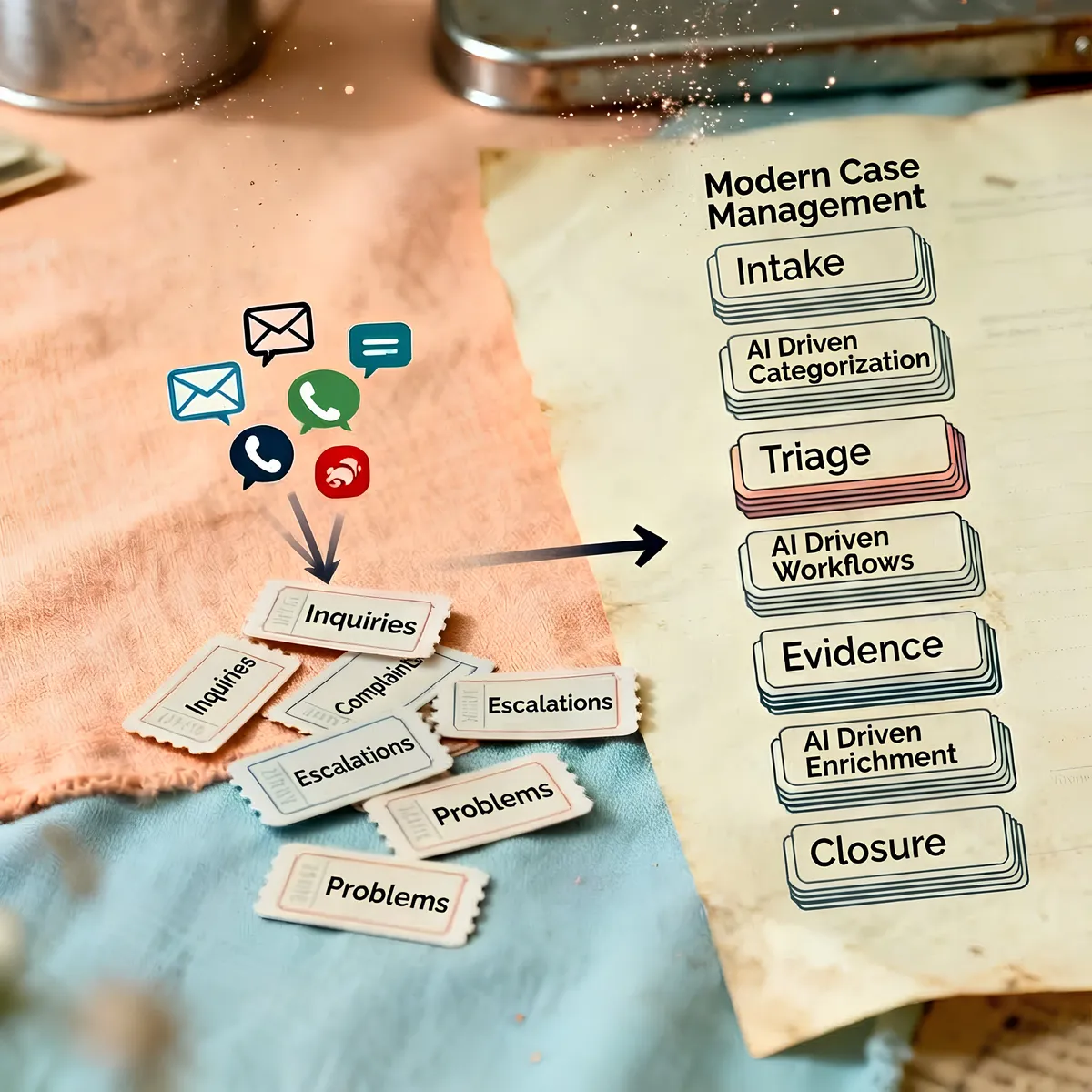 Case study
Healthcare Governance Case Studies
See how regulated healthcare teams improved SLA adherence, reduced escalations, and accelerated audit preparation.
Explore resourceResolveCX on LinkedIn
Follow the latest ResolveCX updates, governance conversations, and practical customer operations insights.
Explore resource