Informational Guide
What Is Incident Management?
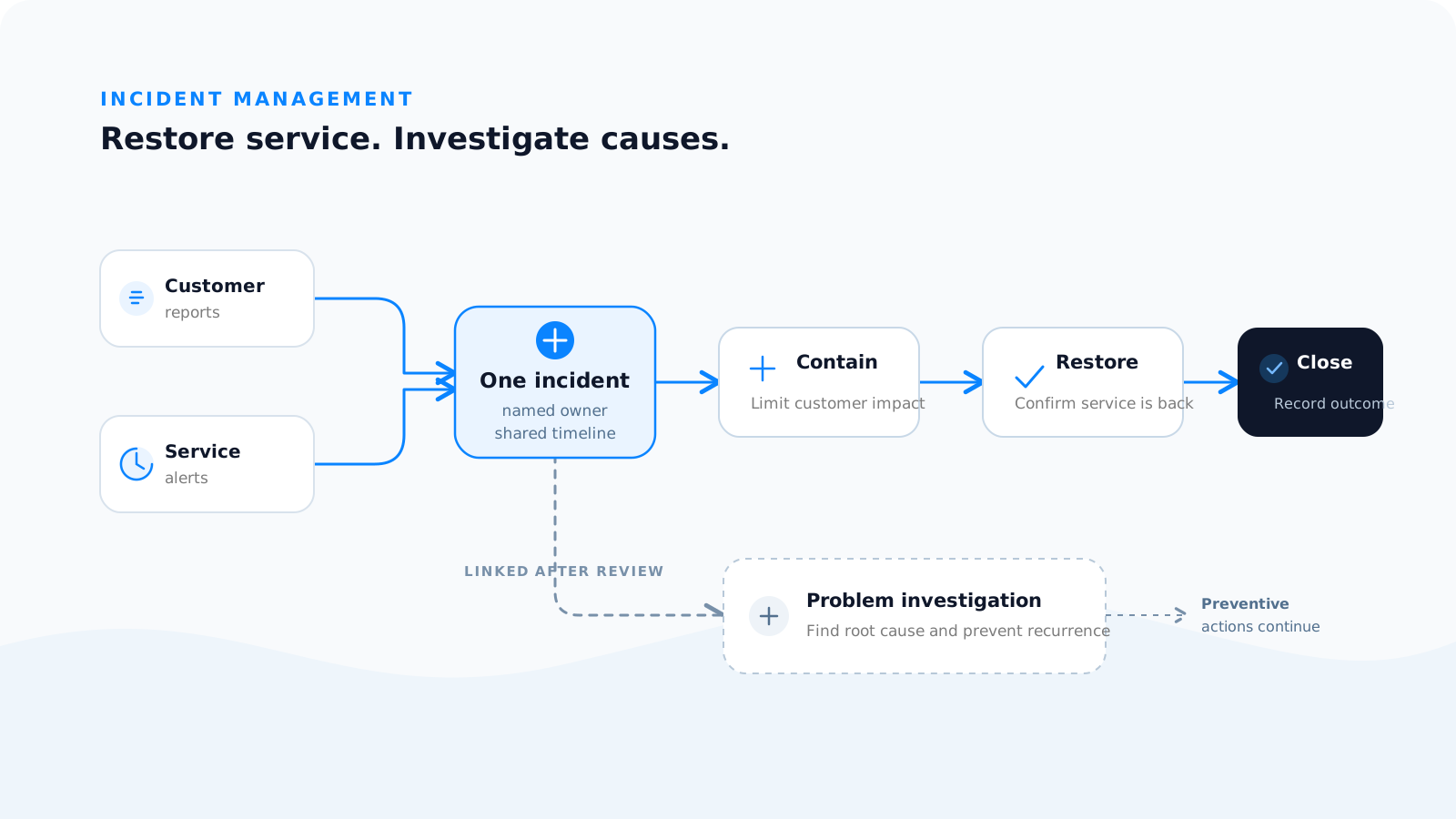
Incident management is the structured practice of identifying, recording and coordinating the response to an unplanned service interruption or reduction in quality. It assigns accountable owners, limits impact and restores service. In customer operations, it also connects affected customer cases, consistent communications and evidence for review, while longer-term cause investigation can continue separately.
Read the eight-stage processIncident management in customer operations
A failed payment, delayed fulfilment or unavailable appointment-booking service may first appear as several unrelated contacts. Incident management brings those signals together around the disrupted service. Individual customers still need their own case owner, remedy and complaint response; closing the wider incident does not automatically complete that work.
In ITIL 4, incident management is a management practice. Its restoration purpose is useful beyond IT. A workaround can restore an acceptable service while an unresolved cause moves to a linked problem record. Permanent remediation is not a universal condition of incident closure.
The benefits are coordinated recovery, clear accountability and consistent updates. The limits matter too: incident management does not replace monitoring, business continuity, specialist security response or clinical safety processes. This guide concerns service operations, not clinical incident reporting functionality.
Incident management compared with related workflows
| Term | Meaning and objective | Customer-operations example |
|---|---|---|
| Event | Observable change or signal; assess whether action is needed. | An alert shows a rising payment-error count. |
| Incident | Unplanned interruption or reduced service quality; restore service. | Customers cannot complete payments. |
| Case | Tracked work for a customer or issue; coordinate an individual outcome. | One customer needs a failed payment checked. |
| Complaint | Dissatisfaction requiring a response under the applicable policy or rules. | A customer challenges repeated payment failures. |
| Problem | Actual or potential cause of incidents; investigate and reduce recurrence. | A release defect repeatedly interrupts payment processing. |
| Service request | Expected request for information, access or a standard service. | An authorised user requests account access. |
Use case management for individual work and complaint management for dissatisfaction. Link both to the incident when relevant, without replacing their obligations. The problem management guide explains the separate investigation of recurring causes.
Common types of incidents
- Service outage: a payment portal is unavailable across multiple customer accounts.
- Data-quality issue: incorrect balances appear on statements and need controlled correction.
- Process failure: an approval queue stops moving, delaying time-sensitive orders.
- Supplier disruption: a delivery partner cannot receive fulfilment instructions.
- Major incident: any category meets agreed high-impact criteria and needs exceptional coordination.
Categories describe what happened; severity describes impact. A single affected customer may still face serious harm. Do not rank incidents solely by contact volume or label a security concern as routine service work.
Incident severity and priority
Severity describes the extent of impact. Urgency describes how quickly action is needed before consequences worsen. Priority sets the response order using both. This illustrative model is not a ResolveCX default, contractual promise or regulatory threshold; configure it for your services, customer needs and risk appetite.
| Severity | Example impact | Coordination and communication |
|---|---|---|
| S1 Critical | Critical service unavailable; widespread or severe customer harm. | Incident command, continuous coordination and an agreed frequent update cadence. |
| S2 High | Significant degradation or substantial customer impact. | Cross-team response and frequent scheduled stakeholder updates. |
| S3 Moderate | Limited impact with a viable workaround. | Named owner, agreed response target and updates at material milestones. |
| S4 Low | Localised low-impact degradation. | Routine ownership, communicated next action and trend review. |
| Impact | High urgency | Medium urgency | Low urgency |
|---|---|---|---|
| High | P1 | P1 | P2 |
| Medium | P1 | P2 | P3 |
| Low | P2 | P3 | P4 |
P1 receives the earliest coordination in this example. A local issue near a critical payment deadline may outrank a broader inconvenience with a safe workaround. Document overrides, reassess impact as facts change and keep regulatory assessment separate.
How the eight-stage incident management process works
Stages can overlap; failed recovery may restart assessment. Keep the next action and accountable person clear.
STAGE 1
Detect
A handler, monitoring team or supplier identifies a signal. Confirm whether service is interrupted or degraded, note the first detection time and preserve the original report.
STAGE 2
Record
Create a traceable incident reference with affected service, estimated start, symptoms, customer scope, source and known uncertainties. Link related contacts instead of duplicating their personal details.
STAGE 3
Classify
Choose a useful category and distinguish the operational incident from requests, complaints and specialist security or safety work. Record suspected causes as hypotheses, not established facts.
STAGE 4
Prioritise
Assess severity, impact and urgency against agreed criteria. Identify vulnerable groups and critical deadlines. Declare a major incident when policy requires it, and reassess as evidence changes.
STAGE 5
Assign
Name the accountable incident owner and response contributors. Agree the next action, escalation authority and update owner. Confirm receiving-team acceptance when work moves between teams or suppliers.
STAGE 6
Contain and restore
Limit further impact with an authorised workaround or recovery action. Check risks and rollback options. Validate acceptable service using technical checks and representative customer journeys; record containment and restoration separately.
STAGE 7
Communicate
Issue coordinated internal and customer updates, recording audience, approver, channel and next update time. Communication starts during triage and continues across all stages, rather than waiting until restoration.
STAGE 8
Close and review
Validate the outcome, complete the response record and communicate closure. Assign residual actions and linked problem work. Review significant or repeated incidents for learning and verify that corrective actions are effective.
Roles, ownership and supplier handoffs
| Role | Accountability or contribution |
|---|---|
| Incident owner or manager | Coordinates the overall response, decisions, escalation and next actions. |
| Service owner | Defines acceptable restoration and accepts residual service risk within authority. |
| Responders and suppliers | Diagnose, contain, recover and supply evidence for their assigned tasks. |
| Communications lead | Maintains approved internal and customer updates and checks delivery. |
| Legal, privacy and compliance | Assess applicable duties, materiality, notification and evidence restrictions. |
Small teams may combine roles, but authority must remain clear. Use escalation management when expertise, decision rights or response capacity are insufficient. A handoff should contain the incident reference, impact, actions attempted, evidence, accepted task, receiving owner and next checkpoint.
For suppliers, add their ticket reference, escalation contact and contractual update commitment. The internal owner remains accountable for customer coordination. If acceptance fails or the supplier misses a checkpoint, escalate rather than assuming that sending a message transferred responsibility.
Communicate throughout the response
Agree audiences, channels, approval rights and update deadlines during triage. Major incidents need coordinated leadership and customer-service messages; lower-severity incidents may use normal case updates. Choose cadence according to impact and policy, not a universal interval. Send a holding update when a promised checkpoint arrives without new findings.
An update should identify the service, confirmed impact, current action, customer workaround and next update time with a time zone. Distinguish estimates from confirmed recovery. Give handlers an approved message and an accessible alternative channel if the normal one is unavailable. Qualified teams own regulator-facing notices; public updates must not disclose sensitive customer details.
Worked example: interrupted customer payments
Illustrative scenario, not a customer result. At 09:00 a payment service starts failing. At 09:06 a handler detects a pattern across three cases and records the estimated start. At 09:09 the incident owner acknowledges, checks scope and assigns responders. A time-critical customer group and no safe payment alternative justify a high priority under the team's policy.
At 09:20 authorised responders contain further impact by suspending failing retries. The communications lead publishes a verified holding message and next checkpoint. A supplier accepts a recovery task with its own reference; the internal owner retains customer responsibility. At 09:45 service checks and representative customer journeys validate restoration.
After observation and reconciliation, the record meets resolution criteria at 11:00. Final updates explain any remaining individual case work. The release defect is still under investigation in a linked problem, with an owner and review date. Detection took 6 minutes, acknowledgement 3, containment 14, restoration 45 and resolution 120, using the separate boundaries below.
Incident management metrics and formulas
Define timestamps before comparing performance: incident start, detection, acknowledgement, containment, validated restoration and record resolution. Logging is a separate administrative event. Here, resolution means the incident meets agreed completion criteria, not the later removal of its underlying cause. Closure may follow resolution after record checks.
| Measure | Per-incident duration or rate formula | Interpretation |
|---|---|---|
| Detection duration | detection − estimated incident start | Shows visibility delay. Mark uncertain starts; do not substitute logging time silently. |
| Acknowledgement duration | owner acknowledgement − detection | Shows response readiness, not merely assignment or notification delivery. |
| Containment duration | containment − detection | Shows time to limit further impact; containment is not necessarily recovery. |
| Restoration duration | validated restoration − incident start | Shows customer-impact recovery time, including detection delay. |
| Resolution duration | record resolution − incident start | Shows completion against agreed incident resolution criteria, not permanent cause removal. |
| Reopen rate | unique cohort incidents reopened within window ÷ unique closed cohort incidents × 100 | Tests closure quality. Define closure cohort and observation window; count each incident once. |
| Update adherence | required updates sent by deadline ÷ all updates due in period × 100 | Includes missed updates in the denominator, not just messages sent. |
| Repeat-incident rate | incidents in period linked to a previously observed cause ÷ all incidents in period × 100 | Shows recurrence signals. State matching rules and separate suspected from confirmed causes. |
For each duration, the mean equals the sum of eligible incident durations divided by the number of incidents with valid start and stop timestamps. Thus mean time to detect is Σ(detection − start) ÷ n; apply the same aggregation separately to acknowledgement, containment, restoration and resolution. A single timestamp subtraction is not a mean.
Publish cohort dates, sample size, units, time zone, elapsed or business-hours convention, exclusions and missing or estimated timestamps. Report open incidents separately rather than assigning them zero duration. Use the same observation window for reopen cohorts; when a rate denominator is zero, report “not applicable”, not 0%.
Segment by severity and service, and inspect medians, upper percentiles and the longest incidents alongside means. Keep clock pauses explicit. Fast closure with rising reopen rates is not improvement; better detection may initially increase recorded incident counts. Avoid an unexplained “MTTR” label because response, restoration and resolution are different measures.
Closure, reopening and learning
Before closure, verify acceptable service, record validation evidence, confirm customer communications and assign outstanding work. A safe workaround may be sufficient if the service owner accepts the residual risk under policy. Record limitations rather than describing a temporary recovery as a permanent fix.
Define a reopening window and trigger in advance. Failed validation or continued interruption may reopen the record; a later recurrence normally creates a linked incident. Keep the original chronology. Review major, repeated or instructive incidents without blame: compare expected and actual response, identify communication gaps and assign corrective actions with owners, dates and effectiveness checks. A linked problem keeps unresolved cause investigation visible after closure.
Incident management in regulated operations
Not every service failure is reportable. Record the legal entity, jurisdiction, affected service, impact assessment and the qualified owner's notification decision. Internal severity is not a legal test, and a structured record does not guarantee compliance. These examples describe different obligations, not a global reporting checklist.
UK financial services: the FCA's current guidance addresses material incidents and applicable sector rules. Principle 11 and SUP 15 duties depend on the firm and facts. New standardised rules under PS26/2 take effect on 18 March 2027 for firms in scope, with harm, safety and soundness, or market-risk thresholds. They are not yet the current reporting process.
England health and care: an appointment-booking outage is a service-operational example. Whether it also engages clinical governance requires qualified assessment. The CQC duty-of-candour guidance defines notifiable safety incidents through regulated activity, unexpected or unintended events and provider-specific harm criteria. That term is distinct from other CQC notifications; this guide does not claim clinical-safety capability.
US healthcare: an unavailable booking service is not automatically a HIPAA breach. The HHS Breach Notification Rule concerns covered entities and business associates following breaches of unsecured protected health information, subject to its definitions, assessment and exceptions. Privacy specialists determine applicable notices and timing.
UAE financial services: the CBUAE Operational Risk Management Regulation, effective 14 September 2026, applies to licensed financial institutions that are juridical persons. Article 15 sets trigger-specific notification duties for significant deviations and events affecting critical operations. It is not a rule for all UAE businesses. Confirm entity scope, trigger and applicable deadlines with qualified advisers.
Practical incident management checklist
- Confirm service impact, source, timestamps and uncertainties.
- Link affected cases and complaints without copying unnecessary personal data.
- Set severity and priority, name the owner and confirm handoffs.
- Authorise containment, document decisions and validate restoration.
- Maintain promised updates and record notification assessments.
- Check closure criteria, reopening rules and residual risks.
- Assign review actions and linked problem investigation, then verify effectiveness.
Exercise runbooks, including failed supplier handoffs and unavailable communication channels. Update decision points, permissions, recovery checks and fallback contacts after reviews.
How software supports the practice
Evaluate impact context, ownership, related records and reviewable decisions. Request demonstrations of clocks, handoff exceptions and access. Do not assume automated recovery, complete evidence capture or regulator-specific exports.
ResolveCX's incident management software supports customer-impact coordination alongside existing service systems. Explore its supported scope with one representative incident, related cases and a proposed communication plan. Monitoring, specialist response and notification judgments remain with the responsible teams.
Frequently asked questions
What is incident management?
It coordinates response to an unplanned service interruption or degradation: assess impact, assign ownership, restore service and communicate. Permanent cause removal need not precede closure.
What is incident management in ITIL 4?
It is a management practice focused on minimising negative impact by restoring normal service quickly. This guide's eight stages are illustrative, not a mandatory ITIL sequence.
How is an incident different from a problem?
An incident is the disruption; a problem is an actual or potential cause. A workaround can restore service while an owned, linked problem investigation continues after incident closure.
Is a service request an incident?
Usually not. A request asks for an expected service, such as approved access. Failure of that service may create a separate incident, regardless of the contact channel.
What makes an incident a major incident?
It meets agreed high-impact criteria and needs exceptional coordination. Consider critical services, customer vulnerability, duration and workarounds. Internal major-incident status does not determine regulatory reportability.
Who owns an incident involving a supplier?
An internal owner remains accountable for coordination and customer impact. Suppliers own accepted recovery tasks. Record their reference, contact, next update and escalation route; confirm handoff acceptance.
What should a customer incident update contain?
State the affected service, confirmed impact, customer action, current response and next update time with a time zone. Separate estimates from facts; exclude sensitive details and speculative causes.
When can an incident be closed or reopened?
Close after validated restoration, completed communications and assignment of residual work. Reopen for failed validation or continued interruption within the agreed observation window; link a new incident for later recurrence.
Which incident management metrics should teams use?
Measure detection, acknowledgement, containment, restoration and record resolution separately. Add reopen, update-adherence and repeat rates. Publish denominators and missing data; compare like services and severities.
Does every incident require regulatory notification?
No. Duties depend on entity, jurisdiction, service and reporting triggers. A qualified owner assesses materiality and deadlines. Internal severity and software use do not establish compliance.
Primary sources
- PeopleCert: ITIL 4 Incident Management practice
- FCA: current incident reporting and March 2027 changes
- FCA PS26/2: final rules and scope
- CQC: notifiable safety incident criteria in England
- HHS: HIPAA Breach Notification Rule
- CBUAE: Operational Risk Management Regulation
Sources support terminology and conditional examples, not legal advice or product certification. Check the applicable current rules when assessing an incident.