

Informational Guide
What Is Problem Management? Process, Roles and Examples
Problem management is the practice of identifying and managing the actual or potential causes of incidents. In customer operations, it connects recurring complaints, cases and service disruptions with investigation, workarounds and corrective action. People assess evidence and review whether actions reduce risk and recurrence, rather than assuming that closing a ticket resolves its cause.
What is a problem in service and customer operations?
A problem is a cause, or potential cause, of one or more incidents. Information Technology Infrastructure Library (ITIL) guidance places problem management within IT service management (ITSM). Customer teams can apply the same investigative discipline to recurring billing errors, failed handoffs or repeated contacts without treating every dissatisfied customer as evidence of a shared cause.
A root cause is an underlying explanation supported by evidence. A contributing factor increases the likelihood or impact of failure without necessarily explaining it alone. Complex services often have several interacting factors. Record uncertainty and competing explanations instead of forcing a single cause or blaming an individual.
How do incidents, problems and customer records differ?
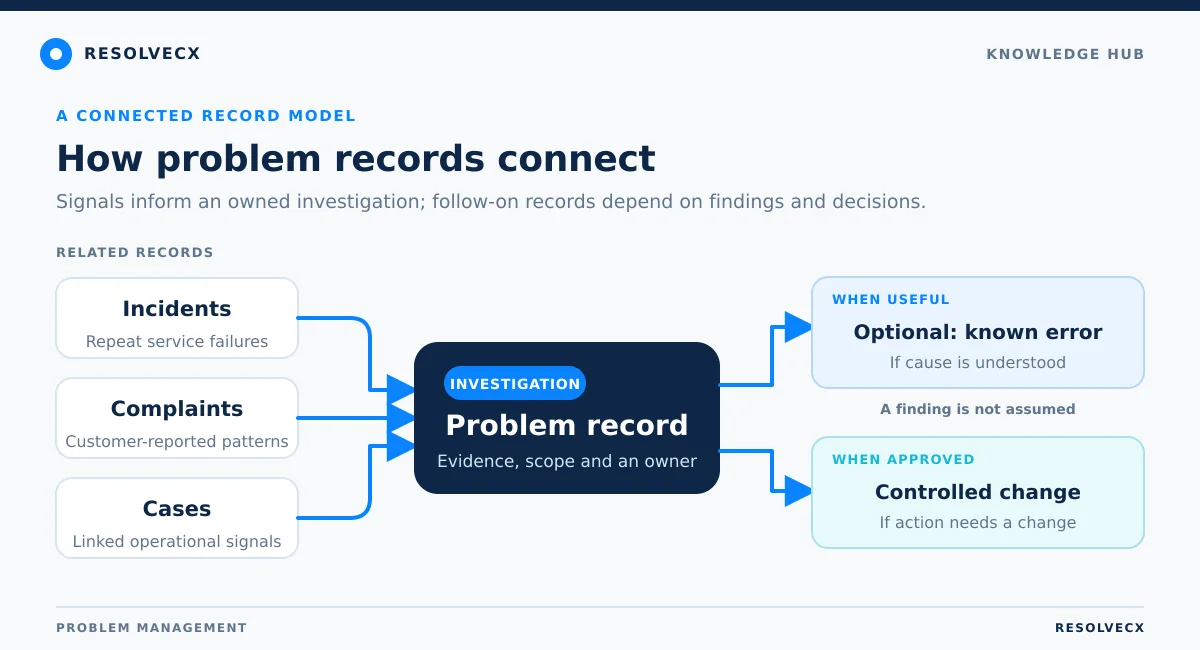
An incident concerns disruption and immediate recovery; a problem concerns actual or potential causes. Complaints address dissatisfaction, cases coordinate individual work, and changes control implementation. These records may relate, but their owners, deadlines and closure decisions remain distinct. Restoring service or resolving a complaint does not automatically close the associated investigation.
| Record | Primary purpose | Example handoff |
|---|---|---|
| Incident | Restore interrupted or degraded service | Provide recovery chronology to investigators |
| Problem | Investigate causes and manage risk | Propose evidence-based corrective work |
| Complaint | Respond to expressed dissatisfaction | Flag recurring customer detriment |
| Case | Coordinate an individual's related work | Supply relevant contact history |
| Escalation | Obtain authority or specialist attention | Resolve blocked investigation decisions |
| Change | Assess and authorize an alteration | Return implementation and test evidence |
| Service request | Fulfil a standard user need | Flag repeated fulfilment failures |
Is problem management reactive or proactive?
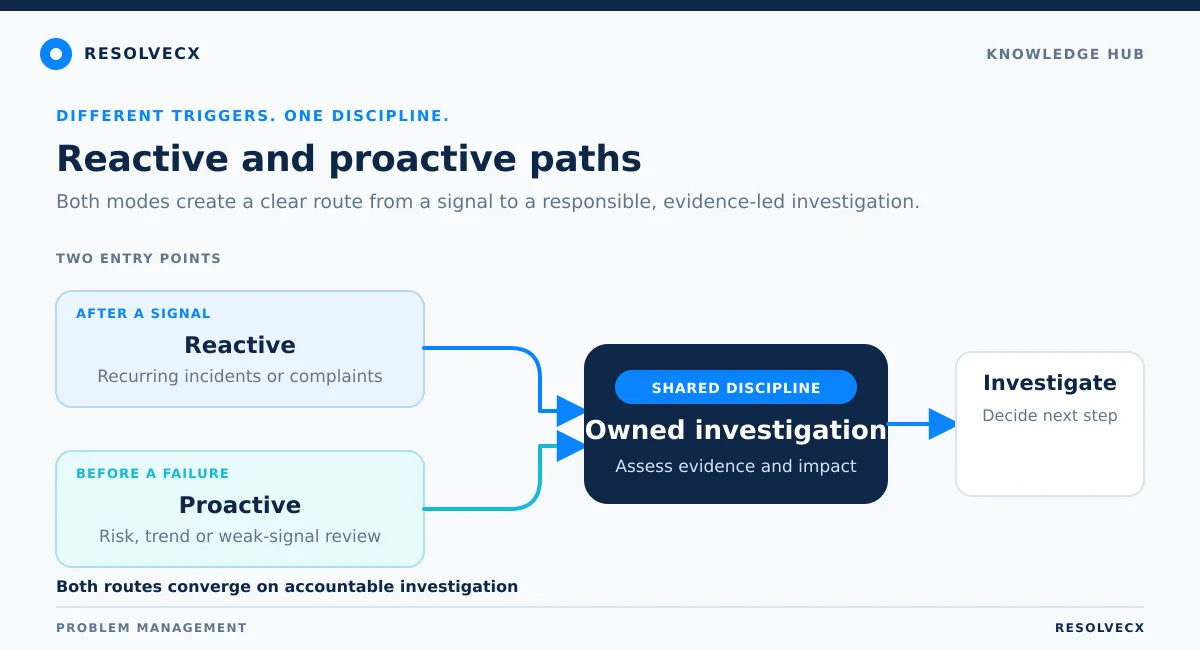
Problem management includes both reactive and proactive work. Reactive investigations follow incidents, major disruptions or repeated customer failures. Proactive investigations examine warning signals before further incidents occur. Both require an owner, evidence, proportionate prioritization and an explicit decision about what happens next; neither guarantees a confirmed cause or permanent remedy.
Reactive example: repeated account lockouts prompt comparison of incident histories. Proactive example: capacity trends or supplier notices expose a plausible future failure. Trend correlations suggest where to investigate, not what caused the issue. Keep urgent restoration running while the investigation proceeds separately.
When should a team open a problem record?
Open a problem record when a potential shared cause or material risk warrants coordinated investigation beyond individual resolution. Triggers include repeated incidents, a single severe event, complaint trends, failed changes, supplier warnings and unresolved findings from reviews. There is no universal minimum incident count: assess impact, uncertainty and the value of further work.
Check existing investigations before creating another record. Describe the observed condition and affected population without asserting a cause prematurely. A named triage owner should accept, merge, redirect or decline the proposal with reasons. Serious harm or security concerns need their established response routes immediately.
How does the problem management lifecycle work?
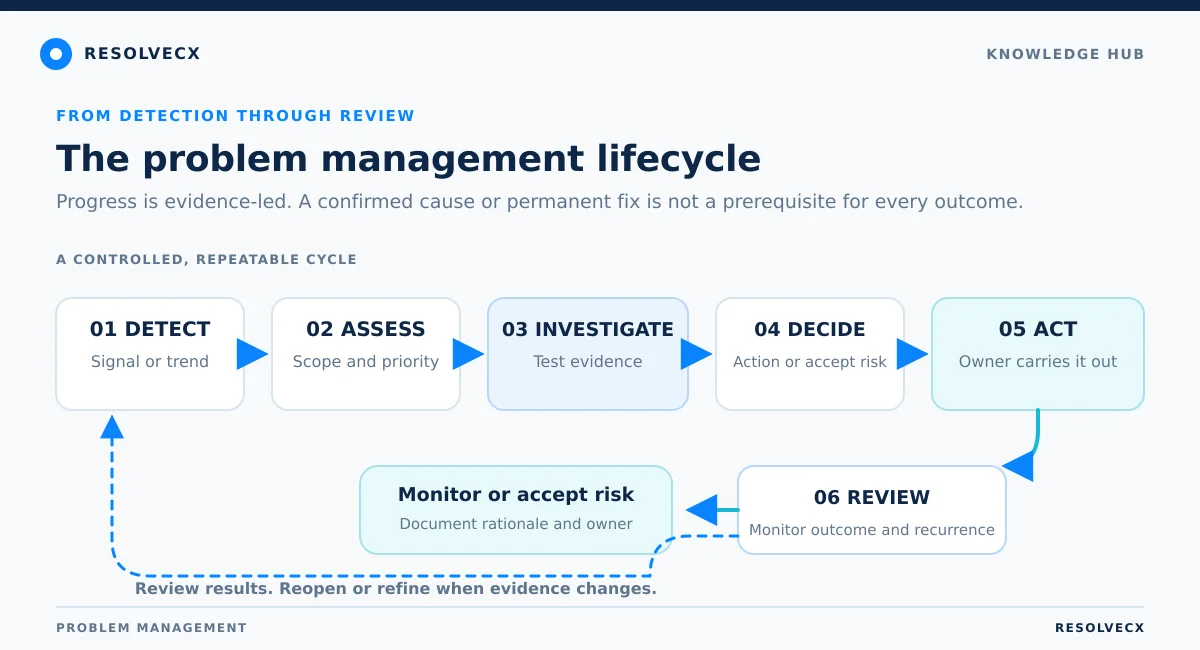
A practical lifecycle moves from detection through assessment, investigation, decision, action and review. Organizations adapt these stages to their services. Each handoff needs an accountable person and evidence, not simply a status change. Investigation may return to earlier stages when new facts contradict the working explanation.
- Detect: capture the signal, source records and customer impact; a triage owner checks scope and duplicates.
- Assess: the service owner agrees priority, investigator, resources and a review date.
- Investigate: specialists build a chronology, test hypotheses and distinguish findings from unresolved questions.
- Decide: an authorized owner chooses corrective action, a safe workaround, accepted risk, deferred action or monitoring.
- Act: action owners implement approved work through relevant change controls and retain test evidence.
- Review: compare outcomes with agreed criteria; close, continue or reopen under organizational policy.
What information belongs in a problem record?
A problem record is the maintained account of an investigation and its decisions. It should let another authorized colleague understand the observed issue, evidence, ownership, uncertainty and next action. Start with minimum fields, then extend them as evidence develops; avoid collecting unnecessary personal information or copying sensitive customer narratives.
| Field group | Information to retain |
|---|---|
| Identity and scope | Identifier, summary, category, affected service and population |
| Signals and impact | Linked incidents or complaints, chronology, frequency and harm |
| Ownership and priority | Investigator, service owner, urgency, rationale and review date |
| Analysis and evidence | Sources, hypotheses, tests, findings, confidence and gaps |
| Decisions and actions | Workaround limits, approvals, action owners and dependencies |
| Review and disposition | Baseline, observation window, results, residual risk and reopening rule |
Who owns problem management?
A problem manager or designated coordinator keeps investigations moving, while a service owner remains accountable for service risk and priorities. Specialists test explanations, action owners deliver improvements, and an authorized reviewer evaluates findings and disposition. Small teams may combine roles, but should still make decision authority and conflicts of interest explicit.
Frontline handlers contribute accurate incident and complaint evidence. Knowledge owners approve reusable guidance, change authorities assess proposed alterations, and suppliers supply relevant diagnostic information. Legal, privacy, security or clinical specialists participate where the circumstances require them. Coordination does not transfer their professional responsibilities to software.
Which root cause analysis method should teams choose?
Root cause analysis (RCA) is structured investigation of why an event occurred and which conditions contributed. Select methods according to complexity and available evidence, not habit. Begin with a timeline and explicit hypotheses. A diagram organizes reasoning; it does not verify causation or replace tests that could disprove the proposed explanation.
| Method | Useful when | Main caution |
|---|---|---|
| Five Whys | Tracing a relatively focused process failure | Do not force five answers or stop at blame |
| Fishbone analysis | Exploring people, process and technology factors | Treat branches as hypotheses requiring evidence |
| Fault tree analysis | Examining combinations producing an unwanted event | Validate logic and assumptions with specialists |
| Kepner-Tregoe analysis | Comparing what is and is not affected | Requires reliable distinctions and observations |
| Pareto analysis | Selecting high-volume categories for attention | Frequency is not proof of cause or severity |
What are workarounds, known errors and a KEDB?
A workaround reduces impact when a full resolution is unavailable, sometimes before the cause is understood. In ITIL 4 terminology, a known error is a problem that has been analyzed but not resolved. A Known Error Database (KEDB) organizes reusable information about such problems, their symptoms and any available workarounds.
Older guidance and local processes may require a documented cause and workaround before using known-error status. State the definition your organization adopts. A workaround is not mandatory for every known error, and a known-error record is not a mandatory output of every investigation.
Record when a workaround is safe, who may use it, approval, limitations, review date and withdrawal criteria. Knowledge management turns findings into accessible, versioned guidance. Retire obsolete instructions after changes; retain investigation history according to policy rather than exposing sensitive evidence to every handler.
How do changes, closure and risk acceptance connect?
Problem management recommends action; change enablement assesses and authorizes alterations to services. Closing a change proves neither that the cause was correct nor that the action worked. Closure of a problem follows organizational criteria and may reflect verified improvement, accepted residual risk or another approved disposition with a review obligation.
A configuration item is a managed service component. A configuration management database (CMDB) records component relationships. These concepts do not establish ResolveCX capabilities.
Deferred action needs a reason, accountable risk owner and next review date. Monitoring needs a measure and trigger for further investigation. Risk acceptance should identify authority, limits and expiry. None means that the underlying uncertainty has disappeared.
How should teams prioritize problem investigations?
Prioritize investigations using impact, urgency, recurrence, exposure and uncertainty. Impact concerns the consequence for customers and services; urgency concerns how quickly the risk needs attention. Frequent minor failures can justify action through cumulative harm, while one rare but serious event may outrank a large queue of routine issues.
Use a consistent scoring approach with documented exceptions. Consider vulnerable customers, critical services, workaround safety, supplier dependencies and investigation cost. Reassess priorities as evidence changes. A high incident priority can inform a problem priority, but should not substitute for assessing future risk and corrective options.
Which problem management KPIs measure success?
Key performance indicators (KPIs) should combine customer outcomes with investigation health. Measure recurrence and impact alongside backlog age, time to reviewed findings and overdue actions. Define each numerator, denominator, population and observation period before comparing results. A higher closure count alone can reward premature decisions rather than meaningful service improvement.
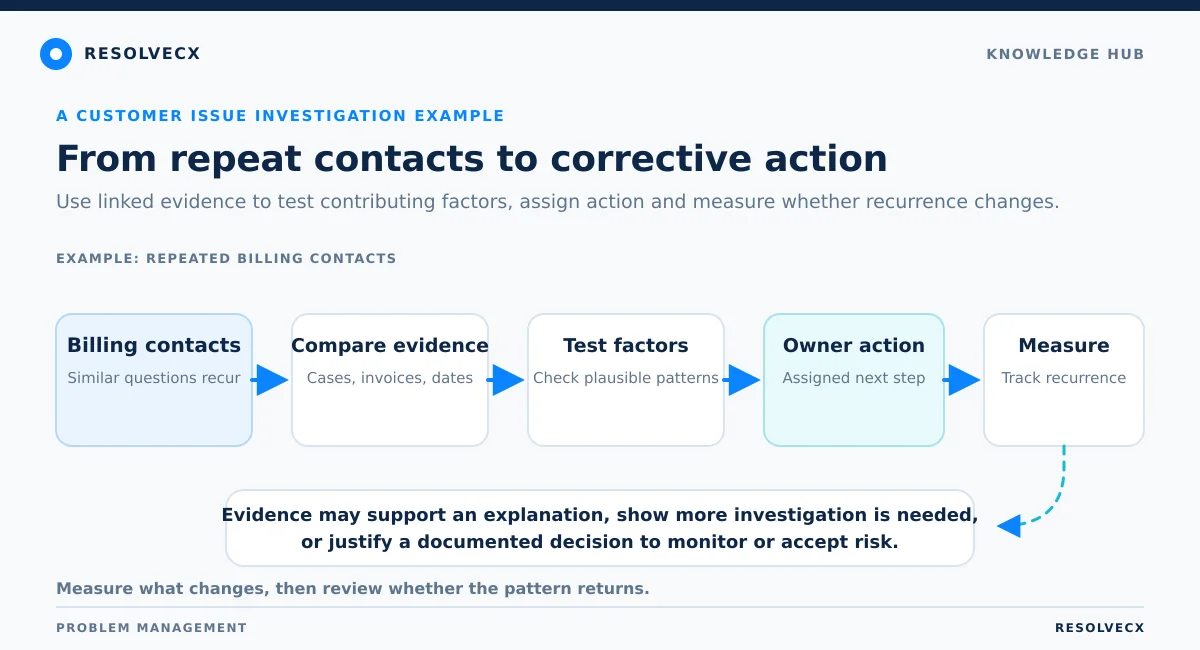
For example, compare billing failures per thousand invoices before and after a change using equivalent populations and periods. Record seasonality, demand shifts and concurrent changes. Improvement alone does not prove causation.
- Recurrence rate: related repeat incidents divided by relevant transactions or users over a stated window.
- Backlog age: elapsed days for open investigations, grouped by priority and blocked status.
- Time to finding: median time from accepted investigation to reviewed finding, including unresolved cases separately.
- Action timeliness: overdue actions divided by all due actions for the period.
- Workaround use: eligible incidents using approved guidance, with effectiveness and adverse effects reviewed.
- Reopening: reopened records divided by reviewed closures, with reasons and comparable follow-up periods.
What does problem management look like in practice?
These illustrative scenarios show general practice, not customer deployments or regulatory advice. A software service team might investigate repeated synchronization failures after restoring service. A telecom team might compare recurring billing contacts, test a tariff-mapping hypothesis, assign a controlled correction and monitor equivalent invoice cohorts. Customer responses continue independently of the investigation.
United Kingdom financial services: Financial Conduct Authority (FCA) complaint-handling rules address recurring or systemic problems for respondents within scope. Applicability and resulting actions depend on the rules and circumstances, not merely the existence of a repeat complaint. Seek qualified advice rather than assuming automatic reporting obligations.
England healthcare: the National Health Service (NHS) Patient Safety Incident Response Framework supports proportionate responses within its applicable contractual scope. Not every adverse event requires the same investigation. Clinical safety decisions remain with qualified teams; this guide does not position ResolveCX as a clinical safety system.
Manufacturing: International Organization for Standardization (ISO) 9001 quality-management requirements depend on the applicable edition and organizational scope. Corrective and preventive action (CAPA) is a quality discipline, not an asserted ResolveCX module. United States and United Arab Emirates teams need their own sector and jurisdiction assessment; UK examples do not establish local obligations.
Common mistakes and practical safeguards
Avoid treating correlation as cause, forcing every investigation into a single explanation, or declaring success when an action is merely complete. Separate restoration from investigation and use blameless evidence review. Keep frontline teams involved so findings reflect actual service conditions rather than only an analyst's interpretation of aggregated records.
Other failure modes include ownerless backlogs, permanent temporary workarounds, hidden risk acceptance and inaccessible knowledge. Assign review dates, explain decisions and test whether handlers can find current guidance. Do not let dashboards or artificial intelligence (AI) replace source inspection, professional judgment or approval.
How ResolveCX supports governed investigation
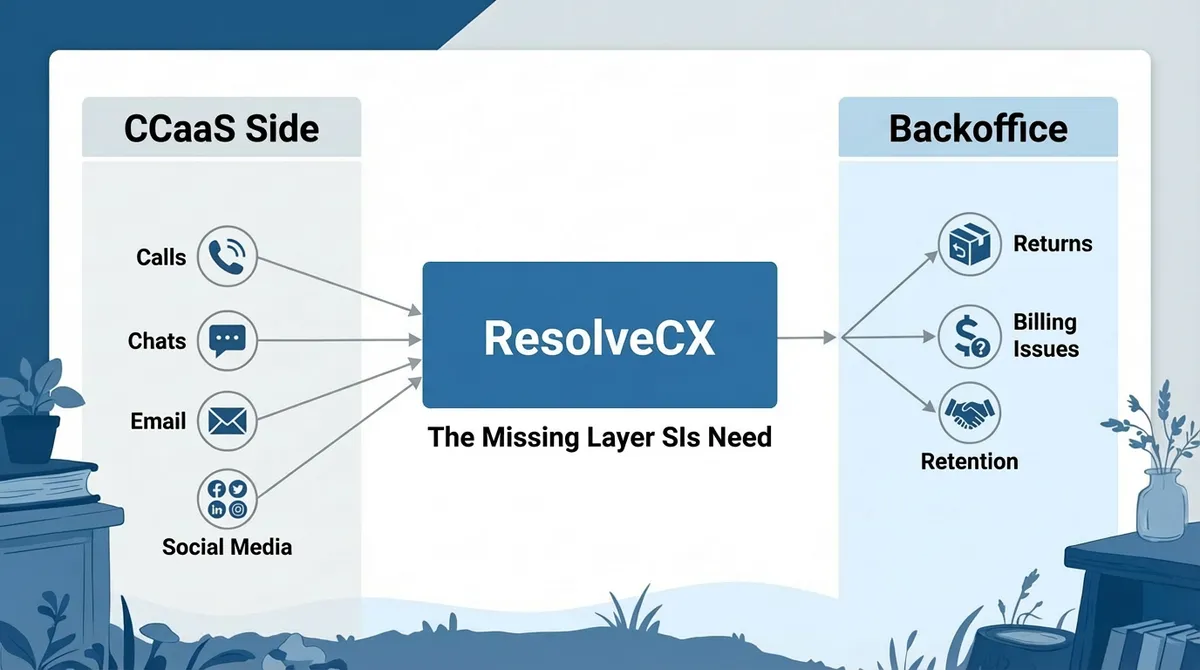
ResolveCX focuses on governed customer and operational resolution alongside existing systems. Discuss how recurring customer signals could connect to investigation, owned corrective work and effectiveness review. Keep the general practices in this guide separate from product evidence: confirm exact record relationships, permissions and configured controls during discovery.
Related-case summaries and knowledge assistance can support people preparing an investigation. People validate sources, determine findings and approve actions. Do not assume a dedicated KEDB, automated cause detection, built-in RCA templates, automatic reopening or regulatory exports without current evidence for the proposed configuration.
Implementation checklist: start with one service
Introduce the practice through a manageable service pilot with explicit ownership and success criteria. Establish the minimum record and decision rules before buying additional automation. Review what the pilot teaches and adapt the workflow; there is no universal implementation duration or incident-volume threshold.
- Agree scope, intake triggers and links to incident and complaint processes.
- Assign investigation, action, knowledge, change and risk decision owners.
- Define required fields, access, evidence retention and review dates.
- Choose methods and train investigators to test competing hypotheses.
- Approve workaround publication, expiry and withdrawal rules.
- Set a baseline, observation window, closure criteria and reopening trigger.
- Review the pilot with frontline teams before expanding.
Frequently asked questions
What is the main purpose of problem management?
To reduce the likelihood and impact of incidents by investigating actual or potential causes and managing workarounds and known errors. It supports better decisions under uncertainty, not guaranteed elimination of every failure.
Can one incident justify a problem investigation?
Yes. One severe incident or a credible potential failure can justify investigation. Use impact, risk and available evidence rather than requiring an arbitrary number of repeat tickets.
Is problem management always proactive?
No. Reactive work investigates events that have happened; proactive work investigates warning conditions and future risks. Both belong in problem management and should use explicit ownership and review criteria.
Does every problem need a permanent fix?
No. An authorized decision may accept risk, defer action, continue monitoring or use a workaround. Record the rationale, owner, limits and review date rather than implying that every disposition eliminates the cause.
Must every investigation create a known error?
No. Investigations can remain uncertain or conclude that further work is disproportionate. Known-error status depends on the adopted definition and available analysis, not a mandatory step applied to every record.
Can a workaround exist before the cause is known?
Yes. A tested temporary response may reduce impact while investigation continues. Document its conditions, risks, approval and review date; do not treat successful containment as proof of the underlying explanation.
How do customer complaints inform problem management?
Complaint patterns can suggest shared contributing factors. Investigators compare source evidence and affected populations while complaint owners continue individual responses. Not every complaint indicates a systemic issue.
Who decides whether a problem can close?
The role authorized by organizational policy decides, using evidence and agreed criteria. Service owners retain risk accountability. A completed task or restored service alone should not determine the investigation's disposition.
How can AI help an investigation?
AI can assist with summaries or relevant knowledge where supported. Investigators inspect source records, challenge suggested relationships and determine findings. A generated pattern is not a verified cause.
What is the difference between a KEDB and a knowledge base?
A KEDB organizes known-error information; a knowledge base serves broader guidance. They may share a platform, but access, approval, review and retirement rules still need clear ownership.
How do teams know corrective action worked?
Compare a defined outcome against a baseline over an agreed observation window. Check comparable populations, other changes and unintended effects. Reopen or extend investigation if the evidence fails the agreed test.
Sources
These sources distinguish general practice from local policy and jurisdiction-specific obligations. Product capabilities require separate evidence.
- PeopleCert: ITIL 4 Practitioner Problem Management (opens in a new tab)
Practice purpose, actual and potential causes, roles and measures.
- PeopleCert: ITIL 4 Foundation Glossary (opens in a new tab)
PeopleCert official training glossary hosted by igen, including the analyzed-but-unresolved known-error definition.
- Ontario: GO-ITS 38 enterprise Problem Management process (opens in a new tab)
An organizational example of record relationships, roles and unresolved dispositions, not a universal policy.
- Purdue: Problem Management Quick Reference Guide (opens in a new tab)
Local definitions and closure rules demonstrate why adopted policies must be explicit.
- FCA Handbook: DISP 1.3 (opens in a new tab)
UK complaint-handling provisions on recurring and systemic problems, subject to scope.
- NHS England: Patient Safety Incident Response Framework (opens in a new tab)
Proportionate responses and NHS Standard Contract applicability in England.
- ISO: ISO 9001 (opens in a new tab)
Current quality-management standard and edition information; not evidence of product certification.
Bring a recurring issue to a problem workflow demo
Discuss investigation, accountable action and effectiveness review for your customer operations, with people responsible for decisions.
Join 1000s of AI Innovators
Weekly insights on production AI, real case studies, and practical automation strategies


Office
Visit or write to us at:
San Francisco, USA
2261 Market Street #85931
San Francisco, CA 94114
Keep exploring
Recommended insights
Relevant guides and real-world perspectives for the work you are doing now.
 Solution
ISO 9001 · Manufacturing
ISO 9001 Problem Management Software
A destination for manufacturing teams exploring problem management in the context of ISO 9001.
Explore resource Solution
CQC · NHS Healthcare
CQC Incident Management Software
A destination for healthcare service teams exploring incident management in the context of CQC-related requirements.
Explore resourceSolutionHIPAA · US Healthcare
HIPAA Incident Management Software
A destination for healthcare service teams exploring incident management in the context of HIPAA-related requirements.
Explore resourceGuideFundamentals
What Is Incident Management?
An overview of incident management, including how organizations record, investigate, and resolve incidents, and how a structured approach differs from ad hoc reporting.
Explore resource Blog
Blog
The ResolveCX Blog
Practical thinking on complaint governance, escalation management, and case resolution for regulated industries.
Explore article Video
Video
ResolveCX: Problem Management Software | Eliminate Recurring Failures at the Root
Investigate recurring failures, document known errors and govern remediation and recurrence monitoring.
Explore videoCase studyHealthcare
Healthcare Governance Case Studies
See how regulated healthcare teams improved SLA adherence, reduced escalations, and accelerated audit preparation.
Explore resourceResolveCX
SocialSocial
ResolveCX on LinkedIn
Follow the latest ResolveCX updates, governance conversations, and practical customer operations insights.
Explore resource