
BPO & Outsourcing Operations
Case Management Software for BPO and Outsourcing Providers
ResolveCX governs every customer case your BPO handles: one structured record per issue, per-client SLA enforcement, named ownership at every handoff, and a complete audit trail your clients can interrogate. When accountability is what your clients are paying for, it needs to be defensible.
Supported Integrations






CCaaS Platform Integrations
Works with your contact center platform
ResolveCX adds governed case management on top of the CCaaS platform your BPO already runs. Choose your platform to see how the integration works.
Cisco Webex
Case management via Webex CC REST APIs and Desktop Widget SDK
View integrationAvaya Experience Platform
Governed cases through AXP open APIs and Avaya Aura CTI
View integrationGenesys Cloud CX
Architect webhook case creation and Interaction Widget panel
View integrationNICE CXone
Studio SNIPPET webhooks and embedded agent desktop panel
View integration8x8 Contact Center
8x8 Flow webhooks and Agent Workspace case panel
View integrationFive9
SuperAPI event subscription and Agent Desktop Toolkit panel
View integrationThe structural failure
Why Case Management Breaks in Contact Centers
Contact centres are not failing because agents are undertrained. They are failing because complex issues have no unified home. This is not a people problem, it is a case architecture failure.
Clients Demand Outcome Proof You Cannot Produce
BPO clients want structured evidence that their customer issues were handled, resolved, and documented to contract standard. Most BPOs cannot provide it, because case outcomes live across disconnected systems with no unified record. When a client asks for a resolution report, the answer is manual reconstruction.
Per-Client SLA Commitments Are Tracked in Spreadsheets
Different clients carry different SLA contracts. Different case types carry different resolution windows. Managing this in spreadsheets means SLA breaches are discovered in client review meetings, not before them, and the evidence needed for a defensible response is already scattered.
Ownership Breaks When Cases Cross Teams or Client Lines
A case that moves from a frontline agent to a specialist team, or from one client delivery pod to another, loses its accountability chain at every transfer. Without enforced ownership at each handoff, cases sit in limbo, acknowledged by nobody, escalated by the client.
QA Findings Cannot Be Tied to Client-Level Case Outcomes
Quality teams identify agent behaviors that generate complaints. Operations teams see client complaints in their systems. These two datasets exist separately, so the same behaviors keep generating the same complaints, and the same client keeps raising the same concern.
Repeat Complaint Clusters Put Client Contracts at Risk
The same complaint types keep returning across a client's account because the root cause was never formally investigated. The client sees the pattern. The BPO cannot explain it with structured data. That gap is how outsourcing relationships end.
No Audit Trail When a Client Raises a Formal Dispute
When a client questions how a case was handled, teams spend days pulling records from email threads, notes, and disconnected systems. The time-stamped, defensible case record that should exist does not.
The solution
A Governed Case Management System for Contact Center Operations
ResolveCX unifies customer case management, multi-team collaboration, QA linkage, and client accountability into a single governed system. It does not replace your CRM or contact center platform, it governs complex cases that span multiple teams and require end-to-end accountability.
Unified Case Management
Every customer issue, regardless of channel, becomes a single structured case with one timeline, one owner at each stage, and a complete audit trail from intake to resolution. No more fragmented tickets. No more lost context.
Multi-Team Collaboration with Enforced Ownership
Cases move between agents, supervisors, specialist teams, and client delivery managers through governed handoff workflows. Each stage has a named owner, SLA timeline, and mandatory completion requirements before the case can progress.
Client Accountability and Reporting Layer
Every case produces a defensible audit trail, all actions, decisions, communication timelines, and resolution outcomes documented. Client reporting is generated from real case data, not manual compilation, enabling transparent, audit-ready client management.
QA and Case Linkage
Quality assurance findings are linked directly to customer cases, connecting agent behavior observations with real customer impact. This closes the loop between QA and operations, turning quality observations into governed, tracked improvements.
Escalation Management Engine
SLA-driven escalation timelines, multi-level escalation paths, and defined ownership across tiers. Escalations are predictable, controlled, and backed by a complete audit trail from trigger to resolution, removing dependence on manager notifications and Slack alerts.
Problem Management for Repeat Issues
Recurring complaint types are grouped into structured problems. Root-cause analysis workflows and corrective action tracking ensure that the operational failures driving repeat contacts are identified, owned, and eliminated.
Sentiment Routing for Escalation-Risk Contacts
The AI detects frustration signals in every inbound contact and routes high-emotion cases, contacts at escalation risk, customers signalling dissatisfaction, accounts with repeat complaint histories, directly to senior handlers or specialist teams. Escalation risk is intercepted before an agent decides to act on it.
AI Case Summarization for Handoff Continuity
When a case moves between agents, tiers, or client delivery teams, the receiving handler gets an AI-generated summary of the full case history, the customer's core issue, actions taken, communication sent, and what they are expecting next. Context is never lost in a handoff. Customers never repeat themselves.
Knowledge Base AI Copilot for Consistent Agent Responses
Across large BPO operations, response consistency is an operational and client risk. The Knowledge Base AI Copilot surfaces relevant articles, approved response frameworks, and procedural steps inline as agents work a case, without search. Every agent operates from the same current policy, regardless of tenure or training level.
Customer Churn Prediction for At-Risk Accounts
The AI scores every customer account against complaint volume, sentiment trend, and resolution quality, producing a live churn risk indicator on each profile. When a score crosses a defined threshold, the platform can trigger a retention workflow automatically, routing the account to a senior handler or scheduling a proactive outreach before the customer decides to leave.
Workflow Builder for Multi-Client SLA Configurations
BPO operations run different SLA commitments, escalation paths, and handoff rules for different clients. The Workflow Builder lets operations teams configure per-client case workflows, escalation timers, approval requirements, tier routing, and notification rules, without developer involvement. Client onboarding and SLA changes are operational decisions, not engineering projects.
Built for
Contact Centers Operating at Scale and Under Client Accountability
ResolveCX is designed for environments where customer cases are complex, multi-touch, and directly tied to contractual performance, client satisfaction, and operational accountability. Case management is not optional, it is the service.
BPOs / Outsourcing Providers
Multi-client operations where case handling quality and defensible audit trails directly impact contract performance and renewals.
In-house Contact Centers
Enterprise customer operations across voice, chat, and email where complex cases require cross-team coordination and SLA accountability.
Customer Support Operations
High-volume environments where cases span support, operations, logistics, and vendor teams, requiring unified governance.
Teams that use ResolveCX daily
Operations Managers
Monitor case flow, SLA performance, and resolution efficiency across campaigns and client accounts.
QA Teams
Link quality findings to real customer cases with direct case-level evidence and impact visibility.
Supervisors / Team Leads
Manage case handoffs and ensure ownership continuity across tier transitions and specialist escalations.
CX Leadership
Gain visibility into repeat issues, systemic operational failures, and client-level performance trends.
Client Delivery Teams
Provide transparent, audit-ready reporting and defensible case outcomes to client stakeholders.
Why CRM and Ticketing Tools Fail at Complex Case Management
CRMs track customer interactions. Ticketing tools log service requests. Neither governs complex, multi-team cases with enforced ownership, client accountability, and audit-ready resolution trails.
| Capability | ResolveCX | CRM / Ticketing |
|---|---|---|
| One structured case per customer issue | ||
| Unified multi-channel case timeline | ||
| Named ownership at every handoff stage | ||
| Multi-team collaboration with enforced governance | ||
| QA and case directly linked in one system | ||
| Audit-ready client reporting from live case data | ||
| SLA-driven escalation workflows | ||
| Problem management for repeat issue elimination | ||
| Sentiment routing for escalation-risk contacts | ||
| AI case summarization at every agent handoff | ||
| Knowledge Base AI Copilot for consistent agent responses | ||
| Customer churn prediction for at-risk accounts |
Frequently asked questions
Questions About BPO Case and Contact Center Management
BPO case management software governs complex, multi-step customer issues that span multiple agents, teams, and client accounts, providing structured cases with enforced ownership, SLA tracking, and audit-ready documentation. Unlike ticketing tools that track individual interactions, it manages the full lifecycle of each issue across every team involved in its resolution.
CRM and ticketing tools log interactions. ResolveCX governs cases, with defined handoff paths, enforced ownership, SLA escalation rules, QA linkage, and client-level reporting built into the case itself. It operates as the governance layer above your existing CRM and contact center platform.
Yes. The Workflow Builder allows operations teams to configure per-client escalation paths, SLA timers, approval requirements, and notification rules without developer involvement. Each client's operational requirements are defined independently and enforced automatically on every case.
Quality assurance findings link directly to the underlying case record, not to a separate system or report. QA teams see the full case context alongside their findings, and operations leadership can track quality trends at the case level, not just as aggregate scores.
Yes. Every case generates a complete, time-stamped record of every action, communication, decision, and handoff, exportable for client reporting and compliance reviews. Clients receive defensible outcome documentation without manual reconstruction by operations teams.
The AI analyzes every inbound contact for emotional signals, frustration, distress, and churn intent, and routes high-risk contacts to senior handlers or specialist teams before a standard agent processes them. This reduces escalation risk, improves first-contact resolution for complex cases, and ensures the most sensitive contacts receive the right handling immediately.
Yes. ResolveCX is designed to operate alongside existing contact center infrastructure, CRM, telephony, quality management, and workforce management tools, providing a governed case management layer without replacing the platforms your teams already use.
Looking for call center-specific case management guidance? Read our Call Center Case Management Software guide
BPO & Contact Center
Give Every Complex Case a Single, Accountable Home
See how ResolveCX helps contact centers govern complex cases, enforce multi-team accountability, and deliver audit-ready outcomes to clients.
Keep exploring
Recommended insights
Relevant guides and real-world perspectives for the work you are doing now.
 Guide
GuideNICE CXone Integration
CXone Studio IVR script-triggered case creation following DEVone API patterns, NICE Enlighten AI classification, embedded CXone agent desktop panel, and bi-directional sync to CXone supervisor dashboards.
Explore resource Guide
GuideCisco Webex Contact Center Integration
API-based case creation from Webex Connect IVR events, agent screen pop via the Webex CC Desktop Widget SDK, case management layer behind the Webex CC agent desktop, and bi-directional status sync to Webex Analyzer dashboards where configured.
Explore resource Guide
GuideAvaya Experience Platform Integration
AXP open API case creation from Avaya IVR events, Avaya Aura CTI screen pop, structured case management behind the ACE agent desktop following DevConnect API patterns, and supervisor dashboard status sync.
Explore resource Guide
GuideFive9 Contact Center Integration
SuperAPI case creation from Five9 IVR script webhooks, Agent Desktop Toolkit screen pop, case management behind Five9 VCC, and bi-directional status sync to Five9 Supervisor Application.
Explore resource Blog
BlogThe ResolveCX Blog
Practical thinking on complaint governance, escalation management, and case resolution for regulated industries.
Explore article Video
VideoResolveCX Video Library
See complaint governance, case management, and escalation workflows explained by the ResolveCX team.
Explore video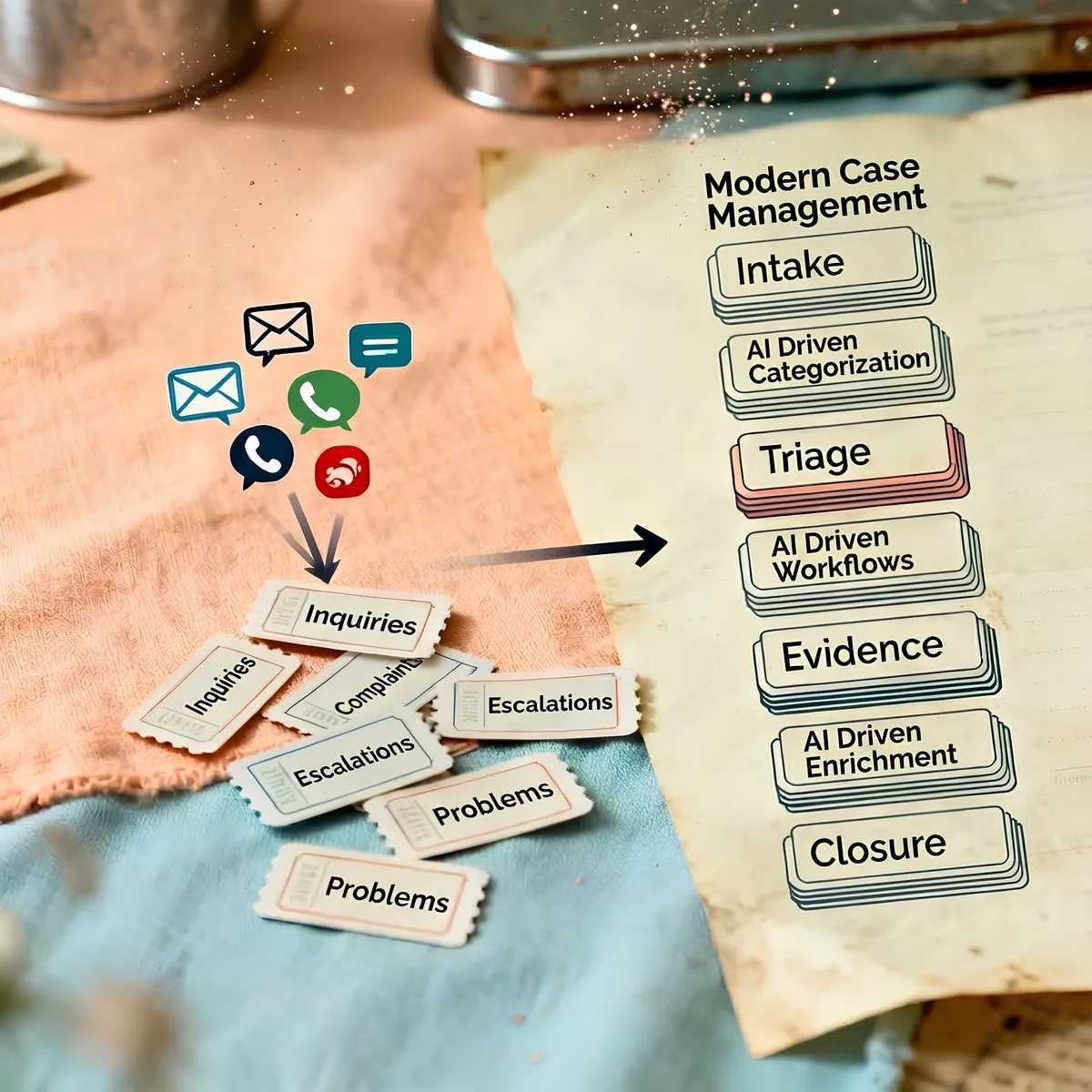 Case study
Healthcare Governance Case Studies
See how regulated healthcare teams improved SLA adherence, reduced escalations, and accelerated audit preparation.
Explore resourceResolveCX on LinkedIn
Follow the latest ResolveCX updates, governance conversations, and practical customer operations insights.
Explore resource